 MLB2026-07-14
MLB Deadline Untouchables: Byron Buxton and Logan Webb Are Staying Put, and That Matters for Fantasy
By Verdexed MLB Desk
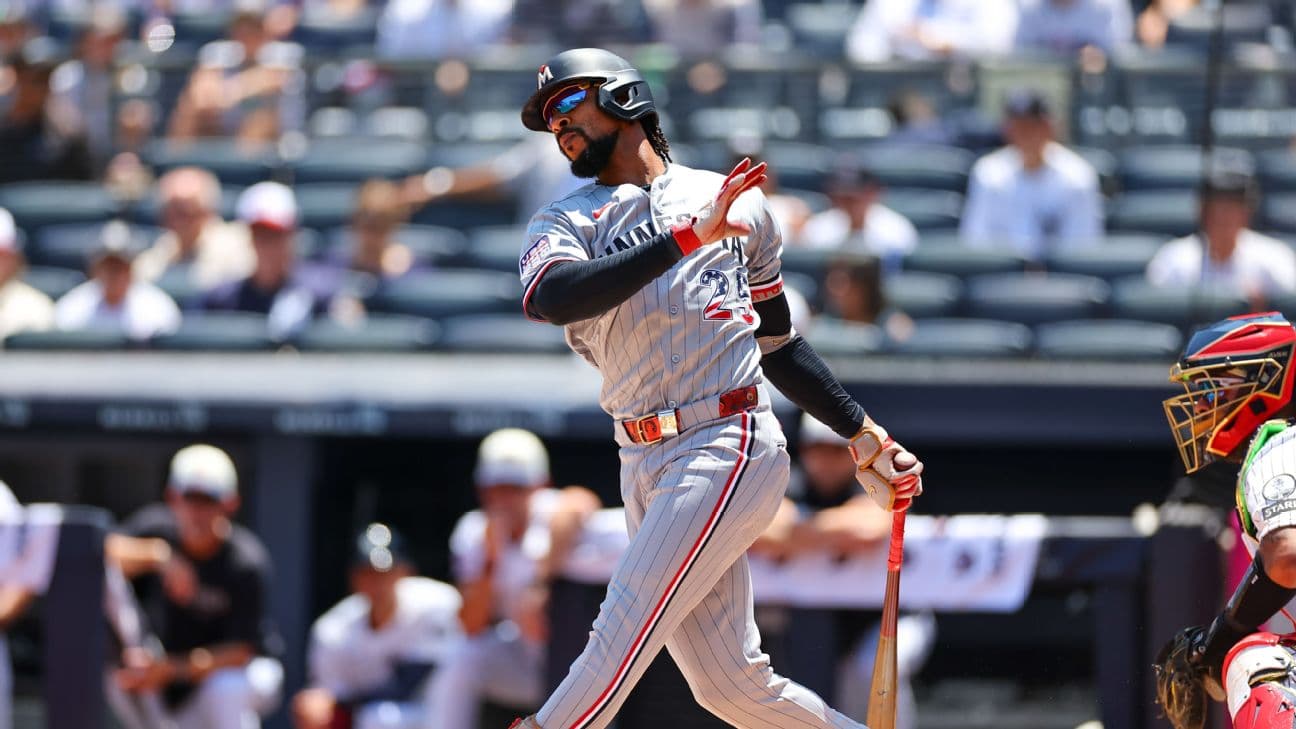
Deadline season fills timelines with rumors, but some of the most useful information for fantasy managers is the opposite of a rumor. It is a firm no. As the Aug. 3 deadline nears, the Twins have made clear they have no plans to trade Byron Buxton, and the Giants have signaled ace Logan Webb is not going anywhere. Knowing which stars are staying put is just as valuable as knowing which are available, because it tells you where your shares are safe and which contenders will have to shop elsewhere.
Byron Buxton: 'I'm a Twin'
Minnesota's front office stated the team has no plans to move Buxton, and the player removed any ambiguity himself, saying plainly that he is a Twin and is not going anywhere. He also holds a full no-trade clause, which gives him the final say regardless of how the market develops. That combination, a stated organizational stance plus contractual control, is about as close to a locked door as the deadline offers.
For fantasy managers, the value of that clarity is stability. Buxton's ceiling has never been in question when healthy; the durability has. But a player staying in a known role, in a known ballpark, with a known lineup around him, is easier to project than one who might be uprooted into a new environment. There is no relocation risk to price in, which makes his rest-of-season outlook cleaner than a comparable star whose address is in flux.
Logan Webb: signed, affordable, and off the market
Webb is the other clear untouchable. Signed affordably through 2028, he gives the Giants no financial reason to sell and every competitive reason to keep him as the anchor of their rotation. San Francisco has indicated it has no intention of trading its ace, and the contract structure backs that up. A cost-controlled front-line starter is precisely the kind of player a team builds around rather than cashes in.
Webb's fantasy profile is built on elite command, a heavy workload, and one of the game's best ground-ball rates, a combination that produces innings and ratios you can bank weekly. Staying in San Francisco keeps him in a pitcher-friendly park, which is a quiet plus for his ERA and WHIP. Managers holding Webb should feel no urgency; the environment that made him valuable is not changing.
Why the no-sell signal matters for your roster
Deadline uncertainty is a hidden tax on fantasy value. A star who might be traded carries a small discount because a move could downgrade his park, his lineup support, or his role. When a team publicly closes the door, that discount disappears. Buxton and Webb are worth exactly what their skills say they are worth, with no relocation asterisk attached.
There is a second-order effect, too. Every contender that wanted to pry Buxton or Webb loose now has to redirect its shopping toward the players who actually are available. That funnels demand toward names like the deadline's rental starters and bats, which in turn raises the odds that those players change teams and change fantasy value. Knowing who is off the board helps you predict who is on it.
Buxton's health is the only real variable
With the trade question closed, the lone remaining risk on Buxton is the one that has followed him his whole career: staying on the field. His per-game production, when healthy, sits comfortably in the upper tier of outfielders because of the rare power-speed combination he brings. The fantasy job is not to worry about his address but to manage around his injury history, banking his elite rate stats when he plays and carrying enough depth to cover the games he misses.
Webb offers the opposite risk profile, which is almost none. He is among the most durable starters in baseball, routinely piling up innings while sustaining strong ratios, and his ground-ball-heavy approach ages well. A pitcher who takes the ball every fifth day in a pitcher-friendly park is the definition of a set-and-forget fantasy asset. Between the two untouchables, Buxton is the higher-ceiling gamble and Webb is the anchor, and neither is going anywhere.
The Verdexed model take
Verdexed's projections treat player context, park, lineup, and role, as core inputs, which is why deadline certainty is a real variable and not just noise. For Buxton and Webb, the model can lock in their environment for the rest of the season, producing tighter, more confident projections than for stars whose destinations are unknown. Webb in particular grades as a stable SP1-caliber option whose home park and workload keep his ratio floor high.
The model's broader read is that the absence of a Buxton or Webb trade concentrates deadline demand on a smaller pool of available arms and bats, which supports the idea that the players who do move will see the largest swings in projected value. Certainty at the top pushes volatility down the board, and that volatility is where the waiver-wire and buy-low opportunities live.
What to do in your league
Hold Buxton and Webb with confidence and do not let deadline chatter tempt you into selling either at a discount. If a nervous manager in your league is shopping one of them out of misplaced trade anxiety, that is a buying window, not a warning. Then turn your attention to the genuinely available players, because that is where the deadline will actually reshape fantasy value over the final two months.
What's next
The deadline will dominate the next three weeks, but the smartest managers read both sides of it. The stars staying put tell you where value is stable; the stars in motion tell you where it is about to change. Buxton and Webb are anchors you can build around. The edge is spending your attention on the players whose situations are still unsettled, and letting the untouchables simply do their jobs.