The Veto Button Is a Smoke Detector: Why Vetoing Fair Fantasy Trades Makes You Your League's Worst Manager
By Verdexed Analytics
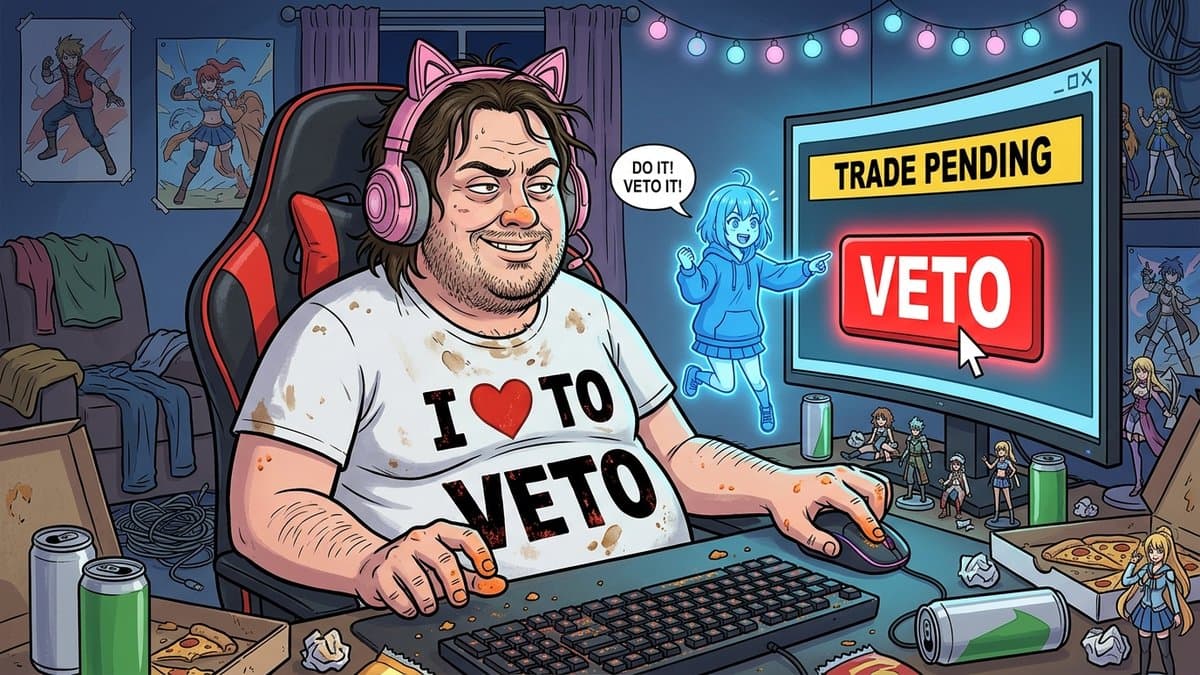
Every fantasy league has one. He has never proposed a trade in his life. He doesn't work the waiver wire, he forgets to set his lineup in Week 11, and he hasn't sent a message in the group chat since the draft. But the second two other managers agree on a deal, he's there, thumb on the veto button, ready to save the league from a crime that didn't happen.
This piece is for him. Not because he'll read it and change. He won't. It's for everyone else in the league, so you know you're not crazy, and so you have something to send the group chat the next time a perfectly fair trade gets killed by people who just didn't like how it looked.
The veto button is a smoke detector
Here is the whole argument in one line: the veto button is a smoke detector. It's for fires. It isn't for when someone down the street cooks a better dinner than you.
The veto exists to stop cheating. That's it. That's the job. Not lopsided trades, not trades you would have priced differently, not trades that make a rival better. Cheating.
The platforms agree. ESPN's fair-play policy defines a collusive transaction as one where a team "makes moves to benefit another team without trying to improve its own position." Read that slowly. The test isn't whether one side won the trade. The test is whether one side stopped trying. A manager who sells veterans for picks is trying to improve his position. A manager who buys veterans for a playoff run is trying to improve his. Two people trying to win, in different directions, is the opposite of collusion. It's the whole point of the game.
Yahoo, where most private leagues live, puts the bar at one-third of the league: in a 12-team league, four votes against a trade kill it. And every one of those votes is anonymous. Think about what that means. Four people, none of whom has to explain himself, can erase a deal two managers spent a week negotiating. No reason given, no reason required, no name attached. That's not a safeguard. It's a loaded gun left on the kitchen table, and some of your leaguemates have been waiting all season to pick it up.
What cheating actually looks like
Before we get to the people abusing the button, let's be clear about when it should be pressed, because there are real cases and a good league catches them.
| What happened | Veto? |
|---|---|
| Two managers agree to rig a result, split winnings, or "help each other out" | Yes |
| A manager who's out of it gives his stars to a friend for nothing | Yes |
| A team drops a top player at a time picked so one rival can grab him | Yes |
| A manager is clearly trading to wreck the league on his way out the door | Yes |
| A contender buys veterans from a seller for picks | No |
| You think one side overpaid | No |
| The trade makes a team you're chasing better | No |
| You would have asked for one more pick | No |
| You didn't think of the trade first | Noand we can tell |
Notice the pattern. Every "yes" has one side not trying to win. Every "no" is two people trying to win who happen to disagree with you about how. One of these is a crime. The rest are feelings.
A field guide to the veto abuser
They come in a few breeds. Most leagues have at least three.
The Jealous Rival
He's sitting two games back of a playoff spot. A team one spot ahead of him just bought a goalie. He does the maths, realises his path to the playoffs got harder, and votes no. He'll tell you the trade was "unbalanced". What he means is that it was balanced, and it helped somebody who isn't him.
This is the most common veto in fantasy sports, and it's the most transparent. If your objection to a trade only exists because of where you sit in the standings, it isn't an objection. It's an admission.
The Appraiser
He would have asked for more. A second-round pick instead of a third. The better of the two prospects. So he vetoes, because in his professional opinion the price was wrong.
Here's the thing: you weren't in the trade. You don't get a say in the price. Managers misjudge value all the time, and that's the game. The guy who sells too cheap learns, the guy who buys smart wins, and the league moves on. The moment the league starts vetoing bad prices, every trade has to be priced to satisfy the least imaginative manager in it, and that's how a trade market dies.
The Tank Police
"He's obviously tanking." This one shows up the minute anyone sells for picks, and it's almost always nonsense.
Selling when you're out of the race isn't tanking. It's rebuilding. Every real sports league does it every year at the deadline, and nobody calls the commissioner. If your league is worried about teams losing on purpose, the answer is a rule, not a veto: a draft lottery, or better, a reverse lottery where the best non-playoff team gets the best odds. Plenty of keeper leagues already run one. In a league like that, tanking hurts the tanker, and accusing a seller of tanking is accusing him of trying to lose the lottery.
The Hypocrite
The rarest breed, and the most fun. He vetoes your sell-off for "competitive balance", and somewhere in the league history there's a trade where he did exactly the same thing. Nobody vetoed his. Nobody wrote him a paragraph. When he did it, it was strategy. When you do it, it's a scandal.
You can't argue with the Hypocrite, because he isn't arguing a principle. He's arguing a result. Just screenshot his old trade and move on.
The Ghost
He hasn't made a move in six weeks. He's never proposed a trade. But he votes on every one, and he votes no. The veto is the only button in the app he still presses. He can't win the league, so he's decided nobody else gets to try either.
What bad vetoes actually cost
Nobody thinks a single veto can wreck a league. It doesn't. It just starts the rot.
Trades are the most interesting thing that happens in a fantasy season. The draft is one night. Waivers are a race to click. Trades are where people talk, negotiate, take risks, and give the group chat something to argue about other than whose turn it is to pick the bar for the draft. A league with an active trade market is a league people want to come back to.
Every bad veto teaches the whole league the same lesson: don't bother. Why spend a week working out a deal if four anonymous people can kill it in an afternoon? So the active managers stop trading. Then the league gets quieter, standings harden by November, the bottom half checks out, and by next August you're begging someone to fill the last two spots.
The veto crowd thinks they're protecting the league. They're slowly suffocating it.
For commissioners: how to fix it
If your league has a veto problem, it has a rules problem. Here's what works.
Write down what a veto is for. One sentence in the league rules: "Trades are vetoed only for collusion or for a team clearly not trying to improve its own position." Borrow ESPN's wording. It's good. Once it's written down, "I didn't like it" stops being a reason.
Switch to commissioner review. Yahoo and ESPN both let a private league's commissioner review trades instead of putting them to a league vote. One accountable person beats four anonymous ones. If you don't trust your commissioner to do that, you have a bigger problem than vetoes.
If you keep voting, make it cost something. Require anyone voting no to say why in the group chat. Anonymity is what makes jealousy feel safe. Take it away and watch how many vetoes disappear.
Kill the tanking argument with a rule. A draft lottery, or a reverse lottery, takes away the reason to lose on purpose. Then "he's tanking" stops being a veto excuse, because tanking stops working.
Overturn the bad ones out loud. When a fair trade gets vetoed, the commissioner pushing it through and explaining why does more for the league than any rule. It tells everyone the veto has limits, and it tells the managers in the trade that the league still wants them in it.
Before you press it
Next time a trade lands in your league and your thumb drifts toward the veto, ask yourself one question:
Is anyone in this trade not trying to win?
If the answer is yes, press it. That's what it's there for. If the answer is no, and what's really bothering you is that a rival got better, or that you'd have done it differently, or that you didn't think of it first, then put the phone down. Go find a trade of your own. Make your team better. Beat them on the scoreboard.
The smoke detector is for fires. Let the guy down the street cook his dinner.
Got a veto story?
Send your worst veto, bad beat or commissioner call to info@verdexed.com with "Veto" in the subject: league size, format, what happened. No names needed, and we won't print any.