 NFL2026-09-09
Week 1 Survivor Pool: The Chargers Are the Safest Board and That Is Exactly the Problem
By Verdexed Analytics
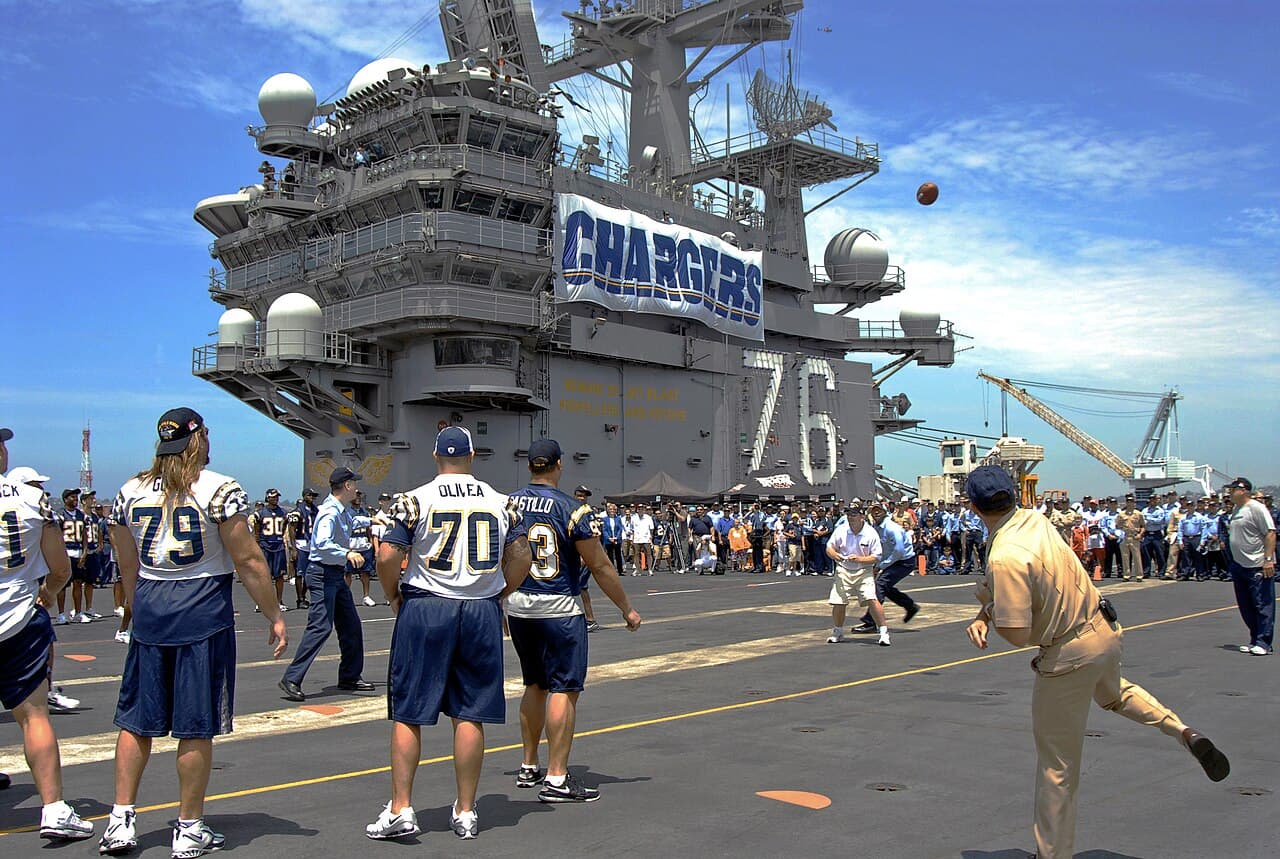
Survivor pools are decided in September more often than in December, and Week 1 is the hardest week of the year to navigate because there is no in-season data to work with. Every projection is built on last year's roster, this summer's practice reports and the market's read of a 32-team offseason. The correct approach is to treat the board as an equity problem rather than a confidence problem.
The Los Angeles Chargers are the highest win probability on the slate, hosting Arizona as a favorite near double digits in the late Sunday afternoon window. Depending on the book, that number has traded between roughly nine and eleven points, which puts the implied win probability comfortably around eighty percent. That is the safest single game available.
It is also going to be the most popular pick in America, and that combination is the oldest trap in survivor strategy.
Why the safest pick is not always the right pick
Survivor equity has two components: the probability your team wins, and the probability your competitors are eliminated. A pick that everyone else makes provides no differentiation. If the Chargers win, you advance alongside the entire field. If they lose, you exit alongside the entire field, which at least keeps you alive relative to the pool but wastes the best team on your board.
The value in Week 1 comes from finding a team with nearly the same win probability that a much smaller share of the pool will select. In a large pool, a five-point drop in win probability paired with a thirty-point drop in ownership is usually a profitable trade.
There is also a future-value consideration. The Chargers are one of the more attractive survivor teams later in the season, and burning them in Week 1 against a team the market already projects as the league's weakest removes an option you may need in November.
The alternatives
Jacksonville hosting Cleveland is the cleanest second option. The Jaguars opened as a touchdown-plus home favorite against a Browns team the market treats as rebuilding, and the implied probability sits somewhere in the low-to-mid seventies. That is a small step down from the Chargers with a meaningful step down in expected ownership.
The added wrinkle is that Cleveland is starting a quarterback making his first start since 2024 on the road in a hostile environment. Openers are unkind to quarterbacks with long layoffs, and the Jaguars' pass rush is the specific way that unkindness usually manifests.
Detroit against New Orleans is the third path. It carries a lower implied probability than either of the first two, but it is the pick with the least crossover risk in most pools, because a large share of the field will be split between Los Angeles and Jacksonville.
The teams to avoid
Dallas is a road favorite against the Giants on Sunday night, and it will draw survivor interest that the number does not justify. Division games in Week 1 are the highest-variance games on any board, because familiarity compresses talent gaps and both teams have a full offseason of preparation for the specific opponent.
Green Bay at Minnesota is priced within two points and should not be considered. Denver at Kansas City on Monday night is a similar story, with the Chiefs favored by a field goal or less. Neither is a survivor game.
San Francisco is a stay-away in the Melbourne opener for a different reason. The travel variable is unmodeled by every projection system, and a survivor pick is not the place to find out how a nine thousand mile flight affects a football team.
The Verdexed model take
Verdexed's model produces win probabilities for each Week 1 game and then runs a pool simulation across expected ownership. The output on this slate is unambiguous: Jacksonville has the highest expected survivor value, not Los Angeles, and the gap widens as pool size increases.
In a pool of fewer than twenty entries, the model prefers the Chargers, because differentiation matters less when the field is small and simply surviving is most of the game. In a pool of a hundred or more, Jacksonville is the pick. In a pool of a thousand, Detroit becomes competitive with Jacksonville on the same logic.
The model also flags a schedule consideration that most pool players ignore. Teams with soft early schedules are worth saving, and teams with one obviously exploitable Week 1 matchup and a difficult remaining slate are worth using now. Jacksonville fits the second profile better than Los Angeles does.
What to do in your pool
Check your pool's rules before anything else. Pools that allow reusing teams change the calculus entirely and push you toward simply taking the highest probability every week. Pools with a strike system reward more aggressive differentiation early.
If your pool is small, take the Chargers and do not overthink it. If your pool is large, take Jacksonville and accept the marginally higher risk in exchange for a much better position if the favorite falls.
Either way, do not pick a division game, and do not pick a team that requires a quarterback debut to go smoothly.
What's next
Week 2 is where survivor pools get genuinely difficult, because the field will have burned its two safest teams and the market will have one week of real data to reprice everyone. Plan two weeks ahead rather than one, and hold at least one high-probability team in reserve for the inevitable week when the board has nothing better than a six-point favorite.