 NFL2026-09-07
Week 1 Defense Streamers: Jacksonville and the Chargers Are the Cheap Points
By Verdexed Fantasy Desk
Seattle is the consensus No. 1 fantasy defense and was drafted like it, which means most managers who want the best streaming value in Week 1 are looking at units still available on waivers. Two stand out, and both are available in a large share of leagues because they are attached to games nobody has circled.
The method for streaming a defense has never been complicated: find a heavy favorite playing a quarterback who is either new to the job or short on protection. Week 1 offers two clean versions of that.
Jacksonville against Cleveland
The Jaguars are home favorites of about a touchdown and a half against the Browns in a Sunday 1 p.m. ET kickoff, with a total that has sat around 40.5. That combination, a mid-sized favorite in a game the market expects to be low scoring, is the exact profile that produces defensive fantasy points.
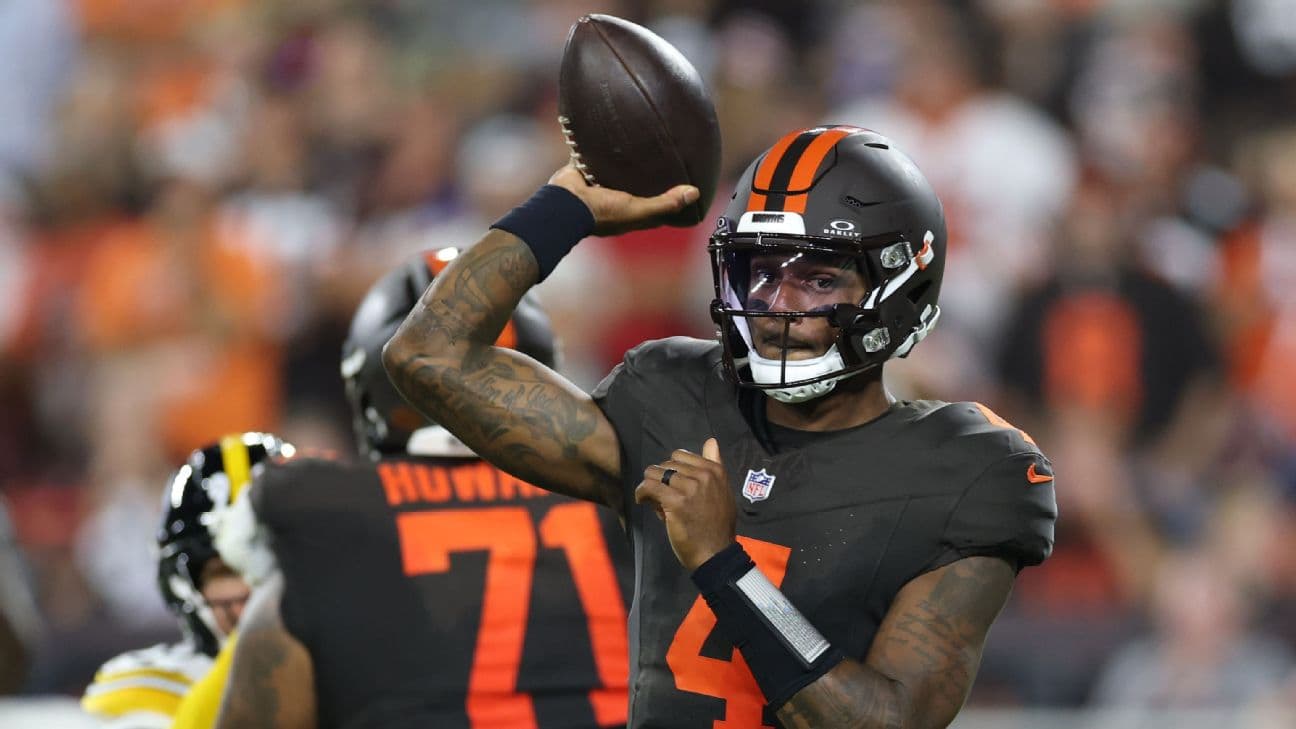
Cleveland's situation supplies the rest. Deshaun Watson won the starting job in camp, and the receiver room he inherited is built around rookies after the club released Cedric Tillman. A quarterback under pressure throwing to first-year receivers who have never played an NFL snap together is the most reliable sack-and-turnover environment available in Week 1.
A total in the low 40s also caps the downside. The failure mode for a streamed defense is not a lack of sacks, it is conceding 30 points, and games the market prices this low rarely produce that outcome.
The Chargers against Arizona
Los Angeles is favored by 11.5 points over the Cardinals, the largest spread on the Week 1 board and the week's only double-digit line. Large spreads and defensive scoring are strongly correlated, because trailing teams throw more, and teams that throw more from behind give up sacks and interceptions.
Arizona's offense arrives in poor shape. Jacoby Brissett is the starter, James Conner opened on injured reserve, and rookie Jeremiyah Love has been roughly a coin flip to play through a high ankle sprain. A team without a settled backfield, trailing by two scores, is a team that throws in obvious situations against a defense that knows it.
The risk on this one is priced into the spread rather than into the fantasy market: a game that gets out of hand early can turn into a quiet second half where starters rest and garbage-time points flow the other way. That is a modest ceiling concern, not a floor concern.
The third option nobody is looking at
Pittsburgh hosts Atlanta as a field-goal favorite, and Atlanta is the last team in the league without a named starting quarterback. Whichever passer Kevin Stefanski selects will be making his first start of the season on the road, either coming off an ACL tear that cost him the entire preseason or arriving on what has been described as a short leash.
A home defense facing an opponent that could not decide who plays quarterback until the final week of preparation is a legitimate streaming case. The spread is small enough that game script is not guaranteed, which is why this is the third option rather than the first, but the pass-rush environment is as favorable as any on the slate.
Kickers: buy the game environment, not the leg
Kicker streaming is an exercise in identifying offenses that will reach the red zone often and stall occasionally. In Week 1, the highest-total game on the board has been Bengals at Buccaneers, and the market has pushed that number up rather than down all week.
The better process is to take the kicker attached to the team the market expects to score most and to avoid the kicker attached to the largest favorite. Blowout favorites go for it on fourth down in the second half and score touchdowns rather than field goals, which is why the Chargers make an excellent defensive stream and a mediocre kicker one.
Dome and fair-weather games carry their usual small edge. In September that edge is minimal, since almost nowhere in the league has weather worth adjusting for yet.
The Verdexed model take
Our projections weight three inputs for team defenses: the implied point total of the opposing offense, the opposing quarterback's pressure-to-sack profile, and the spread. Jacksonville grades out highest among widely available units this week on the first and third of those, and Cleveland's receiver inexperience adds to the second.
The Chargers grade slightly higher on raw expected points and slightly lower on floor, because the model penalizes the specific scenario where a game is decided by halftime.
The broader model finding, and the reason streaming works at all, is that the gap between the best defense on any given week and the fifth-best is much smaller than the gap between their draft costs. Spending a mid-round pick on a defense has never returned that investment reliably. Spending a waiver claim every week has.
Betting angle
The Jacksonville total in the low 40s is the number that ties this together. If a bettor believes the defensive streaming case, the consistent position is the under rather than the side, because the case rests on Cleveland failing to move the ball rather than on Jacksonville scoring.
On the Chargers game, the large spread makes the side unattractive at this price and the first-half line more interesting, since the entire thesis is about early control rather than final margin.
What to do in your league
If Seattle is on your roster, start it and stop reading. If not, claim Jacksonville first and the Chargers second, and understand that both are one-week rentals rather than season-long solutions.
Do not drop a startable skill player to hold two defenses. The value of streaming comes from churning the same roster spot, not from stockpiling. Pick one, play it, and be back on the wire Tuesday.