 NFL2026-07-26
Kyler Murray vs. J.J. McCarthy in Minnesota: The QB Battle That Sets Justin Jefferson's Fantasy Ceiling
By Verdexed Fantasy Desk
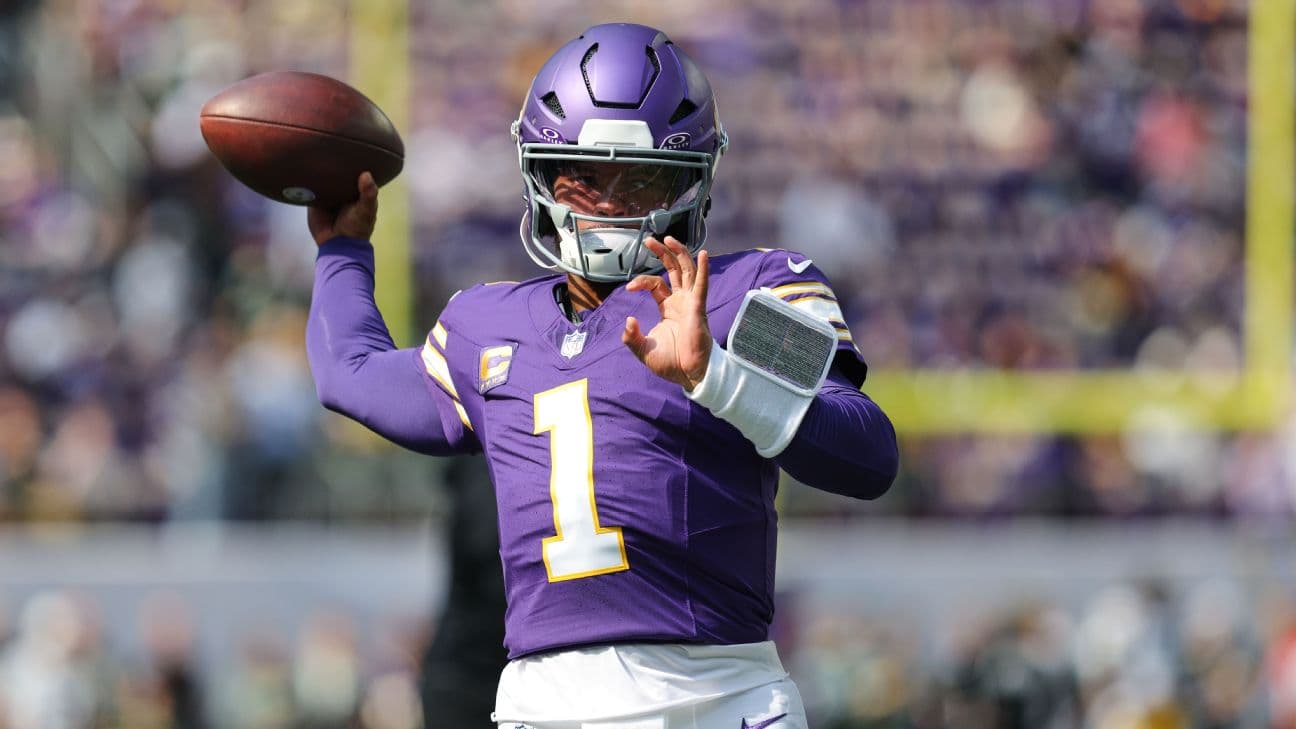
Minnesota will settle its starting quarterback job on the practice field, with Kyler Murray and J.J. McCarthy competing through training camp and head coach Kevin O'Connell declining to attach a public timeline to the decision. It is the most consequential unresolved fantasy situation in the league right now, because it does not just change one quarterback's value. It changes the pass rate, the play speed, and the target distribution of an offense that houses one of fantasy football's premier receivers.
Murray, 28, arrived this offseason after seven seasons in Arizona, where he was the first overall pick in 2019. He carries roughly a 2-to-1 career touchdown-to-interception ratio across 87 starts and, more importantly for fantasy, more than 3,000 career rushing yards and 32 rushing touchdowns. McCarthy enters his third year with the organization after showing improvement late last season.
The competition as it actually stands
The general expectation around the league is that Murray is the better quarterback at this moment, and most projections have him opening Week 1. That is not the same as the job being decided. O'Connell has run genuine competitions before and has been explicit that this one runs into camp, which means the pads-on practices in the first two weeks of August carry real weight.
One piece of context worth sitting with: ESPN's Vikings beat reporting noted the difficulty of finding a salary-cap-era precedent for a top-10 drafted quarterback who lost his job after his team acquired an established starter and then returned to become the franchise's long-term answer. That is a historical argument, not a scouting one, but it frames the stakes for McCarthy. If he loses this, the organizational path back is narrow.
The practical tell will be first-team reps in the joint-practice window and the preseason snap distribution. Coaches say competitions are open. Rep counts do not lie.
Why this is a Justin Jefferson question
Jefferson is the reason this matters to fantasy managers who do not care about the Vikings. He is being drafted as a first-round asset in every format, and the quarterback under center is the single largest swing factor on his projection.
A Murray-led offense historically features quick game, condensed splits, and a quarterback willing to leave the pocket. Scrambling quarterbacks produce more off-schedule throws, which tends to compress target concentration onto the receiver the quarterback trusts most while lowering total dropback volume slightly because of the rushing attempts. For a genuine alpha like Jefferson, that trade is usually neutral to positive on targets and positive on air yards, because the deep shot off scramble drill is one of the highest-value plays in football.
McCarthy's profile points a different direction. A third-year passer in O'Connell's system running more structured play-action and full-field progressions would spread the ball more evenly, which raises the floor of the No. 2 receiver and the tight end while trimming a couple of Jefferson's weekly targets.
The honest summary: Jefferson is a top-five fantasy receiver either way. The distribution around that projection is wider under Murray, with a higher ceiling and a slightly bumpier weekly floor.
The quarterback question for your draft
Murray as a fantasy quarterback is a rushing-floor asset. That is the entire case, and it is a good one. Quarterbacks who run for 400-plus yards and multiple touchdowns produce a weekly baseline that pocket passers cannot match without elite passing volume. Paired with a receiver of Jefferson's caliber, that combination is a legitimate top-eight fantasy quarterback outcome if he holds the job all season.
The risk is not talent. It is job security in a competition and the availability record that has followed Murray through his career. Neither is disqualifying, but both argue against paying a premium price for him in a redraft league before the job is announced.
McCarthy in fantasy terms is a late-round dart with a real path. If he wins, he is a streamer in single-quarterback leagues and a genuine asset in superflex, where the scarcity math changes everything. The move for superflex managers is to acquire him cheaply now, while the market treats the competition as settled.
The Verdexed model take
The model runs Minnesota's offense as a two-branch projection rather than a single point estimate, and the branches diverge more on distribution than on total output. Team passing volume comes out slightly lower under Murray because of the rushing attempts he absorbs, but expected points per dropback comes out slightly higher, largely on the scramble and play-extension value that does not show up in traditional efficiency stats.
For Jefferson specifically, the model's target-share projection is a few points higher in the Murray branch and his expected air yards per target rises meaningfully. For the secondary pass catchers, the McCarthy branch is the friendlier one.
On the betting side, the interesting derivative is the Vikings team total and the Murray rushing props, not the win total. Season-long quarterback rushing yardage markets are notoriously slow to reprice on job-security news, and a Murray announcement would arrive with the number already set. If a book posts a Murray rushing total before the starter is named, that number is priced with competition risk baked in, which is the moment to act if you believe he wins the job.
What to do in your league
Draft Jefferson at his price without hesitation. The quarterback outcome moves his ceiling, not his status as a foundational pick. Treat Murray as a value quarterback rather than a target, and let the room decide whether the competition risk scares them off. In superflex and dynasty, buy McCarthy at his depressed price now, because the cost of being wrong is a bench spot and the cost of missing is a starting quarterback.
What's next
The decision point that matters is the first padded practice week and the preseason opener. Watch who takes the first snap with the starters, watch whether the rep split moves off 50-50, and watch for the O'Connell press conference that stops describing the job as open. That is when the fantasy market reprices, and the edge belongs to whoever moved first.