 NHL2026-07-17
Trevor Zegras Gets Paid in Philadelphia: The Flyers Bet on a Career Year, and Fantasy Should Too
By Verdexed NHL Desk
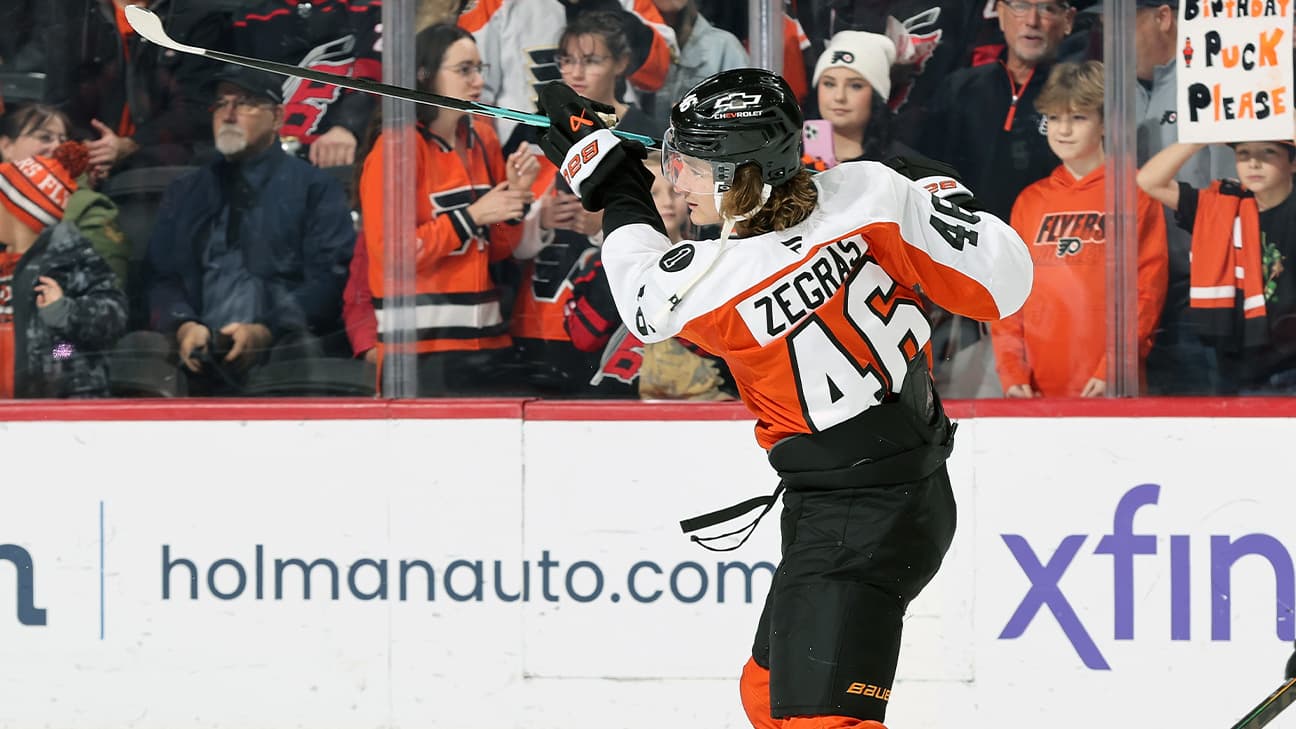
The Trevor Zegras reclamation project in Philadelphia just got a long-term commitment. The Flyers signed the center to a four-year extension worth $36.5 million, a $9.125 million average annual value that makes him the highest-paid player on the roster. After a career year in his first full season since being acquired from Anaheim, the deal is Philadelphia doubling down on a bet that is already paying off, and fantasy managers should be paying attention to a playmaker entering his prime with a defined role.
The career year that earned the deal
Zegras set personal bests with the Flyers, posting 26 goals and 67 points, a marked step up from the injury-plagued and role-limited seasons that closed out his time in Anaheim. The change of scenery worked: a clean bill of health, a top-six role, and power-play responsibility unlocked the creative, high-event game that made him one of the sport's most watchable young players when he broke into the league.
The contract is a significant raise from his previous deal, moving from a modest cap hit into top-tier money that reflects both his production and his upside. Paying a player like a top-50 asset is a statement, and it signals that Philadelphia intends to build its offense around him rather than treat him as a complementary piece. For fantasy purposes, contract-driven role security is a tailwind, because teams feed the players they just paid.
Fantasy fallout: a multi-category contributor with points upside
Zegras is a fantasy asset built on offense. A 67-point season from a center who contributes goals and assists in roughly balanced measure is a solid multi-category line, and the power-play time is the key ingredient. Man-advantage points are the most predictable source of fantasy value for skilled forwards, and Zegras running a top unit gives him a reliable floor of secondary assists and setups on top of his even-strength production.
The upside case is that year one in Philadelphia was a floor, not a ceiling. Zegras is still young, still ascending, and now locked into a featured role with a team that just invested heavily in him. If his linemates and power-play usage hold or improve, a jump toward 75-plus points is well within range, which would push him from a useful mid-round forward into a genuine fantasy difference-maker.
The risks worth pricing in
Zegras is not without warts for fantasy. His game has historically run hot and cold, and his defensive metrics and shot volume have at times lagged behind his highlight-reel creativity. Managers in leagues that count hits, blocks or plus-minus should temper expectations, because he is an offense-first player whose value is concentrated in points, power-play production and the occasional shootout-style flair.
Injury history is the other flag. Part of what depressed his value in Anaheim was availability, and while his Philadelphia season was healthy, a player with his frenetic style carries some ongoing risk. The four-year term suggests the Flyers are comfortable with his durability, but fantasy managers should still bank on him as a strong-but-not-elite scorer rather than an ironman.
The Verdexed model take
Verdexed's fantasy hockey model values Zegras as a top-line points producer whose projection is anchored by power-play deployment. The model treats his career-year production as largely repeatable given his age and role, and it nudges his projection slightly upward on the theory that a newly extended, featured forward tends to see stable-to-rising usage. It slots him as a mid-round target in points-heavy formats and a tier lower in banger leagues that reward physical play.
The model's edge case is the ceiling. Because Zegras is young and only one season into a role that clearly suits him, his range of outcomes tilts to the upside more than a typical established scorer's, which makes him a smart value if he slips in drafts on reputation for inconsistency. In leagues that count only offensive categories, the model is comfortable ranking him ahead of where the market will likely draft him.
What it means for the Flyers' outlook
Beyond Zegras's individual value, the extension is a window into Philadelphia's plans. Committing top-of-roster money to a 20-something playmaker signals that the Flyers see themselves as an ascending team building around skill up the middle rather than a club treading water. For fantasy, a team on the rise is a rising tide: better linemates, more offensive-zone time, and a coaching staff incentivized to lean into its high-end talent all lift the players around the core. Zegras's linemates and his power-play partners become secondary fantasy considerations worth tracking, because a featured center generates value for the wingers who ride shotgun.
The deal also removes a distraction. A player heading toward restricted or unrestricted free agency can carry contract-year noise that clouds his role and his usage; a freshly extended Zegras enters the season with total clarity about his place in the organization. That stability is quietly bullish for his production, because coaches trust and deploy players they have invested in, and trust translates into minutes, power-play time, and the offensive freedom that drives fantasy scoring.
What to do in your league
Draft Zegras as a mid-round offensive centerpiece in points leagues, with the understanding that the power-play role is doing a lot of the work. Fade him a tier in multi-category formats that reward defense and physicality, where his one-dimensional profile costs him. The extension is the tell: Philadelphia just made him the face of its offense and paid him accordingly, and fantasy value follows opportunity. A young, newly enriched playmaker with top-unit power-play time and room to grow is exactly the kind of asset worth betting on before his price catches up to his ceiling.