 NHL2026-09-12
Simon Edvinsson Reports to Red Wings Camp Without a Contract and Without a General Manager
By Verdexed NHL Desk
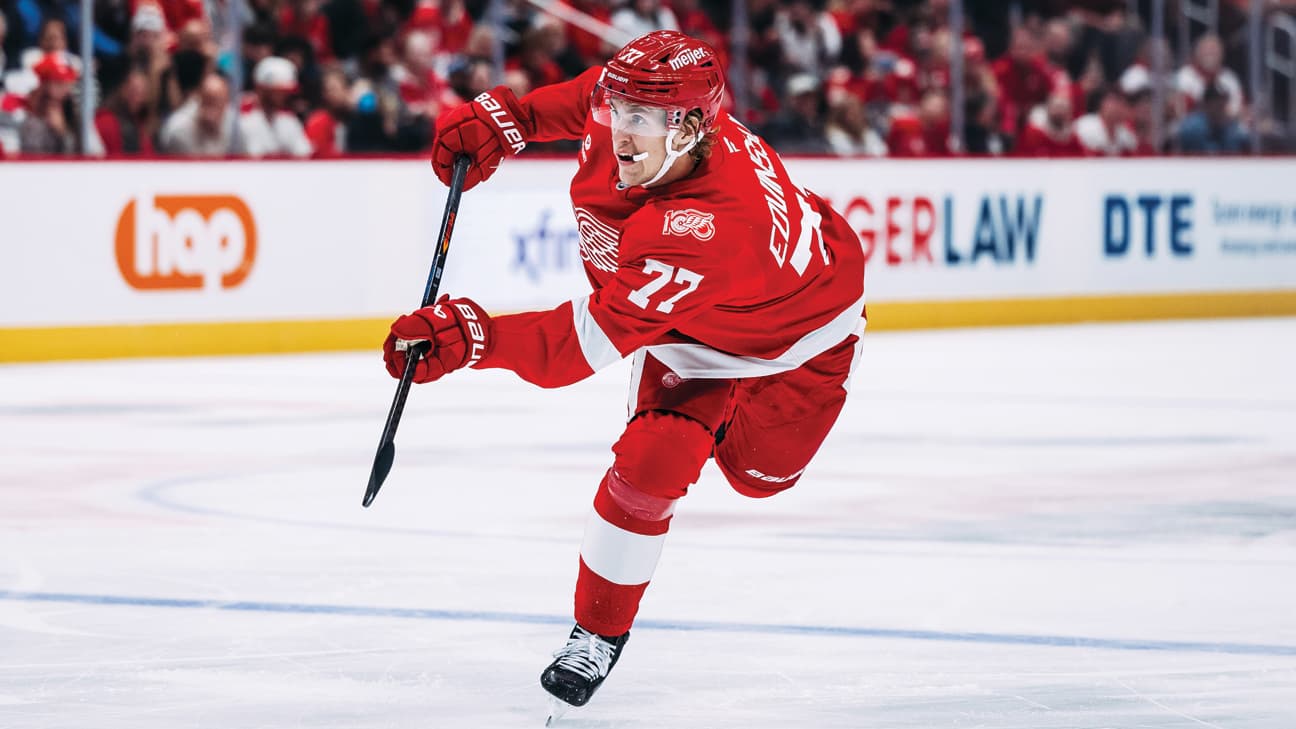
Simon Edvinsson intends to report to Red Wings training camp next week without a contract, according to multiple reports out of Detroit, and the reason is not a dispute over money. His agent has said contract discussions are paused until the Red Wings hire a permanent general manager, a search that has been open since Steve Yzerman stepped away from the role in mid-July.
Camp opens September 17. Detroit is currently running a hockey operation with an interim structure, an unsigned restricted free agent on the blue line, and a captain in Dylan Larkin who has reportedly asked out. That is an unusual amount of institutional uncertainty for a team that is supposed to be entering a competitive window.
The contract situation
Edvinsson completed his entry-level contract and is a restricted free agent, which means he has limited leverage and Detroit has limited urgency. Neither side is behaving as though a holdout is likely. The player plans to be at camp. The agent has simply declined to negotiate a long-term deal with an interim decision-maker, which is a defensible position when the deal in question could run eight years.
The market context has moved against Detroit while they waited. Early projections for Edvinsson pointed toward an eight-year deal in the neighborhood of eight and a half million dollars annually, which would have slotted just below Moritz Seider's cap hit. Since then, the price of young defensemen has risen sharply across the league, with Bowen Byram's six-year deal in Chicago at a twelve and a half million dollar annual value resetting the top of the market.
Whether Edvinsson is in that tier is debatable. That the comparable has moved is not. A deal signed in June would almost certainly have cost less than the deal Detroit signs now.
Fantasy fallout
Edvinsson's fantasy value is unchanged by the contract situation and undervalued by most draft rooms. He is expected to play, he is expected to play a large role, and none of the negotiation affects his ice time. Defensemen who are drafted in the middle rounds and finish as top-fifteen scorers at the position almost always come from this profile: a young player entering his third or fourth season on a team that needs him to take a step.
The power play assignment is the variable that matters. Detroit's blue line usage has been split, and the difference between running the top unit and the second unit is most of the difference between a useful fantasy defenseman and a droppable one. Camp is where that gets decided, and it is the single item worth watching between now and opening night.
Moritz Seider is the safer of the two Detroit defensemen and the more expensive one. For managers choosing between them, Seider is the established production and Edvinsson is the leverage play. In a one-year league, take the certainty. In a keeper format, Edvinsson is the better asset at his current cost.
The Larkin situation is the bigger fantasy question. A captain who has reportedly requested a trade, skipping an informal captain's practice as camp approaches, introduces genuine risk to Detroit's forward group. Any Red Wings forward's value depends on a roster that may not stay intact.
The organizational problem
The general manager vacancy is the root of all of this. A team cannot commit to an eight-year contract, resolve a captain's trade request or make a meaningful in-season acquisition without a permanent decision-maker, and Detroit has been operating without one for two months heading into a season.
That has downstream effects that show up in the standings. Teams in transition tend to make conservative decisions, and conservative decisions in a cap league usually mean missed opportunities rather than avoided mistakes. The Edvinsson negotiation is a clean example: waiting cost money.
The Verdexed model take
Verdexed's team projection for Detroit carries a wider confidence interval than almost any club in the league, and the reason is roster uncertainty rather than talent uncertainty. The model's central projection has the Red Wings on the playoff bubble, which is roughly where the market has them, but the distribution around that projection is unusually fat in both directions.
The upside scenario is straightforward: Edvinsson signs, Larkin stays, the blue line takes a step, and a team that has been close for several seasons converts. The downside scenario involves a captain traded during the season, which historically costs a team more in the standings than the returning assets suggest, because the disruption arrives midseason when there is no time to integrate replacements.
For betting purposes, the model's read is that Detroit's season win total is priced near fair value but that the distribution makes the over and the under both poor bets. The better position is on the playoff market, where the binary structure pays for the uncertainty rather than penalizing it.
For fantasy purposes, the model's guidance is cleaner. Edvinsson's individual projection is strong and largely independent of the contract and the general manager search. He is a buy at his current draft cost, and the risk that most managers are pricing into him is a risk that does not actually affect his production.
What's next
Two dates matter. September 17 is when camp opens and Edvinsson reports, contract or not. The general manager hire has no date attached, which is itself the problem.
Watch the power play combinations in the first week of camp for the fantasy answer, and watch for any movement on the Larkin situation for the roster answer. Both questions should have partial answers before the season starts. The contract may not.