 NHL2026-08-31
Simon Edvinsson Is Unsigned and Detroit Still Has No General Manager
By Verdexed NHL Desk
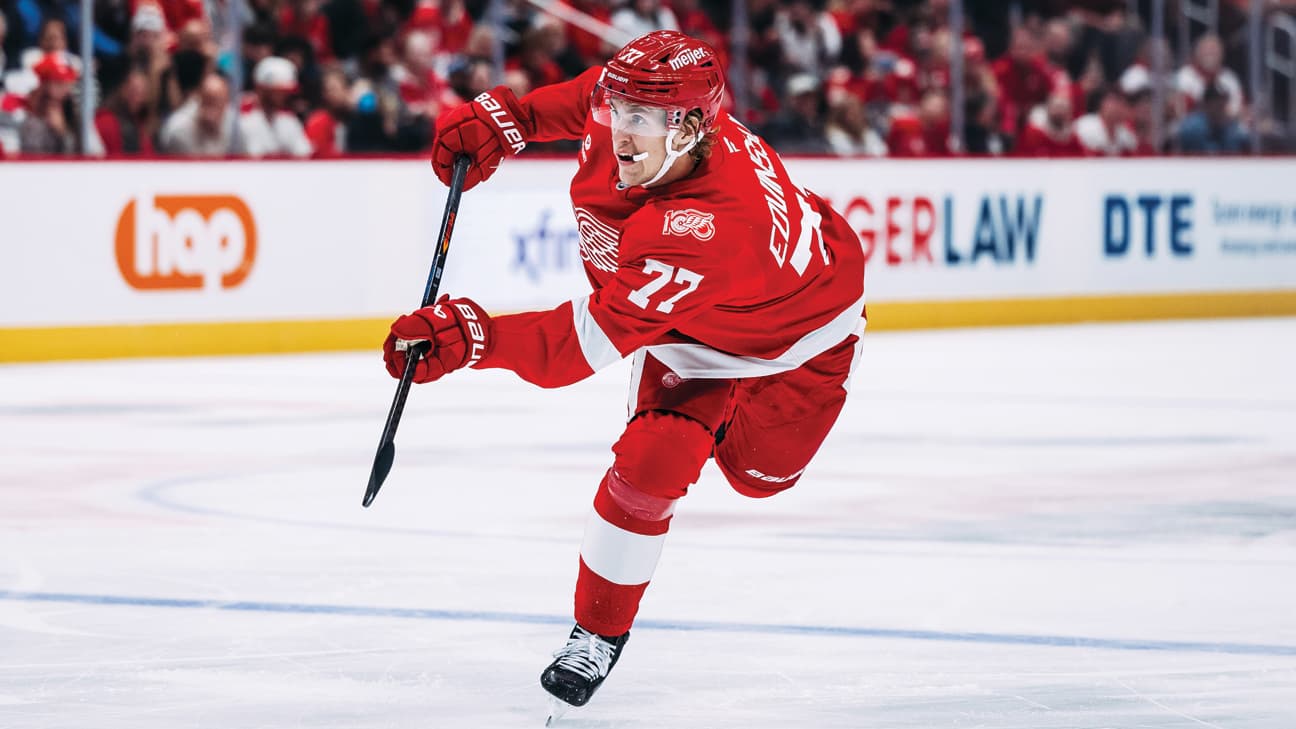
Detroit's most important contract negotiation of the summer is not happening, because there is nobody in the chair to conduct it. Simon Edvinsson remains an unsigned restricted free agent with training camps opening in mid-September, and reporting from his representation indicates talks are effectively on hold until the Red Wings hire a general manager.
Steve Yzerman transitioned out of the GM role in mid-July into a senior advisor position. Detroit has engaged an outside executive search firm, TurnkeyZRG, to run the search, with ownership reportedly looking for an analytics-oriented successor. Assistant general manager Shawn Horcoff is handling day-to-day operations, but that authority reportedly does not extend to making trades.
Why this is not a holdout
The distinction matters. Edvinsson's camp has publicly framed the situation as procedural rather than adversarial. There is no reported dispute over term or dollars, because there has been no real negotiation. He finished a three-year entry-level contract worth roughly $5.3 million total and is now waiting on a counterparty.
He is technically eligible to sign an offer sheet as a restricted free agent, but the commentary around his situation suggests that is not a route he is pursuing while Detroit sorts out its front office.
The number keeps moving against Detroit
The reason this delay is expensive is that the market for young defensemen has moved sharply this offseason. Chicago signed Bowen Byram to a six-year deal at a $12.5 million average annual value. Colorado extended Cale Makar for eight years at a $20.4 million cap hit beginning in 2027-28, the largest contract in league history, which reset the ceiling for everyone below him.
Earlier in the summer, projections for Edvinsson clustered around a long-term deal in the $70 million range. More recent estimates have come in nearer $56 million on a long-term structure. Either way, every comparable signing that lands before Detroit gets to the table becomes a data point his agent can use.
That is the cost of a leaderless summer. A team without a GM cannot make the first move, and in a rising market, waiting is the same as paying more.
Fantasy fallout
Edvinsson is one of the more interesting fantasy defensemen in the league for a specific reason: he plays big minutes on a team that needs him to, and the blue line ahead of him is not crowded. Defensemen who log 22 or more minutes a night with power play time are the position's fantasy currency, and Edvinsson is on the short list of young blueliners with a credible path to that role.
For redraft and one-year leagues, the practical issue is timing. A player who misses part of training camp is a slow starter, and defensemen in particular need reps to lock in pairings and special teams roles. If this drags into mid-September, discount his October production and consider him a buy-low target once the season starts.
For dynasty leagues, nothing has changed except the entry price. A 23-year-old top-pair defenseman whose contract situation creates uncertainty is exactly the asset dynasty managers should be acquiring, because contract noise depresses trade value in a way that has nothing to do with on-ice production.
The Larkin problem sitting behind it
The Edvinsson negotiation is not the only item on the new GM's desk. Captain Dylan Larkin has requested a trade and has not moved off it, with reporting indicating he would accept a deal to Dallas, Vegas, Minnesota or Florida. Larkin is reporting to camp regardless, which keeps the situation stable in the short term without resolving anything.
Those two files interact. A team that trades its captain is a team in a different competitive position than one that does not, and the term and structure a front office offers its 23-year-old defenseman depend on which of those teams it thinks it is. That is a strategic decision an interim executive is not empowered to make.
The Verdexed model take
Our projection system treats Edvinsson as a top-40 fantasy defenseman with meaningful upside if he secures first-unit power play time, and it applies a small discount to his October production based on the camp uncertainty. The model does not move his full-season projection much, because defensemen's scoring rates stabilize within a few weeks and a delayed start costs a handful of games rather than a role.
The bigger model adjustment is at the team level. Detroit's projected point total sits below the market's expectation, and the model's confidence interval around it is unusually wide because of the Larkin situation. A roster that could plausibly trade its captain in October is not a roster you can project cleanly in August.
Betting angle
Detroit's season point total is the market to watch, and the sharp read is to wait. Books have set a number based on the roster as constructed, and the roster as constructed includes a captain who has asked out and a top defenseman without a contract. Both of those resolve in the next six weeks, and the number will be more accurate once they do.
If you want a position now, the Red Wings to miss the playoffs is the cleaner side. Teams in front office transition with unresolved star situations are historically poor bets to exceed expectations, and Detroit's Eastern Conference path does not offer much margin.
What's next
The GM hire is the domino. Everything else in Detroit's offseason, the Edvinsson contract, the Larkin resolution, and the shape of the roster that opens the season on September 29, waits on it. For fantasy managers, the actionable step is to keep Edvinsson on your draft board at his current price and be ready to move him up the moment a contract is announced.