Chris Kreider Landed in Montreal Days After Anaheim Bought Him Out and the Canadiens Got Their Power Play Net Front
By Verdexed NHL Desk
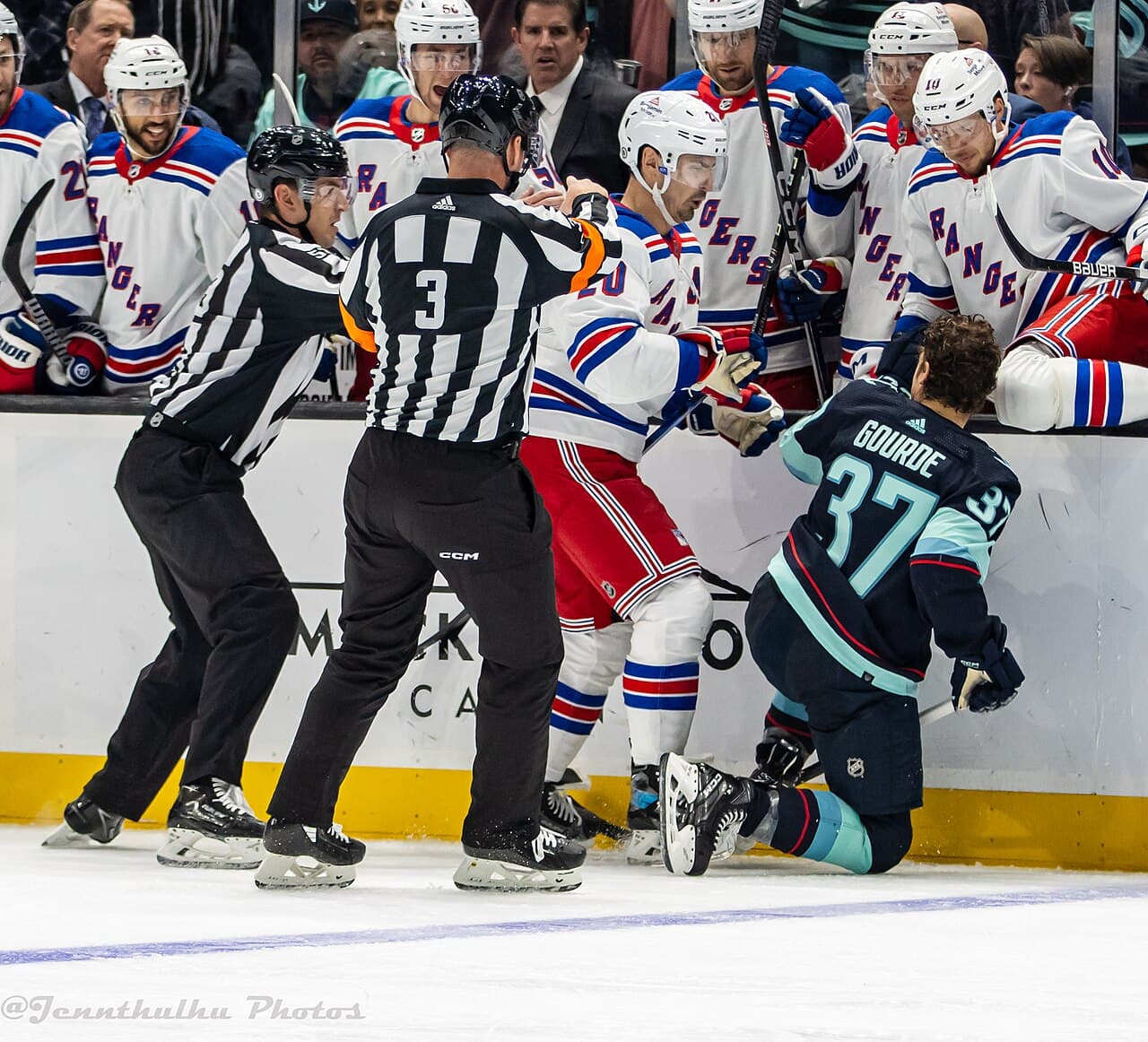
Chris Kreider signed a one-year contract with Montreal worth $2.15 million in guaranteed money and as much as $3.25 million more in performance bonuses, days after agreeing to a mutual buyout with Anaheim. The deal includes a no-movement clause. The Canadiens also signed Zachary Bolduc to a four-year extension worth $16.8 million, a $4.2 million annual cap hit.
Kent Hughes spent the summer doing very little and then did both of these inside a week, with training camp opening in days. The Kreider signing in particular is the kind of low-cost, high-fit move that decides a fantasy hockey draft in the wrong direction if you ignore it.
What Montreal actually got
Kreider is 35 and coming off a 50-point season in Anaheim, where he played 75 games and produced 22 goals and 28 assists with 34 penalty minutes. That is a productive year for a player whose contract was bought out weeks later, which tells you the buyout was about cap structure rather than performance.
What Montreal is buying is a specific skill. Kreider has spent his career as one of the best net-front power play players in the league, a left-shot forward who scores from the crease and on the back door. That is a role, not a vague veteran presence, and it is the exact role that generates fantasy goals.
He is also reuniting with Martin St. Louis, his former New York teammate and now Montreal's head coach. Reports indicate Kreider chose the fit over more money and wanted the security of a spot closer to home. Coaches who know a player tend to use him in the situations where he succeeded before, which in this case means the top power play unit.
The fantasy case is entirely about power play time
Kreider's fantasy value has always been a function of two things: shooting volume and man-advantage usage. He does not drive play, he does not pile up assists, and he does not produce much when he is on a third line without special-teams work.
Put him on Montreal's first power play unit next to a set-up passer and he is a 25-goal player. Leave him on the second unit and he is a 15-goal player who is not worth a roster spot in a 12-team league.
The signal to watch is the first week of camp. Power play units in September are not final, but the group a coach puts together on day one is usually the group he starts the season with. If Kreider is on the top unit at the net front in the first practice, draft him as a mid-round goal-scoring specialist. If he is not, let him go.
The bonus structure in his contract is itself informative. A deal built with $3.25 million in potential bonuses on top of $2.15 million guaranteed is a deal structured around games played and production thresholds, which is how a team signs a player it intends to use rather than one it intends to park.
Bolduc is the more valuable fantasy asset
The four-year, $16.8 million extension for Zachary Bolduc is the move that matters more for the next three seasons, and it is the one drawing less attention.
A $4.2 million cap hit on a four-year term for a young forward is a team buying the good years at a price set by past production rather than future production. That is a bet, and it is the kind of bet that only happens when a front office has seen something in practice and in development that has not fully shown up in a box score.
For dynasty and keeper leagues, that is the actionable information. Montreal committed four years and real money, which means Bolduc is going to get the ice time and the opportunity required to justify it. Players in that situation, young, extended, and on a team that needs them, are the most reliably undervalued group in fantasy hockey.
In redraft leagues, Bolduc is a late-round pick with real upside rather than a must-have. The extension raises his floor of opportunity without guaranteeing production.
The Verdexed model take
The model's projection for Kreider is built on a usage prior rather than an age curve, which is the correct way to handle a player whose value is concentrated in one deployment. His projected goal total swings by roughly nine goals depending on which power play unit he lands on, which is the widest single-variable range on Montreal's roster.
On Montreal as a team, the model moved the Canadiens' projected goals-for up modestly on these two signings, with the larger share of the move coming from Bolduc's projected increase in even-strength ice time rather than from Kreider.
The model's read on Montreal's season is more optimistic than the market's, and the reason is depth scoring. Teams that add two forwards who can produce in defined roles, at a combined cost well under market, tend to outperform their preseason numbers. The Canadiens' point total is one the model likes to the over.
Betting angle
Montreal's team point total is the play. Two September signings that improve the forward group do not typically move a preseason number, and the market has had little reason to reprice the Canadiens after a quiet summer.
Kreider's individual goal-scoring props, if they become available, are worth waiting on until the power play units are set. The range on his output is too wide to bet before camp resolves the deployment question, and the information will be public within a week.
The Atlantic Division market is where a Montreal improvement shows up most efficiently. A team that adds cheap depth scoring in a division with several teams in transition is a candidate to outperform its divisional price.
What it means
Montreal's summer looked like a franchise standing still, and in one week it added a proven power play scorer on a cheap one-year deal and locked up a young forward for four years. Neither move is a headline. Together they are the difference between a team that finishes on the playoff bubble and one that finishes just inside it.
What's next
Camp opens this week for most of the league, and the first power play look is the whole fantasy story here. Watch Montreal's first full practice and note who is standing in front of the net. That answer, and nothing else, determines whether Kreider is worth a pick.