 NBA2026-07-07
Norman Powell Signs With the Bulls: A Crowded Backcourt Clouds an All-Star Scorer's Fantasy Value
By Verdexed NBA Desk
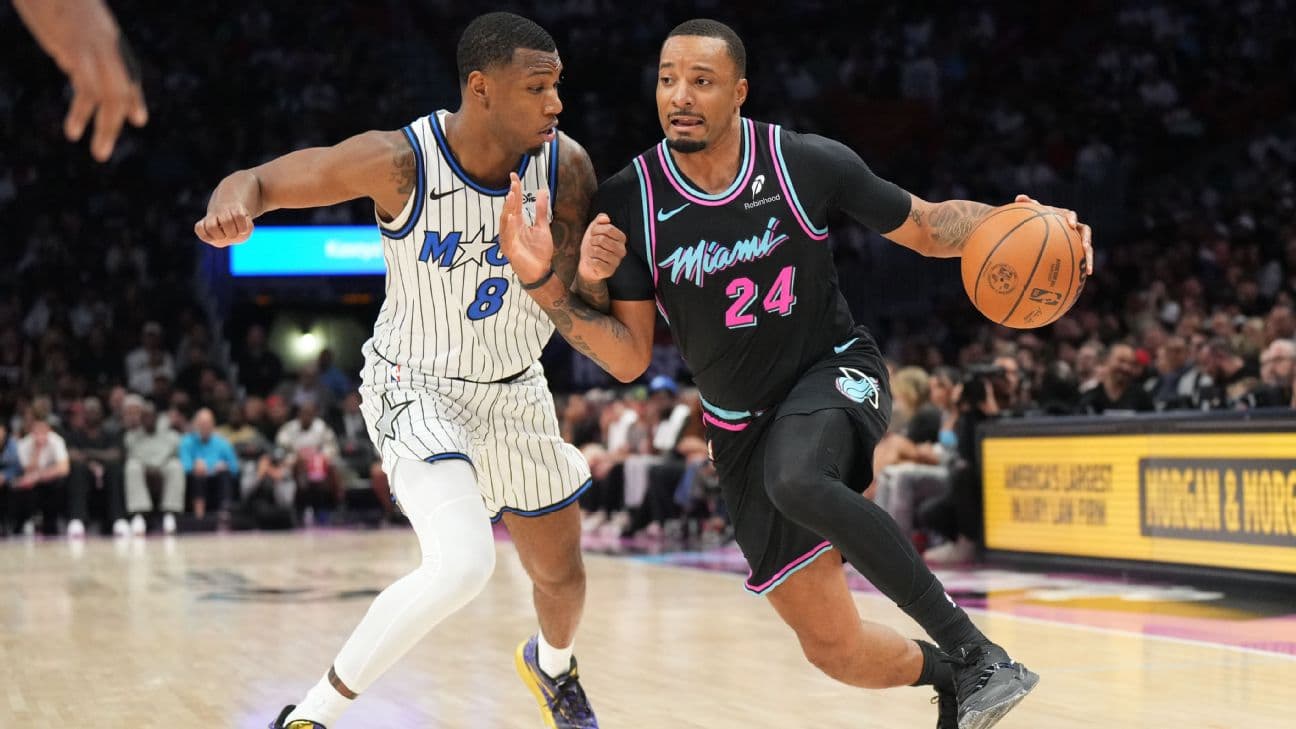
Norman Powell's move to the Chicago Bulls became official on July 6 once the NBA's free-agency moratorium lifted, finalizing a two-year deal reported at $45 million with a team option. Powell arrives in Chicago coming off the best season of his career, one in which he made his first All-Star team as a high-volume scorer for the Miami Heat. The fantasy question is not whether he can score, it is whether a crowded Chicago backcourt will give him the touches to keep doing it at the level that made him an All-Star.
The move also reverberates in Miami. Having already lost Tyler Herro in the trade that reshaped the offseason, the Heat now lose Powell too, stripping away two perimeter scorers and leaving a real creation void around Bam Adebayo.
The Chicago fit and the volume problem
Powell steps into a Bulls backcourt that already features an established playmaker, a rising young wing, and a high 2026 draft pick, a group that needs the ball. In Miami last season, Powell thrived as a primary scoring option who could carry stretches of offense, averaging north of 21 points on efficient shooting. That role produced his career year and his fantasy relevance, and it is precisely the role that is not guaranteed in Chicago.
The fantasy concern is shot volume. Powell's value is scoring-heavy and reliant on threes and efficient two-point buckets, with modest contributions in the peripheral categories. When a high-usage scorer moves into a deeper rotation, the first thing to regress is attempts, and with it the counting-stat production that fantasy managers draft him for. If Chicago's touches are spread across several ball-dominant options, Powell's per-game scoring could dip from his All-Star level even if his efficiency holds.
What Miami's void means
On the other side, Miami's offseason has quietly turned into a subtraction story. Losing Herro and Powell in the same summer removes the Heat's two most reliable perimeter scorers and spacing threats, leaving Adebayo as the clear focal point but without the shot creation around him that a modern offense needs. For fantasy purposes, that reshuffle is a double signal: Adebayo's usage should climb, and whoever Miami adds to fill the void inherits an opportunity worth tracking.
Adebayo becomes the obvious fantasy beneficiary. A bump in usage for an already-productive big who fills multiple categories raises his ceiling, and a Miami offense that runs through him more often is good for his scoring and assist numbers. The flip side is a Heat team that may struggle to space the floor, which can cap efficiency, but from a pure fantasy-volume standpoint, Adebayo's outlook improves.
The Verdexed model take
Verdexed's model views Powell as a talented scorer whose fantasy value just got harder to project, not because his ability changed but because his environment did. The model's read is that Powell's All-Star scoring season sets an unrealistic anchor for his Chicago projection, and managers should expect a step back in volume that pulls his per-game production toward a solid-but-unspectacular level rather than the elite scoring he provided in Miami.
On Miami's side, the model likes Adebayo as a buy. A returning cornerstone whose usage should rise on a team stripped of other scorers is exactly the profile that outperforms a draft slot set before the roster churn. The model also flags whichever perimeter piece Miami adds next as a potential value, since opportunity around Adebayo is now concentrated and available.
Fantasy fallout
The practical advice is to temper expectations on Powell. Draft him as a scoring specialist whose ceiling depends on carving out volume in a busy backcourt, and treat his All-Star season as the top of his range rather than his baseline. He remains useful in points leagues, where scoring efficiency travels, and less appealing in category formats that reward the peripheral stats he does not provide in bulk.
Adebayo is the clearer fantasy move. Bump him up your board to reflect the added usage, and monitor Miami's remaining roster construction, because a thin supporting cast tends to funnel touches to the team's best player. In Chicago, the backcourt logjam makes the whole group harder to trust on any given night, which is a caution for the Bulls' other guards as much as for Powell.
Betting angle
The two franchises move in opposite directions on the futures board. Chicago adds a proven scorer, but into a roster whose win total will hinge on whether its young pieces take a step forward, so Powell's arrival is a talent boost that does not by itself reshape the Bulls' season number. Miami is the more interesting market case: a team that has subtracted two perimeter scorers in one offseason and now leans heavily on its frontcourt star should see its win total drift down until it addresses the void, which is a spot bettors should watch closely as the roster fills out.
Powell's own scoring props are the player-level angle. If the market sets his number on his All-Star scoring season, the crowded backcourt makes the under worth considering, since his volume is the piece most likely to regress in a deeper rotation.
What is next
The swing factor is Chicago's rotation. If the Bulls hand Powell a featured scoring role, his fantasy value holds closer to last season's level; if he becomes one option among several, his volume and production slip. Watch the preseason usage patterns and how the coaching staff distributes the backcourt minutes. For Miami, the watch is on the next move to replace the scoring it lost, and until that arrives, Adebayo is the safe bet to absorb the offense. The Powell signing is a good real-life fit for a Bulls team adding a proven scorer, but for fantasy managers it is a value that comes with a volume asterisk.