Mike McDaniel Is Rebuilding Justin Herbert's Footwork in Los Angeles
By Verdexed NFL Desk
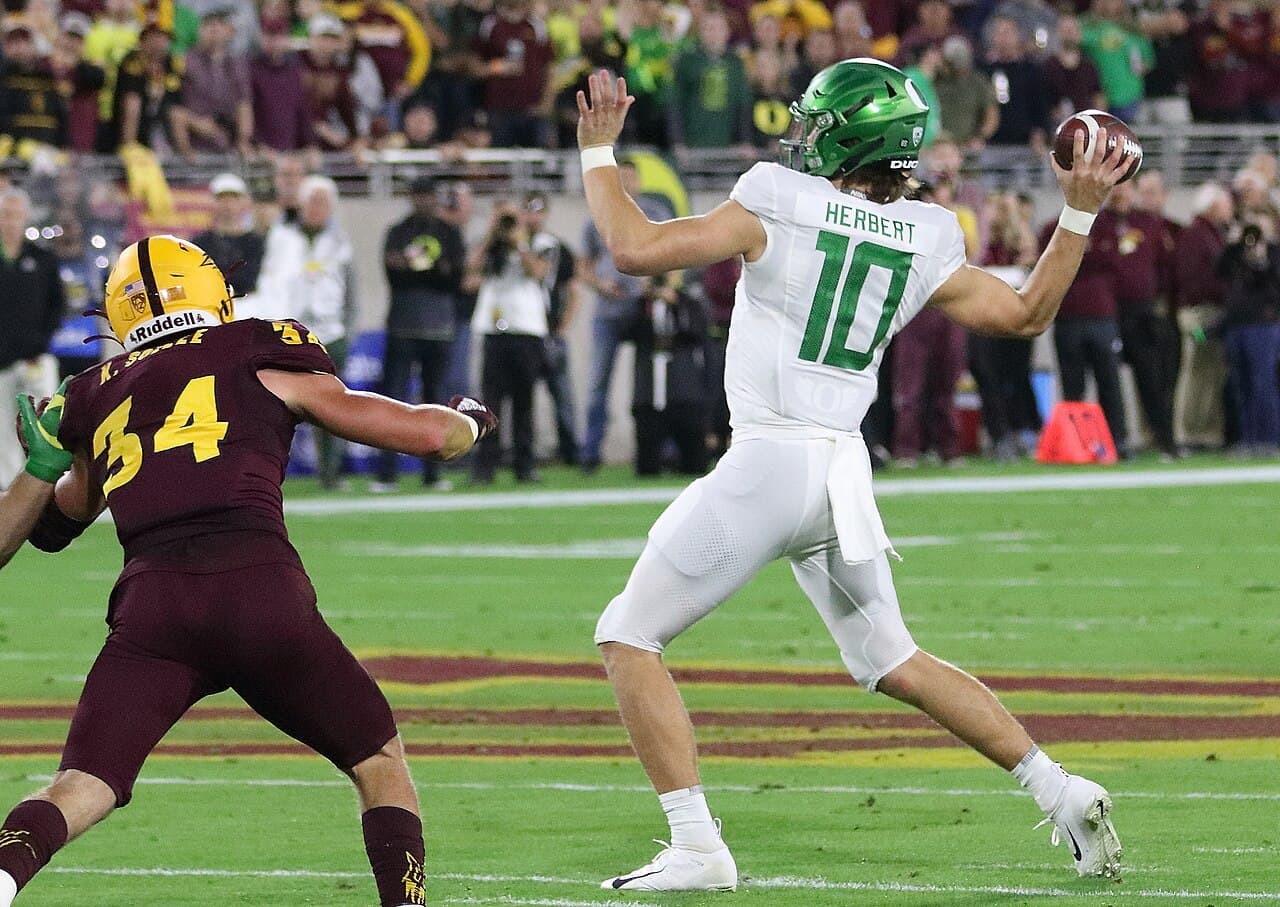
Jim Harbaugh hired Mike McDaniel as the Chargers' offensive coordinator this offseason, and the first visible change of camp is not a play call. It is Justin Herbert's stance. Los Angeles has Herbert aligning with his left foot forward in the shotgun, a mechanical adjustment designed to shorten the time between snap and release.
McDaniel, fired as Miami's head coach, arrives with the most distinctive offensive system of the last five years: heavy pre-snap motion, outside-zone run concepts that stress defensive pursuit, and a passing game engineered to turn short completions into long gains through spacing and speed. He has been direct in public about the goal, framing it as Herbert playing the best football of his career and owning the position in a way he has not before.
Why the footwork matters
The mechanical change is the tell for the whole system. Herbert has spent his career as one of the most physically gifted throwers in the league while operating in offenses that asked him to hold the ball. A left-foot-forward shotgun stance is the setup for a quicker release from a stationary base, which is the foundation of a timing offense.
That in turn changes what the receiving corps is asked to do. McDaniel's passing game does not ask receivers to win contested downfield battles as often as it asks them to catch the ball at or near the line of scrimmage with a defender in trail position. The yards come after the catch. That is a different skill profile than the one the Chargers have been optimizing for.
Fantasy fallout: the receivers
Ladd McConkey is the most obvious beneficiary. A separator who works the middle of the field and creates after the catch is precisely the archetype McDaniel's system has historically fed, and the quick-game emphasis raises target volume for the player operating closest to the line. McConkey's projection moves up in this offense, and his floor moves up more than his ceiling does.
The downstream effect on Herbert is more nuanced. Quick-game offenses tend to suppress yards per attempt while raising completion percentage and attempt volume. For fantasy purposes that is roughly neutral in points but meaningfully better in consistency. Herbert has been a frustrating fantasy quarterback in part because his production came in bursts. This system should smooth it.
Fantasy fallout: the backfield
Omarion Hampton is the player whose range widens most. His rookie year was derailed by an ankle injury in Week 5 and he was not close to full health when he returned, which means the market is pricing a damaged sample rather than the player.
McDaniel's run game is the best-documented running back accelerator in the league. Outside zone with heavy motion creates defined creases and punishes over-pursuit, and it has repeatedly produced efficient rushing seasons from backs whose draft capital did not suggest it. Hampton has the draft capital and the athletic profile. The historical base rate is on his side as well: backs taken inside the top 25 of the draft have a strong record of breaking out in year two even after disappointing rookie seasons.
The Verdexed model take
The model raises Los Angeles's projected offensive efficiency more than its projected point total, which is the signature of a scheme change rather than a talent change. Efficiency gains in a quick-game system show up as sustained drives, higher third-down conversion rates, and fewer three-and-outs, all of which raise the floor of every skill player without necessarily raising the ceiling of any one of them.
Hampton is the exception. The model's rushing projection for him carries the widest confidence interval of any Chargers skill player, with the upper band reaching low-end RB1 territory. That is the position to take: Hampton is the value, McConkey is the safety, Herbert is the streaming quarterback who should stop being a headache.
Betting angle
The Chargers' team total in low-pace matchups is where a McDaniel offense tends to beat the market, because a quick-game system sustains drives against defenses built to defend explosives. Conversely, the over on Chargers game totals in expected shootouts is less attractive than the roster suggests, because sustained drives eat clock.
Herbert's passing yardage props are the market inefficiency worth tracking. Books will price him off career averages built in a different system. A higher-attempt, lower-yards-per-attempt profile can land in the same place, but the distribution is different, and the week-to-week variance should compress.
What to do in your league
Draft Hampton ahead of his current cost and be aggressive about it. The combination of second-year rebound base rates, a healthy offseason, and the most run-back-friendly scheme change of the offseason is the kind of stacking that produces league winners.
Take McConkey at cost, not above it. Take Herbert late as your only quarterback if you are punting the position, because the consistency gain is real and the price is not. And watch the joint practices in mid-August for one specific thing: how often Los Angeles uses pre-snap motion. If that number is where McDaniel's Miami offenses lived, the scheme is fully installed and every projection above should be treated as conservative.
The Harbaugh tension
The one thing that could blunt all of this is philosophical. Harbaugh's teams have been built on a specific identity: run the ball, control the clock, win the field-position battle, and let the defense decide games. McDaniel's Miami offenses were built on tempo, motion, and manufactured explosives.
Those two ideas are not incompatible, but they compete for snaps. A Harbaugh offense that runs the ball 30 times a game caps the number of dropbacks available for the quick-game passing attack. The most likely resolution is a hybrid: McDaniel's concepts inside Harbaugh's game-management philosophy, which is very good for the running back and merely fine for the quarterback.
For fantasy purposes that hybrid is the base case, and it is why Hampton grades out as the better investment than Herbert or the receiving corps. Every version of this offense runs the ball. Only some versions throw it 35 times a game.
What's next
The Chargers' joint practices are the checkpoint. Motion rate and personnel groupings in those sessions will reveal how much of the Miami system actually made the trip, and whether the run game is running McDaniel's outside zone or Harbaugh's gap concepts. That distinction decides how much of Hampton's upside is real.