Sam Darnold Is on His Seventh Play Caller in Six Years, and the Seahawks Barely Changed the Playbook
By Verdexed NFL Desk
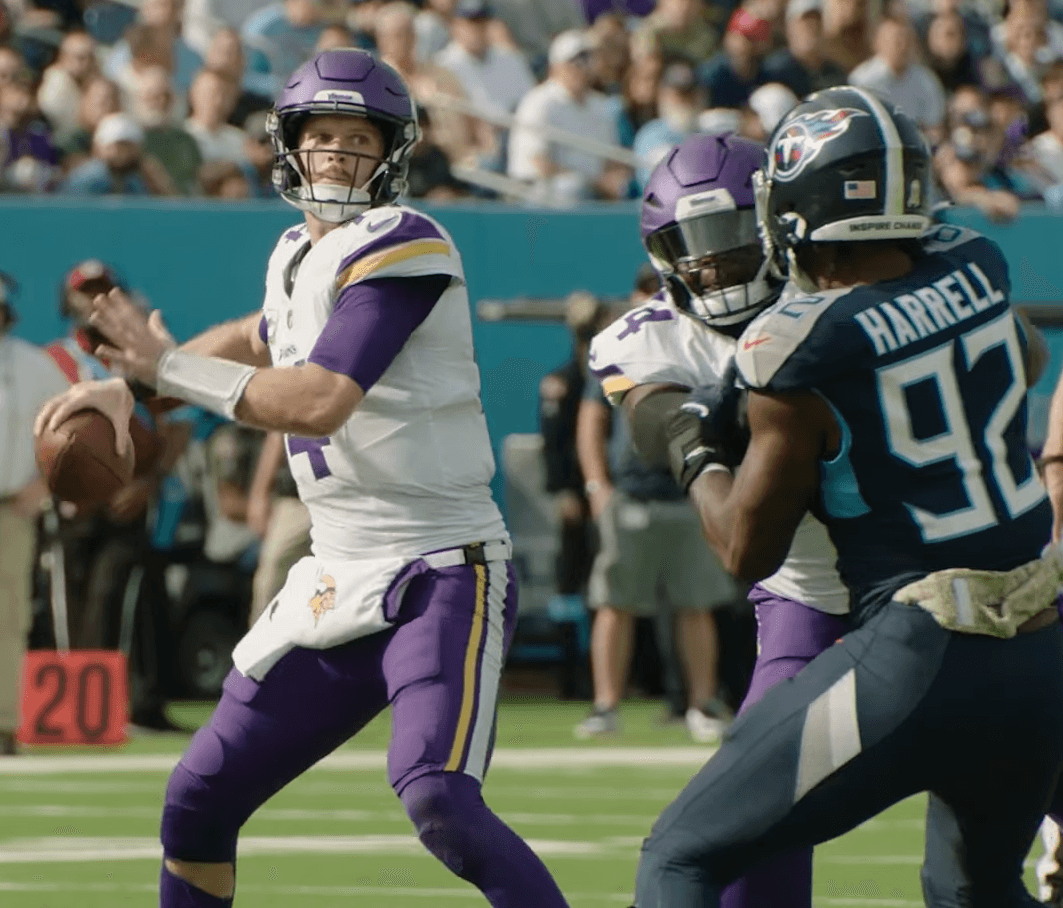
Sam Darnold will play for his seventh offensive coordinator in six seasons in 2026. That is the kind of statistic that normally reads as a warning label, and it is showing up in his falling fantasy draft price. In this case the statistic is misleading, and the reason is that Seattle replaced one Shanahan disciple with another.
Klint Kubiak left Seattle to take the head coaching job with the Las Vegas Raiders. The Seahawks hired Brian Fleury, who spent the past seven seasons as an assistant with the San Francisco 49ers under Kyle Shanahan, to replace him. Darnold has said publicly that the transition has been minimal and that he is not starting from scratch. That framing is consistent with what Seattle has described: a version of the same scheme with a different voice calling it.
Why continuity of scheme beats continuity of coordinator
Fantasy analysis has long treated coordinator turnover as a uniform negative, and for good reason. New systems mean new terminology, new route trees, new protection rules, and a September of a quarterback thinking instead of playing. The evidence for that effect is real.
The effect is much weaker when the incoming coordinator runs the same offense. Shanahan-tree offenses share a common language: outside zone as the run foundation, play-action off that action, defined progressions that reduce the quarterback's decision load, and heavy use of pre-snap motion to diagnose coverage. A quarterback moving from Kubiak's version to Fleury's version is learning a dialect, not a language.
That distinction is the entire argument for why Darnold's market slide is an overcorrection. The market is pricing coordinator turnover. What actually happened is coordinator substitution within a system.
The Darnold question underneath it
The larger question is what Darnold actually is, and 2026 arrives with the least ambiguous answer of his career: he is the starting quarterback of the defending Super Bowl champion.
That resume line does more to explain his fantasy price than the coordinator news does. Quarterbacks who win championships get drafted higher than their statistical profile supports, and quarterbacks whose situations look uncertain get drafted lower. Darnold is currently experiencing both forces at once, which is part of why his ADP has been volatile.
The honest statistical read is that Darnold in a Shanahan-tree offense has produced at a level well above his career baseline, and that the system explanation for that improvement is at least as strong as the player-development explanation. Which of those two is true matters enormously for 2027 and matters very little for 2026, because in 2026 he is still in the system.
Fantasy fallout
Darnold should be drafted as a mid-to-late QB1 in single-quarterback leagues, which is roughly where he was before the coordinator news started moving his price. If he has slipped below that tier in your league's drafts, he is a value, and he is the specific kind of value that streaming-oriented managers should want: a quarterback with a stable system, a good roster, and a price that reflects perceived instability rather than actual instability.
The downstream effects on Seattle's skill players are more important than the effect on Darnold himself. Shanahan-tree offenses produce a predictable shape: a running back with a high touch volume and receiving usage, a primary receiver with a heavy target share concentrated on intermediate routes, and a tight end whose value depends on the specific coordinator's tendencies. Fleury's version should preserve most of that structure.
The one place to be cautious is the tight end and secondary-receiver usage, because that is where coordinators within a system differ most. Kubiak and Fleury may have different preferences on how much 12 personnel they run, and that is the variable that decides whether Seattle's second tight end and third receiver have any fantasy relevance at all. Preseason Weeks 2 and 3 will show it in personnel groupings.
Betting angle
Seattle's win total and NFC price reflect a defending champion, which means they carry the usual champion's tax. Markets price recent success heavily, and the historical record of Super Bowl winners repeating as top-tier regular-season teams is worse than the market typically assumes, largely because of roster attrition and schedule strength.
Against that, the coordinator change is a smaller factor than a public bettor reading headlines would assume, which cuts the other way. A market that has discounted Seattle for the Kubiak departure has probably overdone it, and a market that has not discounted them at all is pricing the champion's tax correctly.
The most direct expression is Darnold's season-long passing props. A quarterback whose situation looks less stable than it is tends to have his passing yardage and touchdown numbers set conservatively, and the scheme continuity argues that his production baseline should hold.
The Verdexed model take
Verdexed's model applies a scheme-continuity adjustment separate from its coordinator-change adjustment, and the two work in opposite directions here. Seattle gets a small penalty for turnover and a substantially larger credit for retaining the offensive system, netting out to roughly neutral.
Neutral is the important word. The model does not see Seattle's offense as improved by this change, and it does not see it as damaged. It sees an offense that should produce approximately what it produced last season, with the usual variance from personnel and health, and it prices the skill players accordingly.
The actionable output is that every Seattle offensive player whose ADP has fallen since the coordinator news is a buy at the discount, and none of them should have their ceiling revised. That is a narrow, unglamorous conclusion, and it is the kind of edge that August drafting is actually made of.
What's next
Watch personnel groupings in Seattle's next two preseason games. Specifically, the snap rate of the second tight end and the deployment of the primary receiver from the slot versus the boundary. Those two data points will tell you whether Fleury's version of the offense differs from Kubiak's in any way that matters to a fantasy lineup.
Everything else, including the seventh-coordinator narrative, is noise that the market has already priced. The edge is on the other side of it.