 NFL2026-07-06
Mike McDaniel Takes Over the Chargers Offense: What His Arrival Means for Justin Herbert and the Fantasy Board
By Verdexed NFL Desk
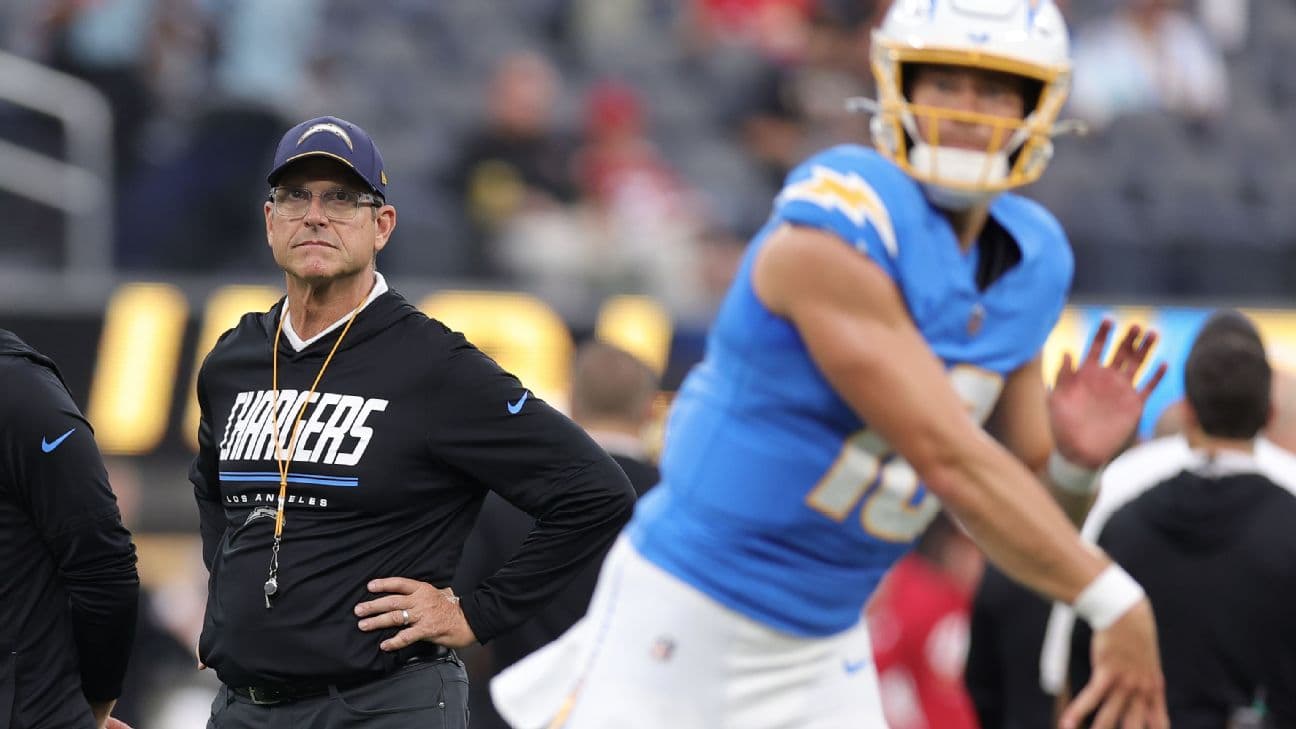
One of the most consequential coordinator hires of the 2026 offseason gets its first real test when the Chargers open training camp. Los Angeles brought in former Dolphins head coach Mike McDaniel to run the offense under Jim Harbaugh, replacing Greg Roman after a wild-card exit. The pairing marries Harbaugh's identity with McDaniel's motion-based, yards-after-catch scheme, and the fantasy implications run through the entire Chargers depth chart.
For fantasy managers setting draft boards in July, a scheme change of this magnitude is exactly the kind of signal that should move players up and down before ADP fully catches up.
The scheme fit
McDaniel built his reputation on an offense defined by pre-snap motion, manufactured touches, and a relentless focus on getting playmakers the ball in space. In Miami he coordinated a system that produced elite passing efficiency and turned speed into explosive plays, and he spent formative years in the San Francisco outside-zone and motion tree. The lure of returning to California and coaching a quarterback of Justin Herbert's caliber is what drew him to the job, and Harbaugh gets a designer who can modernize a Chargers attack that had grown predictable.
The headline is what this does for Herbert. A quarterback with Herbert's arm and mobility slotting into a scheme designed to create easy throws, layered crossers, and yards after the catch is a fantasy profile worth buying. McDaniel's offenses reduce a passer's degree of difficulty while raising his ceiling, and Herbert has the physical tools to push that ceiling higher than most of the quarterbacks McDaniel has coached.
The pass-catcher fallout
The receiver who stands to gain most is the one who wins in space. A separator and route technician profiles perfectly as the McDaniel offense's high-volume target, the role that turns quick game and motion concepts into a steady PPR floor with spike weeks built in. Ladd McConkey is the archetype for that usage in Los Angeles, and his fantasy stock deserves a bump in a scheme tailored to manufactured touches and YAC.
The outside receivers benefit from the vertical shots McDaniel's motion creates, which can lift a big-bodied perimeter target's touchdown equity even if his target share holds steady. The tight end and slot roles matter too, because McDaniel historically schemes easy completions underneath. Managers should track how Herbert's targets distribute in camp, but the structural read is clear: this offense creates more efficient, higher-value looks than the one it replaced.
The backfield question
McDaniel's system is famous for its running-back value, built on wide-zone runs and a role for a change-of-pace back who can turn a crease into a home run. Los Angeles leaned into that this offseason, adding ex-Ravens speedster Keaton Mitchell on a two-year deal to complement its lead back. Mitchell's skill set, explosive burst and receiving juice, mirrors the lightning-in-space archetype McDaniel has featured before, which makes him a late-round dart worth a look even behind an established starter.
The lead back is the bigger prize. A wide-zone scheme with a designer like McDaniel tends to inflate a workhorse's rushing efficiency and goal-line volume, and a three-down back in this system carries real RB1 upside. The camp storyline to watch is how the touches split, because McDaniel offenses have historically supported one high-value early-down back plus a specialized change-of-pace piece rather than a pure timeshare.
The Verdexed model take
The Verdexed model treats a McDaniel arrival as a positive efficiency shift for the entire Chargers passing game, and it nudges Herbert's projection upward on the strength of scheme-driven completion rate and explosive-play equity. The model is most confident on the primary slot and underneath target, whose manufactured volume it views as the stickiest fantasy outcome in this offense.
On the team side, the model likes the direction of the Chargers' scoring environment, which flows into a modest lift on their win total and their game totals relative to a Roman-era baseline. The one caution the model flags is backfield ambiguity: McDaniel systems create value but do not always concentrate it, so the lead back is a buy while the committee risk keeps the model from fully endorsing every name in the room.
The Harbaugh factor
One wrinkle separates this offense from McDaniel's Miami tenure: the head coach. Jim Harbaugh's teams have leaned on a physical, run-oriented identity, and the marriage of that philosophy with McDaniel's finesse passing concepts is the central question of the Chargers' 2026 offense. The optimistic read is a balanced attack that runs to set up McDaniel's play-action and motion shots, a script that supports both the backfield and the passing game. The pessimistic read is a philosophical tug-of-war that mutes the ceiling of both.
For fantasy managers, the balance point matters. A run-heavy tilt boosts the lead back's volume while capping the passing game's raw totals, whereas a pass-leaning script does the reverse. The camp reporting to watch is how run-pass responsibilities settle, because it determines which Chargers skill players hit their ceiling.
What to do in your league
Draft Herbert as a value if he slides on name recognition rather than scheme, because this is a genuine quarterback-friendly system. Push the primary Chargers pass-catcher up your board as a floor-plus-ceiling PPR asset, take a late shot on Keaton Mitchell as a McDaniel-style spark, and prioritize the lead back as the backfield's high-upside piece while monitoring the camp split. Scheme changes are one of the few offseason signals that reliably beat stale ADP, and McDaniel landing in Los Angeles is one of the loudest of 2026.