Week 2 DFS: The 49ers Own the Slate's Top Implied Total and Carson Wentz Is the Value
By Verdexed Analytics
The Week 2 main slate is defined by one number and one game. San Francisco carries the highest implied team total on the board as a 12.5-point home favorite over Miami, and Vikings at Bears is the game environment that everything else on the slate has to be measured against. Baltimore, Dallas and Chicago all sit above 25 points in implied team total. Everything else is a step down.
That shape creates a specific kind of slate. When one team is projected to score far more than the rest of the field, the chalk is obvious and expensive, and the edge moves to whoever finds the second-best environment at a discount. This week that discount lives in Chicago.
The top of the board
The 49ers are the highest-owned game stack on the slate and they deserve to be. A near-two-touchdown favorite with a leaky opponent is the textbook profile for a team that scores four touchdowns and hands the ball off 30 times, and the Christian McCaffrey placement on injured reserve has created a rookie lead back in that environment at a price that will not reflect the workload.
The complication with a 12.5-point favorite is that the blowout script cuts both ways. San Francisco scoring 34 points is compatible with its quarterback throwing for 190 yards, because the second half turns into clock management. That makes the running backs the highest-confidence exposure and the passing game the higher-variance one.
Baltimore hosting New Orleans is the second-cleanest favorite spot. The Ravens are roughly a touchdown favorite and their implied total sits above 25, and the Saints just allowed a defensive profile that Tyler Shough exploited for 410 yards in the other direction. This is the spot for Baltimore's skill players at reasonable ownership, because the 49ers game absorbs so much attention.
Dallas at Washington rounds out the group above 25. Both offenses project well and the game has the shape of one that stays competitive, which is the underrated ingredient in DFS: a competitive game produces more total plays than a blowout with the same final margin.
Vikings at Bears is the slate's best environment
Chicago is favored by roughly 5.5 with the total near 48.5, and the Bears arrive at that number because of what they did in Week 1: a 59-point output in a game that also surrendered 37. That is 96 combined points, and markets remember.
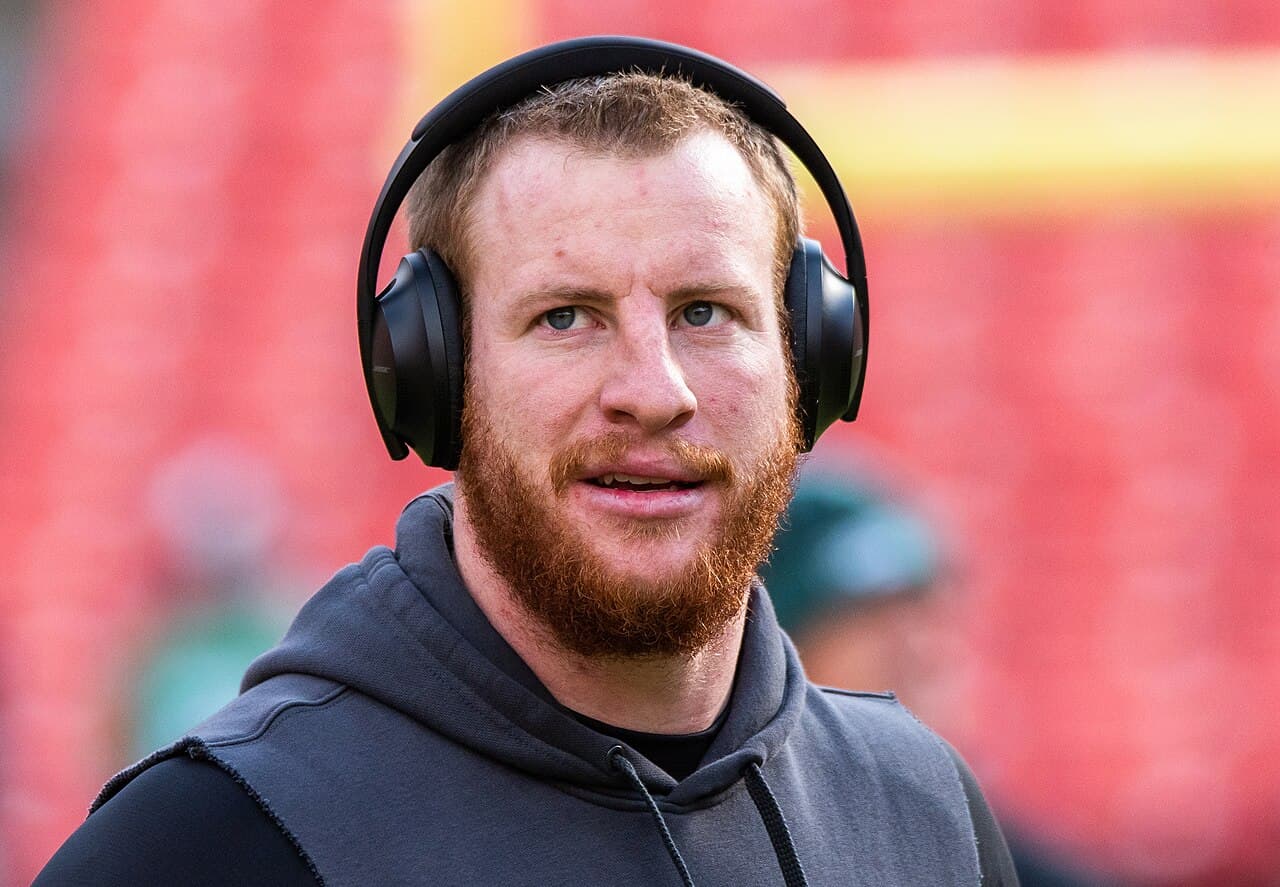
Carson Wentz is the most attractive value at quarterback on the slate by a meaningful margin. He threw three touchdowns in relief of Kyler Murray in Minnesota's 39-22 Week 1 win, and he is preparing to start in Chicago with Murray still working through the concussion protocol after a limited Wednesday practice. His salary reflects a backup quarterback. His projection reflects a starter in a high-total game against a defense that gave up 37 points a week ago.
The leverage in playing Wentz is not just the price. It is that his ownership will be suppressed by uncertainty. Every hour that the Murray question stays unresolved is an hour that recreational players avoid the Minnesota quarterback slot entirely, which is exactly the dynamic that creates a low-owned, high-projection play.
Cheap pieces worth rostering
Colston Loveland is the Bears piece that makes the math work. Chicago's tight end was priced in the low-to-mid range on DraftKings for this slate and sits in an offense whose head coach has been explicit about wanting to score as many points as possible. Tight end remains the position where a mid-priced hit changes a lineup's ceiling most dramatically, because the replacement level at the position is so low.
Elic Ayomanor is the minimum-salary dart. The Titans rookie receiver is priced near the bottom of the wide receiver pool, and minimum-salary receivers with a real route share are the mechanism by which a lineup affords two of the expensive pieces at the top. The projection is volatile. The price is what makes it worth it.
Michael Mayer is the contingent cheap play. If Brock Bowers is ruled out after missing Wednesday's practice, Mayer steps back into the Raiders TE1 role he held in Week 1, when he led the team in target share. Las Vegas at the Chargers carries a total near 43.5, which caps the ceiling, but a target-share tight end at a low price in a game that will likely be decided in the red zone is a legitimate cash-game consideration.
The Verdexed model take
The model's core read on this slate is that the correlation between the top implied total and the top raw projections is unusually tight, which means the field will converge on the same lineups. When that happens, the tournament edge is not in identifying the best play. It is in identifying the second-best play that nobody is on.
Concretely: the 49ers game is the best environment and will be the most owned. Vikings at Bears is the second-best environment and will be meaningfully less owned because of the quarterback uncertainty. Roster the Chicago and Minnesota pieces at a higher rate than the raw projections suggest, specifically because the uncertainty is the source of the discount.
For cash games, the priority order is different. Cash lineups should prioritize the 49ers backfield and the Baltimore skill players, because the point of cash is to hit a floor, and a favorite's running back with a four-game injury window in front of him has the most reliable floor on the slate.
Stacks to consider
The Minnesota passing game stacked back to a Bears receiver is the highest-leverage correlation play available. Both sides of that game project to score, both are discounted relative to the 49ers game, and a shootout outcome is the single most likely path to a winning tournament score.
The San Francisco game stack is harder to build profitably because Miami is not projected to keep pace, which is the condition a bring-back needs. A one-sided blowout stack is a lower-ceiling construction than most people assume.
Baltimore stacked with a Saints pass catcher is the sneaky third option. New Orleans threw 56 times in Week 1. A team that throws 56 times as a seven-point underdog against a good defense is a team that will throw a lot again.
What to watch before lock
Three reports decide meaningful salary this week. The Murray designation in Minnesota determines whether the Wentz play exists at all. The Bowers designation in Las Vegas determines whether Mayer is a value or a fade. And the Denver report on RJ Harvey, who did not practice Wednesday, determines whether JK Dobbins is a chalk play or just a good one.
All three resolve Friday. Build two versions of your lineup now and swap the pieces when the designations land, rather than waiting until Sunday morning to start from scratch.