 NFL2026-09-12
Week 1 DFS: The Cheapest Tight Ends on the Main Slate Are the Whole Board
By Verdexed Analytics
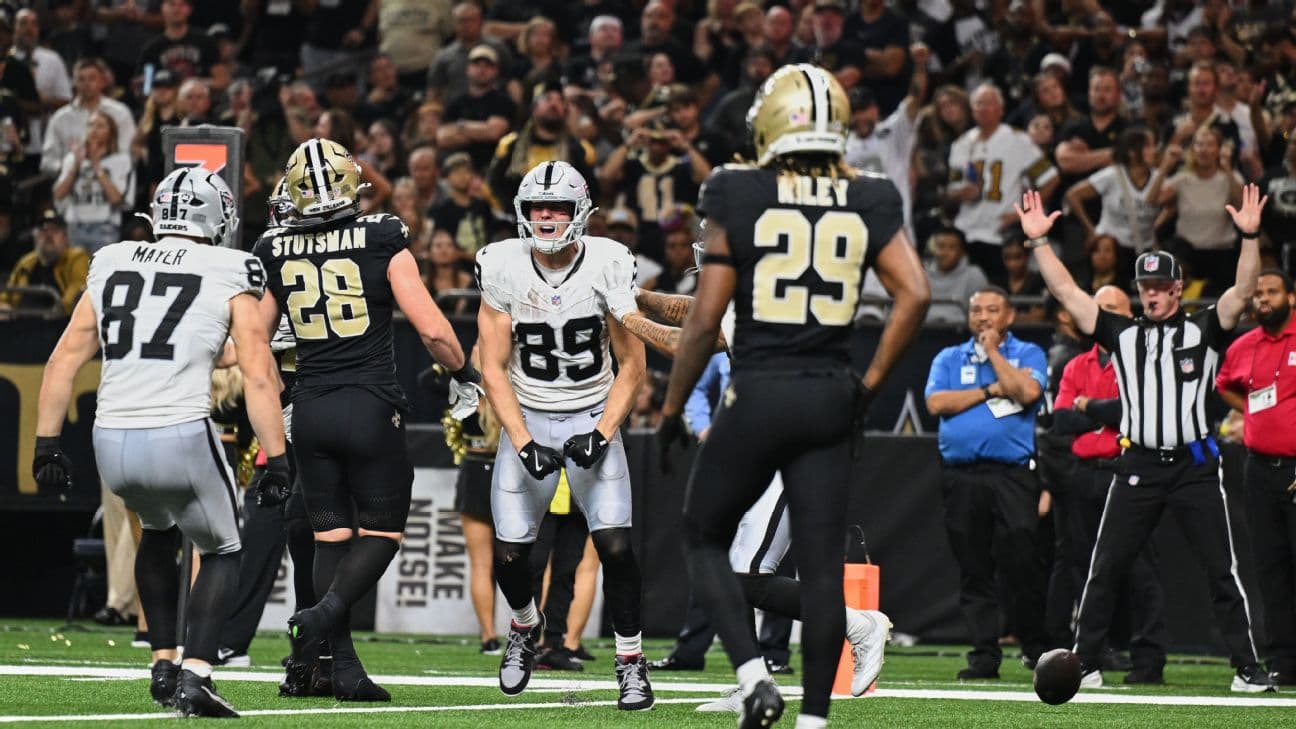
The Week 1 main slate has an unusual structural feature: the two best value plays on the board are tight ends priced near the bottom of the position, both of them created by injuries that happened in the last week. How a lineup uses that salary relief determines almost everything else about the build.
Brock Bowers underwent a meniscus procedure and is out, which pushes Michael Mayer into the Las Vegas starting role at a minimum price against a Miami defense that was one of the league's worst against tight ends last season. In New Orleans, a passing game that projects to throw often against Detroit has a tight end priced in the same range with one of the highest projected values at the position. Neither play requires a leap of faith. Both require only that the projected volume shows up.
Why cheap tight ends matter more than cheap anything else
Tight end is the position where salary relief compounds. A minimum-priced running back usually comes with a real chance of five fantasy points. A minimum-priced tight end stepping into a starter's target share has a realistic path to double digits, because the position's scoring is target-driven and the replacement rarely splits work the way a backfield does.
Mayer is the cleanest example. In the games he played without Bowers a season ago, he saw roughly a quarter of the team's targets and averaged double-digit PPR points. That is not a projection built on hope. It is a repeat of a documented role, at a price that treats him like a punt.
The New Orleans side of it is a game-script argument. If the Saints trail Detroit, which is the most likely outcome on this slate, their pass volume rises and the targets behind the top receiver become genuinely valuable. A tight end priced under four thousand dollars in a game with that shape is the definition of a leverage play.
What the saved salary buys
Freeing three to four thousand dollars at tight end lets a lineup afford the top of the running back board without punting elsewhere. Jahmyr Gibbs carries the highest projection on the slate and correspondingly heavy ownership, which creates the standard tournament dilemma: the chalk is chalk because it is correct.
The resolution is not to fade the highest projection. It is to pay for it and find leverage somewhere the field is not looking. On this slate, that means the tight end position itself. If the field spends up at tight end on the two expensive options that have drawn heavy projected ownership, a lineup that pays down to Mayer or the New Orleans option and up at running back is differentiated on the exact axis where differentiation is cheapest.
The stacks worth building
Cincinnati's top pairing is the obvious anchor. A quarterback and his primary receiver in an offense that concentrates targets is the highest-correlation play on any slate, and Week 1 is the week correlation matters most because usage patterns have not been confirmed and the market is pricing off last season.
Tennessee's backfield is the contrarian cash play. Tony Pollard draws a New York run defense that was among the league's worst against the run last season, at a price well under six thousand dollars, in an offense that is expected to be more functional than it has been. Analysts are split on him because of the timeshare behind him, and that split is exactly why his ownership will be lower than his matchup deserves.
Jacksonville's cheap receiving options are the tournament swing. Two pass catchers priced under six thousand dollars in a game the Jaguars are favored in by more than a touchdown gives a lineup a way to get exposure to a likely winning offense without paying for its most obvious piece.
The Verdexed model take
Verdexed's projection engine flags the same structural inefficiency the pricing does. Week 1 salaries are built primarily from prior-season production and offseason expectation, which means they lag any change that happened in the last ten days. The two tight end injuries qualify. So does every depth chart change that was finalized after cutdown day.
The model's guidance for this slate has three parts.
First, pay down at tight end. The projected points per dollar at the two cheap options exceeds anything else on the board by a wide margin, and there is no positional scarcity argument for spending up when the replacement-level starter is available at a punt price.
Second, do not fade the top projection at running back. The model agrees with the field that the highest-projected back is correctly the highest-projected back. Tournament leverage on a Week 1 slate is better found at tight end and in the cheap receiver range than in fading the most likely outcome.
Third, weight game script heavily in single-entry formats. Week 1 has an unusually tight board, with the majority of spreads sitting inside a field goal, which means blowout-dependent plays are less reliable than usual. Volume-based plays in games projected to be close outrank efficiency-based plays in games projected to be lopsided.
Ownership and leverage
The projected chalk on this slate concentrates in two places: the top running back option, and the two premium tight ends. That is a fortunate distribution for anyone building tournaments, because it means the cheap tight end path is simultaneously the value path and the leverage path. Those two things rarely align.
The other leverage point is the Tennessee game. A backfield facing a bottom-tier run defense at a mid-range price with divided public opinion is the single largest gap between projection and expected ownership on the board.
What to do
For cash games, the build is straightforward: pay for the top of the running back board, punt tight end into a confirmed starting role, and fill the middle with pass catchers in games projected to be competitive.
For tournaments, take the same core and add one contrarian piece from a game the field is ignoring. The temptation in Week 1 is to get clever with an entire lineup. The better approach is to be right about the structural edges, which on this slate are clear, and take one calculated swing rather than five.
One final note that matters in Week 1 specifically: late inactive reports move this slate more than any other week of the season. Several relevant players carry questionable tags into Sunday, and the salary structure means a single late scratch can hand a minimum-priced player a full workload. Build lineups that can absorb a swap, and check inactives before lock.