Travis Hunter Is the Talk of Jaguars Camp: The Fantasy Read on a Two-Way Star
By Verdexed NFL Desk
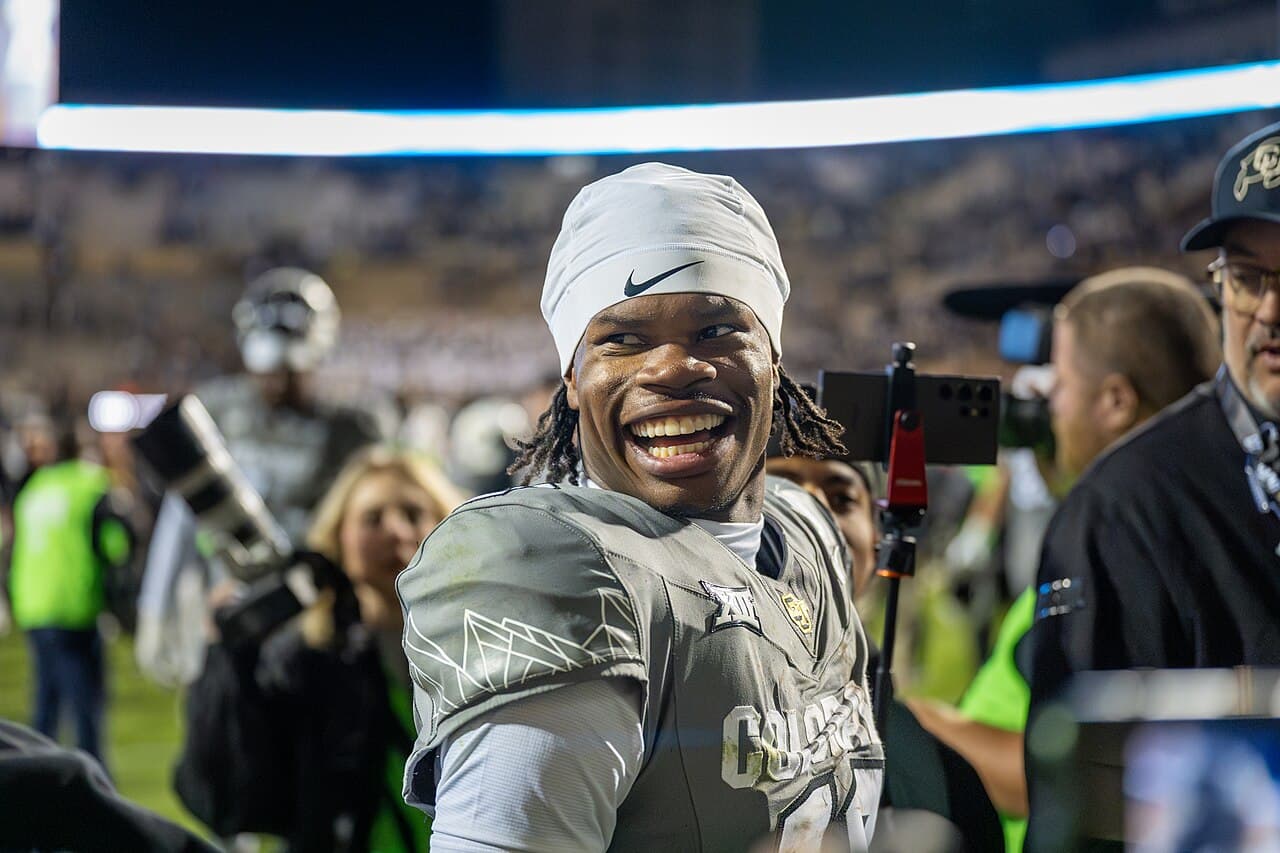
Travis Hunter was the story of Jacksonville's Sunday practice, jumping a crossing route for an interception on a Trevor Lawrence throw and flashing on offense in the same session. For a player whose entire fantasy case rests on how much time he actually spends at wide receiver, a highlight on defense is a complicated kind of good news.
Hunter reported to camp having added roughly ten pounds of muscle over the offseason, per reporting out of Jacksonville, a direct response to a rookie year that ended early. He caught 28 passes on 45 targets for 298 yards and a touchdown across seven games in 2025, added 11 tackles and three passes defensed on defense, and then had surgery on an LCL injury in his right knee that put him on injured reserve. The snap ledger from that abbreviated season is the most useful thing fantasy managers have: 324 offensive snaps, 162 defensive snaps, three on special teams.
What the snap split actually says
That 2-to-1 offensive tilt is the number to anchor to, and it is worth remembering it came in a season where the Jaguars were still figuring out what they had. Early camp indications this summer point the other way. Hunter currently profiles as Jacksonville's top outside cornerback, a role the team has real incentive to lean into, and the receiver room in front of him is deeper than it was a year ago.
Brian Thomas Jr. remains the alpha and the gravity that opens everything else. Jakobi Meyers occupies the high-volume intermediate role. Parker Washington has carved out a real job. That is three established pass catchers before Hunter's name comes up, plus a tight end room and a backfield that soaks up targets. There is no scenario where Hunter leads this team in routes run unless someone in front of him gets hurt.
The optimistic read is that the defensive workload does not have to come at the expense of the offensive one. Coaches have talked all offseason about managing his total load rather than choosing a side, and a player who can handle 60 plays a game is a different asset than one capped at 40. The pessimistic read is that a team with a top-flight corner on a rookie contract will always find a reason to keep him on defense, especially in a division with Cincinnati-caliber passing attacks on the schedule.
Fantasy fallout
Hunter is a bench stash in redraft, full stop. The current market treats him as a late-round dart throw, and that is the correct price for a player whose realistic weekly range runs from three targets to nine depending on game script and how many defensive snaps he logged the series before.
The way to draft him is as your final receiver, not your fourth or fifth. Managers who reach for the name in the middle rounds are paying for a role that does not exist yet. Managers who take him after the position is otherwise solved are buying a genuinely asymmetric outcome: if Jacksonville decides in October that Hunter is its second-best offensive weapon, the player who rostered him for a bench spot has a WR2 for free.
In dynasty the calculus flips. Hunter is 23 with two-way athleticism nobody else in the league has, and the contract structure means Jacksonville controls him through his prime. Dynasty managers should be buying the uncertainty, not selling it, because the outcome that pays is the one where the Jaguars eventually stop splitting him and commit to offense.
The Verdexed model take
The model's projection for Hunter is built off a snap-share distribution rather than a point estimate, and that distribution is unusually wide. The median case lands him in the WR40 to WR50 band, which is roughly what his current draft cost implies. The 80th percentile case, where offensive snaps push past 70 percent because of an injury ahead of him or a midseason role change, puts him inside the top 24. The 20th percentile case has him functionally undraftable in 12-team leagues.
That spread is the whole argument. Most late-round receivers have narrow outcome ranges because their role is capped by talent. Hunter's is capped by usage, and usage is the one input that can change overnight.
Betting angle
Hunter's receiving yardage season prop is the cleanest way to express a view here, and the market has been slow to settle on a number precisely because nobody knows the snap plan. The lean is toward the under on any total that assumes a full-time receiver workload, and toward the over on any total priced off last year's seven-game sample.
The more interesting derivative is Brian Thomas Jr. Every defensive snap Hunter takes is a snap where Jacksonville's passing game runs through Thomas and Meyers, which supports Thomas's target-share prop more than the raw team pass volume would suggest.
What to do in your league
Draft Hunter last. Not late, last. He is the ideal final-pick swing in a redraft league because his floor costs you nothing and his ceiling is a weekly starter, and because the information that resolves his range arrives in September rather than August.
Monitor two things through the preseason: whether he takes first-team defensive reps in the Jaguars' preseason games, and whether Jacksonville's offensive coaching staff starts describing packages built specifically for him. The first tells you the defense has won the argument. The second tells you it has not. Everything else in camp is noise.
The precedent problem
There is no clean historical comparison for what Jacksonville is attempting, which is exactly why the projection ranges are so wide. The closest modern analogues are players who were tried on both sides of the ball for a handful of packages, not players asked to hold down starting jobs at two positions simultaneously. Every one of those experiments ended the same way: the team eventually picked a side, usually the defensive one, because defensive snaps are harder to replace than the fourth receiver's.
That precedent argues for restraint in redraft and patience in dynasty. The most likely path is that Hunter becomes a very good NFL cornerback who plays 20 to 30 offensive snaps a game in packages designed for him, which is a fascinating football player and a frustrating fantasy asset. The less likely path, and the one worth a final-round pick, is that his offensive production forces the issue.
The knee is the other variable nobody should ignore. He is roughly a year removed from LCL surgery, and the added weight was reportedly a durability play as much as a physicality one. A player carrying a two-position workload on a repaired knee is a candidate for load management the first time Jacksonville hits a soft stretch of schedule.