 NFL2026-07-27
Travis Hunter Is a Cornerback First in 2026: Jacksonville's Plan Caps His Fantasy Ceiling
By Verdexed Fantasy Desk
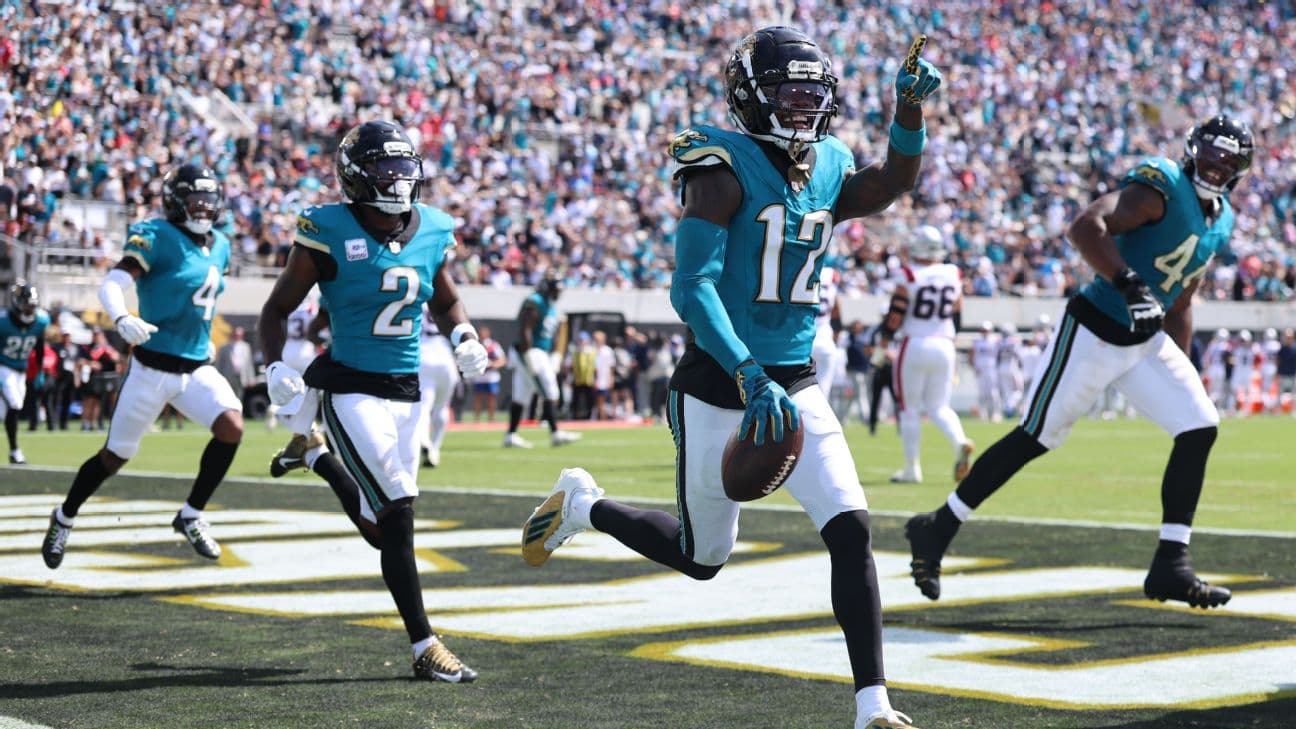
Travis Hunter is healthy, cleared for full training camp participation, and headed for a different job than the one he held as a rookie. The Jacksonville Jaguars have signaled that Hunter will play primarily at cornerback in 2026, with head coach Liam Coen maintaining that the two-way star will still be worked into the wide receiver rotation. For fantasy managers, that sentence order matters enormously. Cornerback first, receiver second, is close to the worst possible configuration for a player being drafted on offensive upside.
The health news is genuinely good. An LCL tear in October ended Hunter's rookie season after seven games, and Jacksonville's front office indicated in the spring that he would be limited through the offseason program with a target of full participation by camp. He has hit that target. What has changed is not his availability but the allocation of it.
The snap math that decides everything
As a rookie, Hunter played roughly two-thirds of his snaps on offense and about a third at cornerback. Even at that split, and even in only seven games, he became the first NFL player this century to post 200-plus receiving yards and 10-plus tackles in a single season. That is a genuinely unprecedented usage pattern, and it produced flashes of real receiving production.
Flip the ratio and the fantasy math collapses. A receiver who plays a minority of offensive snaps does not run enough routes to generate a stable target share, and target share is the single most predictive input for receiver scoring. A player can be an elite athlete, an elite route runner and an elite contested-catch winner, and still be a fantasy bench piece if he is on the field for 35 percent of the passing downs.
There is a second-order problem too. Part-time receivers are used situationally, which means their target volume is not just lower but lumpier. Two catches one week, seven the next. That variance is poison for a weekly lineup decision.
Why Jacksonville is doing it
The reasoning is defensible from a football standpoint even if it is inconvenient for fantasy. Elite cornerback play is scarcer and harder to replace than a third receiver, and Hunter's coverage tape is the reason he was a top-of-the-draft prospect. A defense that can put a true shutdown corner on an opponent's best receiver changes how the entire unit is built.
There is also a workload argument. Hunter's rookie season ended with a knee injury, and asking a player to carry a near-full snap load on both sides of the ball across 17 games is a durability bet that no team has successfully made in the modern era. Reducing his offensive volume is, in part, an availability strategy.
Coen has been consistent that Hunter will still be a receiver. The question is whether "still a receiver" means 25 snaps a game or 12.
Fantasy fallout
Hunter's redraft value is now a bet on a role that his own coaching staff has publicly downgraded. In leagues that use standard scoring positions, he belongs in the late-round dart-throw tier rather than anywhere near the top 40 receivers. The upside case exists and it is real: if Jacksonville's receiver room hits injury trouble, Hunter's offensive snaps go up immediately, and his ceiling in that scenario is a weekly starter. But drafting for that contingency at a cost above the tenth round is paying full price for a lottery ticket.
Dynasty is a different calculation entirely. Hunter is 23 years old with a genuinely unique skill set, and roles change. A new offensive coordinator, a receiver injury, or simply a season of clean health could push the split back toward offense in 2027. Dynasty managers should not be selling into the negative news cycle. If anything, the current sentiment creates a buying window on a player whose long-term offensive value has not been extinguished, only deferred.
The other side of this is that Jacksonville's other pass-catchers just got clearer. Every offensive snap Hunter does not take is a route someone else runs. Managers holding Jaguars receivers should treat the role clarification as a modest positive for target concentration.
The Verdexed model take
Our projection system builds receiver output from route participation, target rate per route and expected team pass volume. Hunter's route participation input is the variable in question, and there is no honest way to project it tightly right now, because the team has described the plan in words rather than in a depth chart. Our model handles that by widening his distribution rather than by picking a point estimate, which is exactly why he grades as a high-variance, low-median asset.
The single most valuable thing a fantasy manager can do over the next three weeks is watch how Jacksonville actually deploys him in practice periods. Beat reporting on which team periods Hunter participates in, and on whether he is taking first-team offensive reps or rotating in behind the starters, will be far more informative than any coach's public framing. Camp usage is a leading indicator. Coach-speak is not.
Betting angle
The market has been reasonably efficient here. Hunter's receiving prop numbers for the season have drifted downward as the cornerback-first reporting firmed up, which means the easy fade has already been taken. The residual value is on the defensive side, where a full-time cornerback with his ball skills is a live candidate for interception markets that tend to be priced conservatively for players without an established defensive snap history.
Jacksonville's team totals are the cleaner expression. A defense that adds a legitimate shutdown corner should see its opponent scoring rate come down, and our model is slightly lower on Jaguars game totals than the consensus as a result.
What's next
Camp practices will resolve this within two weeks. Watch for three specific signals: whether Hunter takes first-team reps in seven-on-seven offensive periods, whether he lines up outside or in the slot when he is on offense, and whether the coaching staff's language shifts from "primarily cornerback" to something softer.
Until one of those signals moves, the correct fantasy posture is patience. Hunter is one of the most talented players in the league and one of the least draftable at his current cost. Both things are true at the same time, and the second one is what should govern your draft board.