 NBA2026-08-31
The Thunder and Spurs Open as Co-Favorites and Philadelphia Is the Big Mover
By Verdexed Analytics
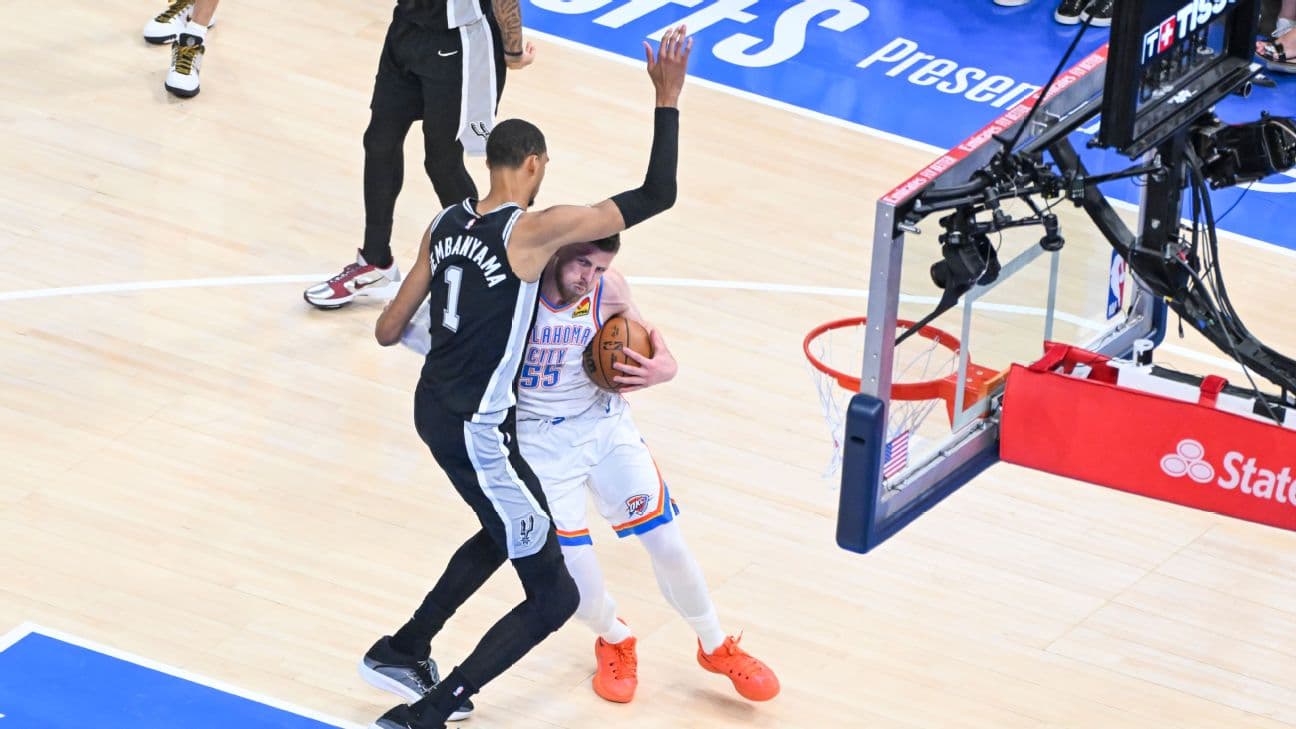
The NBA championship market has settled after one of the busiest offseasons in recent memory, and the shape of the board is not what it was in June. Oklahoma City and San Antonio are co-favorites at roughly +270. Philadelphia, which signed LeBron James and traded for Jaylen Brown, sits near +900 alongside the reigning champion New York Knicks. Miami added Giannis Antetokounmpo to a frontcourt that already featured Bam Adebayo and has been priced considerably longer than that star power suggests.
The Knicks won the 2026 title, beating San Antonio in five games for the franchise's first championship since 1973, with Jalen Brunson taking Finals MVP after New York erased a 29-point Game 4 deficit at Madison Square Garden.
Why the Spurs are co-favorites after losing the Finals
San Antonio's price reflects a projection rather than a result. Victor Wembanyama is 22, coming off a Defensive Player of the Year award and a Finals appearance, and he signed a five-year maximum extension worth roughly $252 million this summer that includes a player option in the fifth year. He chose the 25 percent maximum over pursuing the supermax escalators that could have taken the deal past $300 million.
A team built around a player of that caliber, entering his fourth season with the roster continuity to build on a Finals run, is exactly what markets pay for. The number is short but defensible.
Oklahoma City's case is more familiar. The Thunder have depth, they have Shai Gilgeous-Alexander, and their roster construction is the one most insulated from the apron restrictions that are squeezing other contenders.
The Philadelphia move
The Sixers were 60-1 before the offseason. They shortened to 20-1 after acquiring Jaylen Brown from Boston and moved to roughly +900 after signing LeBron James to a two-year deal. That is one of the largest futures moves any team has made in a single offseason.
The basketball question is whether that roster fits together. Tyrese Maxey needs the ball. Brown needs the ball. James, even at this stage, is at his best as a primary initiator. Adding talent almost always improves a team's regular season floor, but the specific combination of three ball-dominant perimeter players has a mixed history in the playoffs.
Miami's price is the market's biggest question
The Heat acquired Antetokounmpo in a trade that was made official in early July, ending more than a year of speculation, and then added shooting around him over the rest of the summer. On paper that is a top-two frontcourt in the league next to a roster that has consistently outperformed its talent.
Yet Miami's championship price has stayed long, quoted at one book as high as 40-1 during the summer. The market's stated reasons are the Eastern Conference's sudden depth, the fit question between two dominant interior players, and the fact that Antetokounmpo is coming off what was, by his standards, a down season.
Those are real concerns. They are also the kind of concerns that get resolved by twenty games of evidence, which means the price will not stay where it is for long in either direction.
The Verdexed model take
Our simulation has three meaningful disagreements with this board.
First, the model is lower on San Antonio than +270 implies. Losing a Finals is a strong predictor of a good team, not a great one, and the Spurs' supporting cast projects as roughly average. The model rates Wembanyama as the most valuable individual player in the league and still cannot get San Antonio's title probability to the 27 percent that the price implies.
Second, the model is higher on Miami than the market. A frontcourt of Antetokounmpo and Adebayo, with shooting added around them, projects as an elite defense and a top-eight offense. The model's biggest concern is spacing, not talent, and spacing problems are more fixable in-season than talent problems.
Third, the model is close to the market on New York. Defending champions are consistently underrated by futures markets in the offseason that follows, and roughly +900 for a team that just won a title with its core intact is one of the fairer prices on the board.
Betting angle
Win totals are the better market than championship futures, for the same reason they always are: they resolve on 82 games rather than four playoff rounds, and they are set before rotations are known.
Two specific angles this year:
Miami's win total. A team adding a player of Antetokounmpo's caliber typically sees its total move less than the talent addition warrants, because books anticipate load management and fit questions. If Miami's number is set conservatively, it is the strongest over candidate on the board.
Philadelphia's win total. The opposite case. James is entering a season at an age where availability is the primary variable, and a roster with three high-usage perimeter players tends to take longer to find its rotation than the market expects. The under is the side, particularly for a team whose futures price has moved this far this fast.
On the championship market itself, the reigning champion at roughly +900 is the only price in the top tier where our model's probability exceeds the implied number. That is where the value is, and it is the least exciting ticket on the board, which is generally how it works.
What's next
Training camps open in late September, and the first month of the season will answer the two questions the market cannot price yet: how Miami spaces the floor around two dominant bigs, and how Philadelphia divides possessions among three players who have each been the best option on their previous teams.
Both answers arrive by December, and both will move these prices more than anything that happens between now and opening night.