 NFL2026-09-11
The Rams Scored Seven Points as Super Bowl Favorites and the Market Has a Decision to Make
By Verdexed NFL Desk
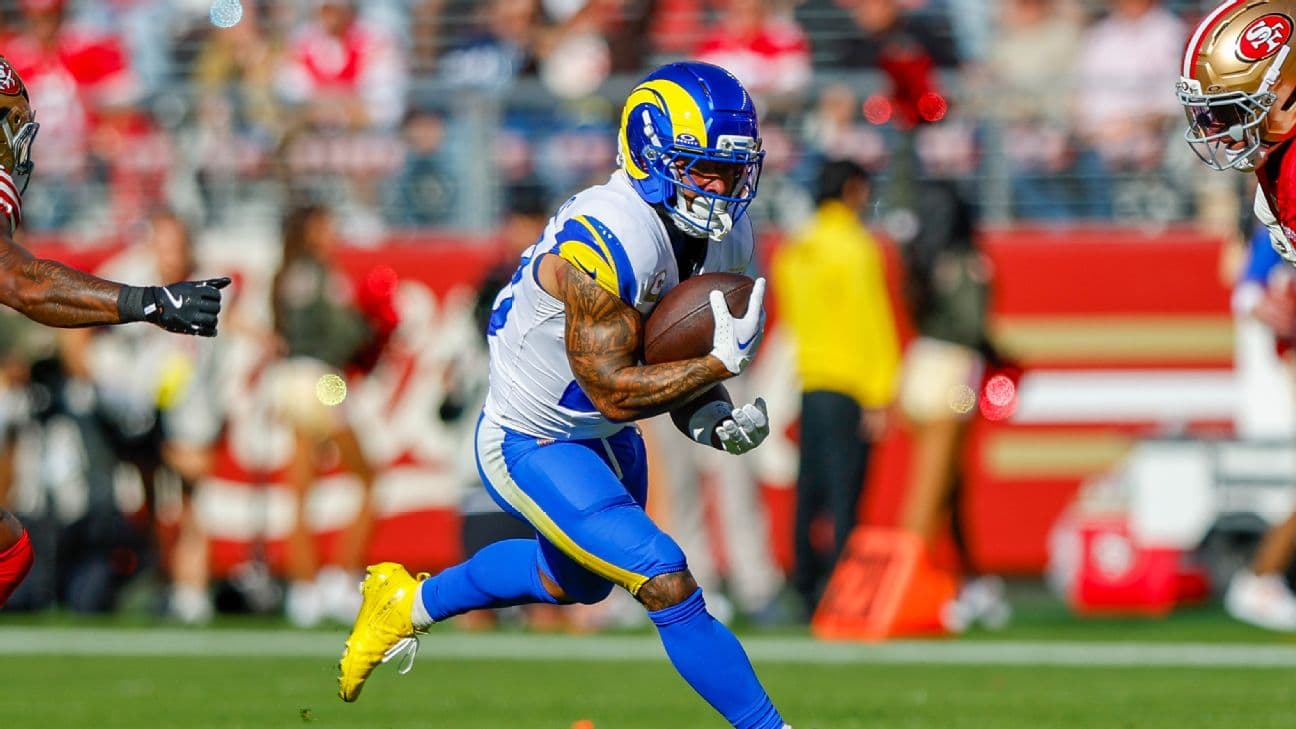
The Los Angeles Rams entered the 2026 season as the shortest price on the Super Bowl board and opened it by scoring seven points. San Francisco won 27-7 at the Melbourne Cricket Ground, and the Rams were not competitive on offense for most of the afternoon.
Matthew Stafford went 4-of-11 for 65 yards in the first half. The offense converted one of five third downs over the same stretch. Its only touchdown came on a short Kyren Williams run set up by a 41-yard catch-and-run from Puka Nacua, which was also the single play that looked like the offense the Rams believed they had assembled.
The one thing that worked
Nacua led the team with five catches for 74 yards and played a notably high share of the offensive snaps. Part of that is game script, since a team trailing by three scores in the second half runs more plays with its best receiver on the field. Part of it is scheme: Nacua was used more often in heavy personnel early in the game than he was late last season, which is a deliberate choice rather than a consequence of the scoreboard.
That snap share is the most useful fantasy takeaway from the Rams' side. Nacua's floor was never the question. The question was whether an offense with a new-look supporting cast would spread targets in a way that capped him. It did not. He was the primary read on the drives that mattered and the primary read on the drives that did not.
Stafford's targeting pattern reinforced it. He went to Nacua repeatedly and early, including on the deep ball that Renardo Green intercepted in the second quarter. That is a quarterback with one receiver he trusts and a list of alternatives he does not, which is a familiar dynamic in this building and one that has historically produced enormous target volume for whoever occupies the Nacua role.
The part that should worry Los Angeles
Both McVay and Stafford referenced a lack of communication on offense after the game. That is a specific and unusual thing for a coach and a veteran quarterback to say together, because it is not a talent problem or an execution problem. It is an operational one, and operational problems in September are the ones that get fixed fastest.
That is the optimistic framing. The pessimistic framing is that this was not a fluke result against an overmatched opponent. San Francisco is a legitimate contender, its offensive line did not allow a sack on 34 dropbacks, and it controlled the game in all three phases. The Rams were beaten by a good team while looking disorganized.
The defense deserves a separate note. Los Angeles spent the offseason building a front designed to end games, and it allowed 27 points while generating little disruptive pressure. A defense constructed around star power at the edge has a higher variance outcome than one built on depth, and Week 1 landed on the wrong side of it.
Betting angle
The Rams' Super Bowl price will move, and the question is whether it moves too far. One game is roughly six percent of a regular season, and futures markets systematically overreact to Week 1 results because the sample is the only data anyone has. A team that entered the year as the favorite and lost a road game, in an unusual travel situation, to a division rival that is also a contender, has not changed as much as the price implies.
The disciplined read is that the Rams were slightly overpriced before the season and are now closer to fair, rather than a value. Their number was compressed by the offseason additions and by a market that likes narrative. If the price drifts far enough past fair on the way down, that is when to act, and not before.
The more immediate market is the Week 2 spread. Teams coming off a 20-point loss in which the offense looked out of sync tend to be slightly underpriced the following week, because the public bets recent results. The Rams travelled to Australia and back, which is a genuine physical cost, but they also get the schedule's standard reset.
Fantasy fallout
Nacua is untouched. If anything his stock improved, because a high snap rate and a quarterback who locks onto him is the exact combination that produces a WR1 season regardless of team efficiency. Buy him from a manager who is reacting to seven team points.
Kyren Williams scored, which will keep his managers calm, but the underlying game was poor and his value has always been touchdown-dependent within an offense that has to be functional to give him goal-line work. He is a hold, not a buy.
Everyone else in the Rams' passing game is a fade until proven otherwise. An offense that completed four passes in a half does not support secondary options, and a team carrying a crowded tight end room is not about to concentrate targets there.
The Verdexed model take
Season-long models should barely move on a single game, and the Rams' underlying projection is still that of a top-six team. The efficiency inputs that matter, such as pressure rate allowed and expected points added per dropback, were bad in Melbourne, but one game of those numbers carries very little predictive weight compared with a full offseason of roster and personnel data.
What the model does update on is the communication issue, because it is the kind of problem that shows up again in Week 2 or disappears entirely. The honest position is that this is a wide-error-bar week, and the right response is to wait for a second reading rather than to reprice a contender off one bad afternoon.
What's next
Watch the third-down rate and the personnel groupings. If the Rams come out in Week 2 with a cleaner operation and Nacua still on the field at a high rate, this was a slow start against a good defense in a strange environment. If the offense is still out of rhythm, the Super Bowl price was wrong in August and the market will keep finding out.