The Bengals WR3 Job Is Still Open and Colbie Young Is Making It Interesting
By Verdexed Fantasy Desk
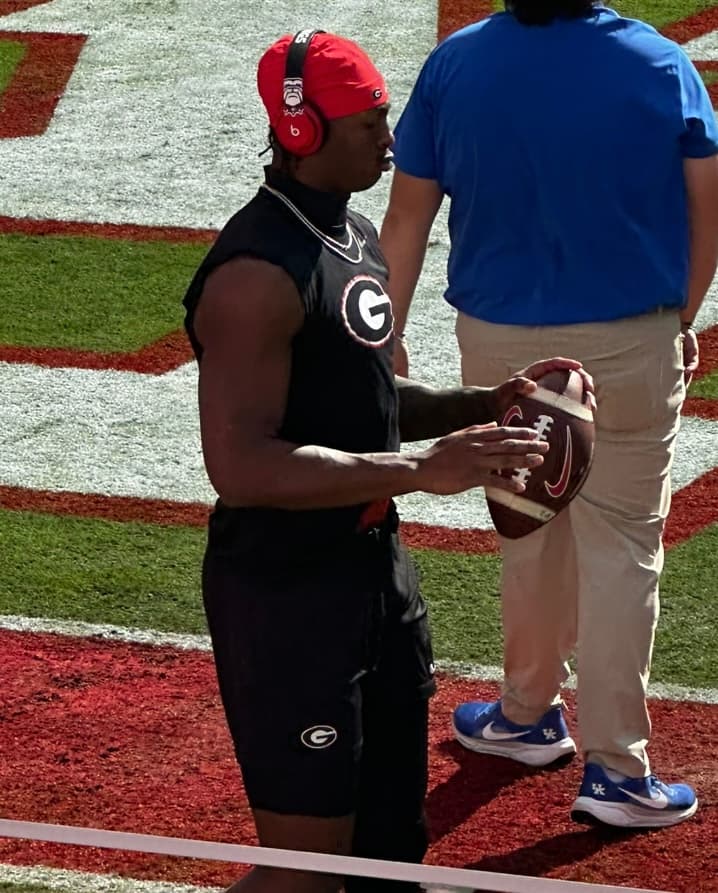
Cincinnati enters the second week of August with the same unresolved question it carried into camp: who is the third wide receiver in an offense that funnels an enormous share of its targets to two players. Ja'Marr Chase and Tee Higgins are locked in as one of the best receiver duos in football. Behind them, Andrei Iosivas, Charlie Jones and fourth-round rookie Colbie Young are splitting reps with no clear separation, and the competition has been one of the more closely tracked storylines of Bengals camp.
For fantasy purposes this is not a small job. Joe Burrow throwing to a top-two receiver room means the third option operates in more single coverage than almost any other WR3 in the league, and Cincinnati has historically run a high volume of three-receiver personnel.
The incumbent
Iosivas opens camp as the nominal leader because he has held the role. His production over the past two seasons has been consistent without being exciting: he posted 36 catches for 479 yards in 2024 and 33 catches for 435 yards in 2025. Those are the numbers of a rotational contributor, not a player who forced the coaching staff's hand.
That consistency cuts both ways. Iosivas knows the offense and has Burrow's trust in the situational route concepts, which is worth more in August than raw athleticism. But an uneven 2025 is exactly what opened this competition. A player who had genuinely locked down the role would not be fending off a fourth-round rookie in his third training camp.
The rookie
Young, the fourth-round pick out of Georgia, is the reason this battle is a story rather than a footnote. He drew notice during minicamp as one of the standouts of the receiver group and has carried that into camp. His college production, roughly 1,500 receiving yards and 13 touchdowns across four seasons split between Miami and Georgia, is not eye-popping in raw terms, but the profile is a big-bodied outside receiver rather than a slot specialist.
That distinction matters for how the Bengals would use him. Cincinnati's WR3 has typically been a field-stretching outside piece when Chase moves into the slot, which is a role that produces low-volume, high-variance fantasy weeks. A rookie who wins that job is a bench stash, not a starter, but he is a bench stash attached to one of the best quarterbacks in football.
Charlie Jones and the return-game path
Jones has the narrowest path. He has been productive as a returner and is trying to convert that explosiveness into offensive snaps, which is a conversion that fails more often than it succeeds. If Jones wins snaps it is likely to be in a designed-touch role rather than as a full-time route runner, and designed-touch receivers rarely sustain fantasy relevance across a season.
The exception is injury. If either Chase or Higgins misses time, the Bengals' third receiver becomes an immediate every-week starter in most fantasy formats, and the version of that player who can run the full route tree gets the promotion. That is an argument for Iosivas holding value as a contingency asset even if he loses the job outright.
Fantasy fallout
The target math is the whole story. Chase and Higgins have combined for a target share that leaves the rest of the offense fighting over scraps, and Cincinnati also uses its tight ends and running backs in the passing game. A WR3 in this offense is looking at a weekly target floor low enough that he only matters in deep leagues or best-ball formats.
That does not make the job worthless. Best-ball drafters should care a great deal, because the spike weeks in this offense are enormous. A receiver who catches four passes a week in Cincinnati will occasionally catch two of them for 40 yards and a touchdown apiece against a defense that has committed everything to the top two.
The practical draft advice: do not spend a redraft pick on the winner of this battle in a standard-sized league. Do take a late best-ball flier, and do monitor the depth chart into the preseason, because the identity of the WR3 determines who inherits WR2 usage the first time Higgins misses a game, which has been an annual occurrence.
The Verdexed model take
The model's receiver projections weight two things heavily: expected target share and the quality of the quarterback delivering those targets. Cincinnati is an extreme case where the second input is elite and the first is compressed. That combination produces a projection curve with a low median and a fat right tail, which is precisely the shape that best-ball formats reward and redraft formats punish.
Running the three candidates through that framework, the model does not meaningfully separate them on projected points, because the role defines the output more than the player does. What it does separate is contingency value. Iosivas projects best in the scenario where Higgins misses time, because the model's usage priors favor the player with the most snaps in the full route tree. Young projects best in the scenario where the Bengals shift toward more three-receiver looks, which the model flags as plausible given the offensive personnel.
What to do in your league
In redraft leagues of 12 teams or fewer, leave this alone until the preseason games sort it out. There is no version of the Bengals' WR3 that belongs on a starting roster in Week 1.
In best ball, take the winner in the last few rounds regardless of who it is. The upside case is a receiver seeing single coverage from Joe Burrow, and that is worth a dart throw at the end of a draft.
In dynasty, Young is the only one of the three worth acquiring. He is the youngest, has the clearest path to a long-term role, and Higgins' contract situation means Cincinnati may eventually need a second receiver to develop internally.
What's next
The Bengals play their preseason opener Thursday against Detroit, and reports out of Cincinnati indicate Burrow and the starters are expected to play. That is unusually useful information for a competition like this one, because the third receiver's snaps with the first-team quarterback are the only reps that actually resolve the question. Watch who lines up outside when Chase moves inside on the opening series. That is the tell.