 NFL2026-07-26
Panthers Plan More Slot Work for Tetairoa McMillan: The Usage Shift That Builds a Fantasy WR1
By Verdexed Fantasy Desk
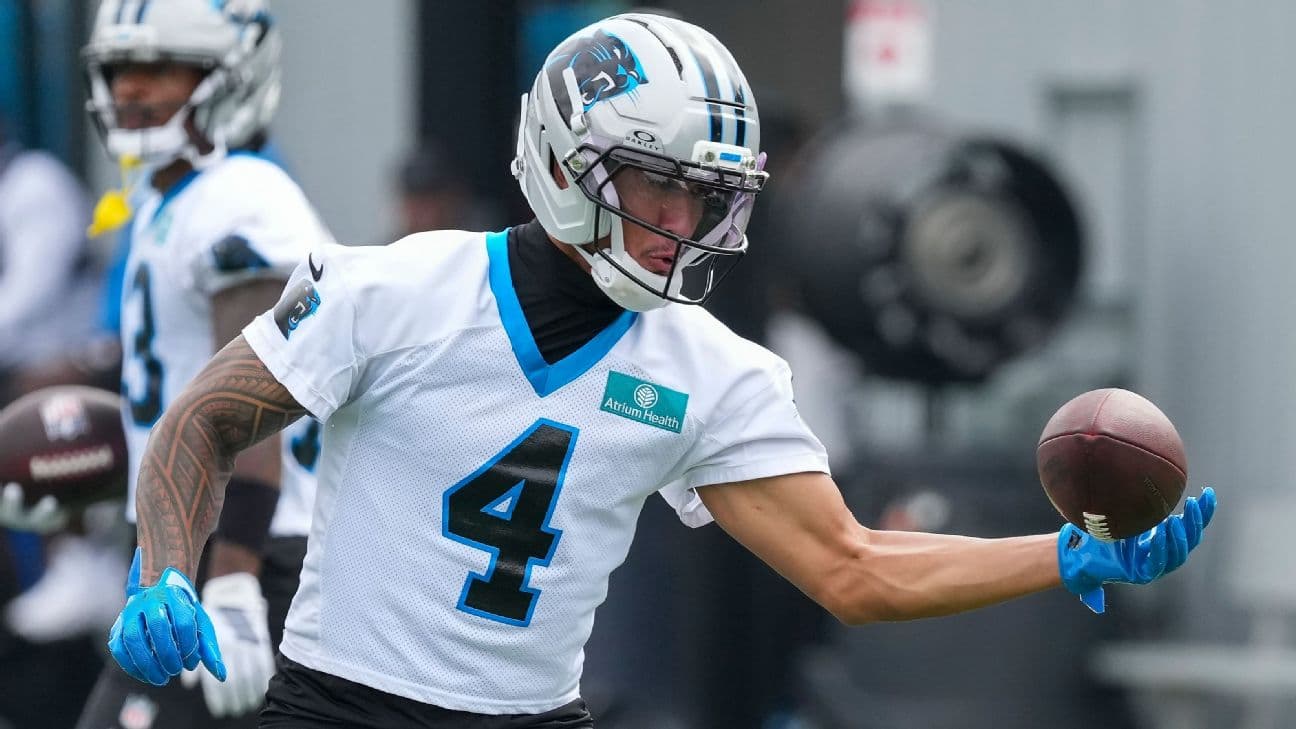
The Carolina Panthers intend to give Tetairoa McMillan more snaps in the slot in 2026 without removing him from the outside X role that produced his rookie season, according to reporting out of the team's training camp, which opened July 22. The plan described is to move him in and out of alignments, schemeing matchups and getting him into space where he becomes an easier target for quarterback Bryce Young.
McMillan is coming off an Associated Press Offensive Rookie of the Year season in which he caught 70 passes for 1,014 yards and seven touchdowns, the only rookie receiver to clear 1,000 yards. He was the No. 8 overall pick in the 2025 draft and became the second Offensive Rookie of the Year in Panthers history, joining Cam Newton from 2011.
Why alignment is worth fantasy points
This is the least glamorous and most predictive kind of offseason news. Receiver fantasy production is a function of targets, and target volume correlates more tightly with where a receiver lines up than with how good he is. Slot alignment produces a higher target-per-route-run rate almost universally, because the slot receiver has a two-way go, faces a smaller cushion, and is the natural first read on quick-game concepts that quarterbacks default to under pressure.
An outside X receiver who wins contested balls on the boundary produces spectacular tape and volatile weekly fantasy lines. He also sees more press coverage, more bracket looks against the opposing team's best cornerback, and a higher share of low-percentage targets. Those are exactly the conditions that make a talented rookie's second-year leap look like a plateau in the box score.
Moving McMillan around the formation attacks both problems. It gets him away from the opponent's top corner on a portion of snaps, and it puts him on the routes with the highest completion probability. The Panthers are explicitly not abandoning the X role, which is the right call, because a receiver with his size profile is a genuine asset on the boundary in the red zone. The blend is what matters.
The Bryce Young connection
The other half of this is the quarterback. Reporting from camp has emphasized how much time McMillan and Young spent together this offseason, and Young has spoken publicly about McMillan's approach to improvement without treating the rookie season as a finished product.
That chemistry framing is soft evidence on its own, but it aligns with the structural point. A quarterback who has taken the volume of pressure Young has taken benefits enormously from a reliable inside target on quick-game and option routes. Those are the throws that keep an offense on schedule, and the receiver who runs them collects targets whether or not the offense is any good. For fantasy purposes, that is the important part: slot volume is relatively insulated from team quality.
The offensive line context that cuts the other way
One complicating factor deserves flagging. Carolina placed left tackle Ikem Ekwonu on the PUP list as he recovers from a torn patella tendon suffered in the playoffs. Active PUP allows a player to be activated at any point during camp or the preseason, so this is not a season-long designation, but a tackle returning from that injury is not a lock for a normal August.
Protection quality is the input that determines whether a quick-game plan is a strategic choice or a necessity. If Carolina's line holds up, McMillan's slot snaps become a matchup weapon layered on top of a functional dropback passing game. If it does not, the offense collapses into checkdowns and the target share matters less because the total pie shrinks. Track Ekwonu's activation as a leading indicator on the entire Panthers passing game.
The Verdexed model take
The model's second-year projection for McMillan sits above his rookie output on both targets and yards, and the alignment news pushes the target line specifically. The mechanism is straightforward: a shift of even 15 to 20 percent of his snaps from boundary X to slot raises his expected targets per game while lowering his average depth of target, which nets out as more receptions, similar yardage, and a materially higher floor in points-per-reception formats.
The touchdown projection is the piece that does not move much, and that is worth being honest about. Seven touchdowns as a rookie is neither a fluke nor a repeatable baseline. Red zone target share is the noisiest input in any receiver projection, and Carolina's red zone volume depends on an offense that has not yet proven it can consistently get there.
The net model read is a receiver whose floor rose more than his ceiling. That is exactly the profile that gets underdrafted in a market that pays for upside.
What to do in your league
McMillan should be drafted as a back-end WR1 in points-per-reception formats and a high-end WR2 in standard scoring. The reception-volume argument is the case, and the alignment plan is the evidence. Managers who watched the rookie tape and came away thinking contested-catch specialist are reading the wrong signal about how he will be used.
In dynasty, this is a hold or a modest buy rather than a sell-high. The Offensive Rookie of the Year award inflates trade prices, but the usage plan justifies the premium in a way that a rookie award alone would not.
What's next
The verification points are all in August. Watch the alignment charts from padded practices and the preseason snaps, which will show whether the slot usage is real or a camp talking point. Watch whether McMillan runs with the first team in three-receiver sets from the inside. And watch Ekwonu's activation date, because the difference between a competent Carolina offense and a broken one runs through the left side of that line.