 NBA2026-09-06
Karl-Anthony Towns Is Extension Eligible and the Knicks Are Not Offering the Max
By Verdexed NBA Desk
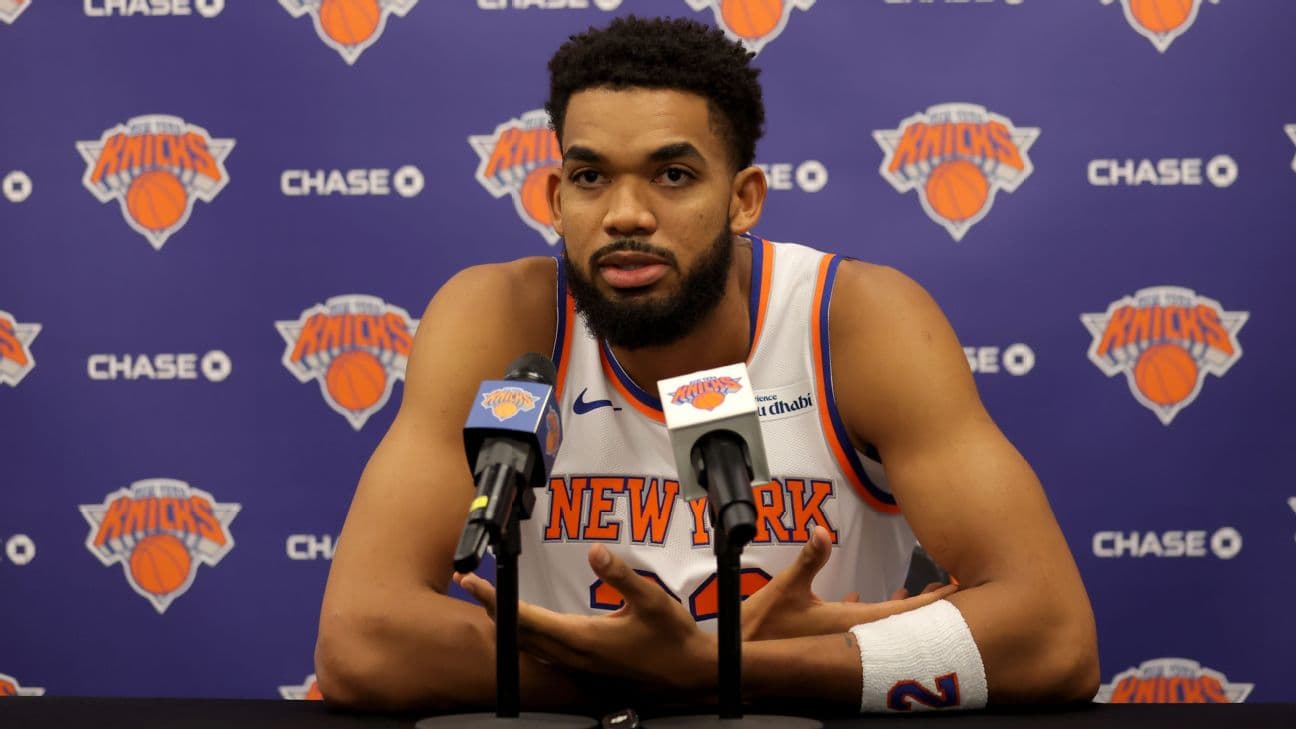
Karl-Anthony Towns is eligible for an extension worth as much as four years and approximately $272 million, and the New York Knicks are not expected to offer it. Reporting from The Athletic indicates the Knicks plan to make Towns an extension offer in the near term but that it will not be the maximum, and no agreement had been reached as of earlier this week.
This is the first meaningful roster decision of the Knicks' title defense. New York beat San Antonio in five games in June for its first championship since 1973, with Jalen Brunson taking Finals Most Valuable Player honors, and the front office now has to figure out how to keep that group together under a collective bargaining agreement designed to make exactly that difficult.
The math the Knicks are actually solving
New York already has long-term money committed to Brunson, OG Anunoby, Mikal Bridges, and Josh Hart. Adding a maximum extension for Towns on top of that group would push the team deep into second-apron territory for years, and the second apron is not merely a tax bracket. It restricts the ability to aggregate salary in trades, to use exceptions, and in some cases to move future first-round picks, which is the machinery a contending team uses to fix problems mid-season.
That is why the reported hesitation is about flexibility rather than about whether Towns is good. A championship roster with no mechanism to change itself is a roster that ages in place. The Knicks are trying to keep both the player and the tools.
Towns is not without leverage. His contractual situation gives him a path toward free agency if he declines to extend, and a big man of his offensive caliber would command serious money on an open market. But ESPN's Brian Windhorst has reported that Towns's preference is to extend in New York, which changes the negotiation from a standoff into a haggle over how large the discount is.
Miles McBride and Josh Hart are also extension eligible, which is the quiet part of this story. Every dollar committed to Towns narrows what the Knicks can do for the rest of the rotation, and the front office has to sequence these decisions rather than treat them independently.
Fantasy fallout
Contract news does not usually move fantasy value, and this is mostly no exception. Towns is going to be on the Knicks this season regardless of how the extension resolves, and his role in a title-winning offense is settled.
The angle worth tracking is what an unresolved extension does to a player's season. Players in contract years occasionally see usage tick up, and more relevantly, teams occasionally become more cautious with load management for a player whose long-term status is unsettled. Neither effect is large, and neither should move Towns off draft boards where his production profile has him.
The bigger fantasy question is the one this negotiation eventually forces: whether New York can keep this rotation intact, because a Knicks team that has to shed salary in a year is a Knicks team where somebody's minutes change materially.
The betting angle
New York's title odds for the coming season are being priced on continuity, and continuity is exactly what this negotiation is testing. If Towns signs a below-max extension, the Knicks preserve both the roster and the flexibility to add at the deadline, which is the best-case outcome and one the market has largely assumed.
If the negotiation drags into the season without resolution, that is a genuine distraction risk for a defending champion, and it is not currently reflected in the futures price. Markets treat contract disputes as noise until they become a story, and by then the number has moved.
The award markets are the more interesting derivative. A big man with a maximum-extension case to make has an incentive to produce a maximum-extension season, which is a soft argument for Towns in the All-NBA markets that tend to be priced lazily in September.
The Verdexed model take
Verdexed's model treats roster continuity as the dominant predictor of year-over-year performance for a team returning a championship core, ahead of individual player projections and well ahead of offseason additions. On that basis, the outcome that matters is binary: does Towns remain a Knick through the season, and does the front office retain the mechanisms to make a deadline addition.
The reported framing points toward yes on both. A player who prefers to stay, a team that intends to make an offer, and a gap that is about the size of the number rather than about the destination is a negotiation that closes. The model's projection is that New York enters the season with its title-winning group intact and with more deadline flexibility than a maximum extension would have allowed.
The risk case is the one where the discount Towns is asked to accept is larger than the reporting suggests. A defending champion asking its second-best player to take a significant haircut is a negotiation that can turn adversarial quickly, and adversarial negotiations in New York do not stay private.
What to watch
The specific number in the Knicks' first offer is the whole story. A near-max offer with a shorter term is a deal that gets signed. A substantially reduced offer is the start of a longer process that could run into the season.
The secondary marker is what happens with McBride and Hart. If New York moves on either of those extensions before resolving Towns, it is a signal about how the front office is sequencing its cap sheet, and it will tell you more about the Towns outcome than any quote.