 NFL2026-07-25
Jonathon Brooks Draws Rave Reviews at Panthers Camp: A Late-Round RB With Starter Upside
By Verdexed Fantasy Desk
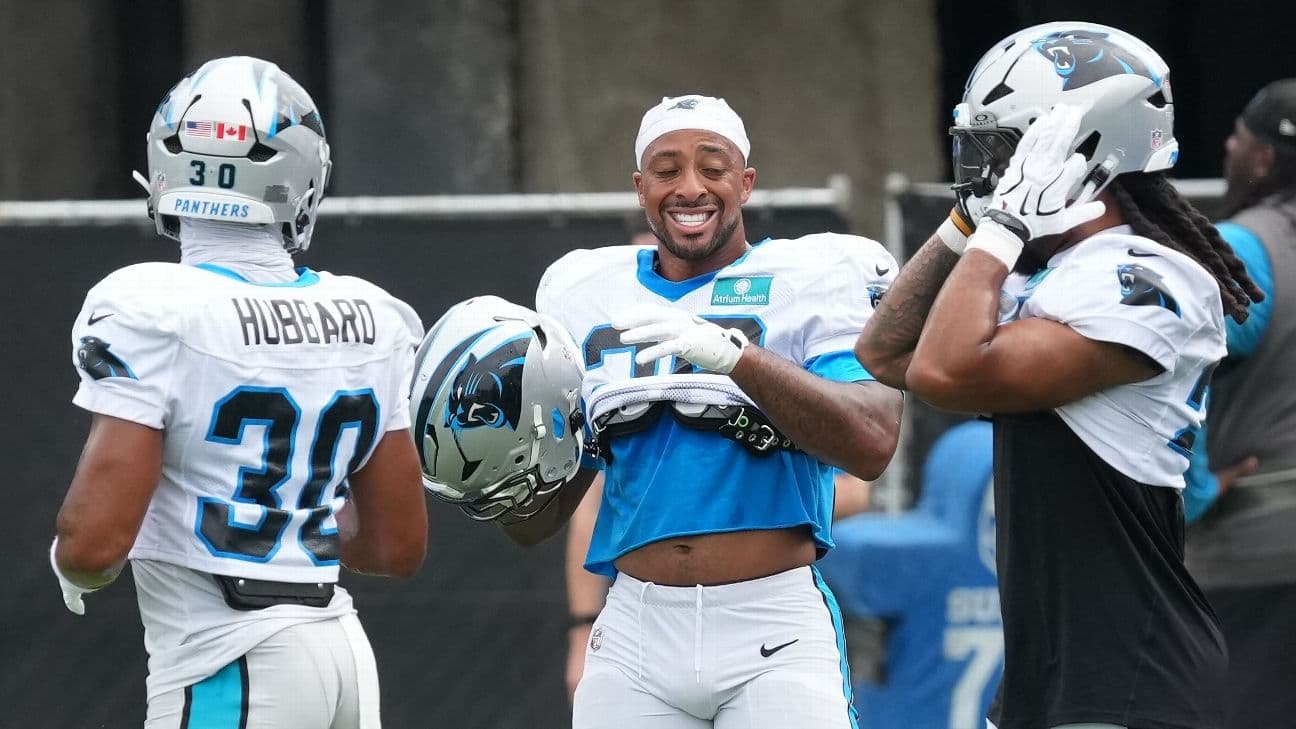
Jonathon Brooks opened Carolina Panthers training camp without limitations and drew public praise from head coach Dave Canales, who told reporters the running back looks like the player he remembers. NFL Network reported there will be no restrictions on Brooks through camp. For a player who has appeared in three NFL games across two seasons because of two torn ACLs, a clean first day is the news, and it arrives at a moment when Brooks is still being drafted as an afterthought.
Carolina selected Brooks 46th overall in the 2024 draft, a slot that reflected genuine first-round talent discounted for a college knee injury. He played three games as a rookie before a second tear ended that season and consumed all of 2025. He has now had a full offseason of rehab and a full camp runway, which is more preparation than he has had at any point as a professional.
The opportunity in Carolina
The Panthers' backfield is not a settled hierarchy. Carolina has veteran and complementary options, but it does not have an entrenched three-down starter whose job is beyond challenge, and the coaching staff has an obvious institutional investment in a back it spent second-round capital on. Canales' offense has historically funneled work to a primary back when one separates, which is the environment where Brooks' profile plays best.
The reason Brooks was drafted where he was is worth remembering. Coming out of Texas he was regarded as a complete back: patient in zone concepts, decisive through the hole, and genuinely useful as a receiver out of the backfield. Pass-game utility is the trait that turns a committee back into a fantasy starter in PPR formats, and it is the part of his game least dependent on the explosive traits an ACL recovery can dull.
What the camp report actually tells us
Coach praise in July is cheap, and fantasy managers should discount most of it. The specific value here is in two details rather than the enthusiasm.
First, the absence of limitations. Teams routinely manage returning players with rep counts, no-contact periods, and veteran rest days. A report that Brooks will carry no restrictions through camp means the medical staff has signed off on full participation, which is a materially higher bar than being activated off a list.
Second, the phrasing about him looking like the player the staff remembers. That is a comment about movement quality rather than about availability, and movement quality is the thing that separates a back who returns from a back who returns and produces.
Neither guarantees anything. Both are the right signals at the right time.
Fantasy fallout
Brooks has been drafted deep into the double-digit rounds, in the range where managers take handcuffs and dart throws. Reported ADP data has placed him around the RB34 tier, which is roughly the price of a backup with a path to relevance rather than a potential starter.
That price does not match the profile. A second-round pick with a receiving skill set, no entrenched competition, and a head coach publicly endorsing his movement is the definition of a late-round pick with starter upside. The realistic range of outcomes runs from a rotational back who never separates to a lead back who finishes as a top-20 fantasy option, and a double-digit-round pick only needs the middle of that range to return value.
The risk is not subtle. Two ACL tears in the same career is a serious medical history, and re-injury risk in that population is elevated. Brooks should be drafted as an upside swing, not as a player you build a roster around.
The Verdexed model take
Verdexed's projection engine separates opportunity from efficiency, and Brooks scores far better on the first than the market implies. His projected snap share carries a wide distribution because the Carolina depth chart is genuinely unresolved, but the upper half of that distribution puts him in weekly starter territory.
The efficiency projection is where the model applies its discount. Backs returning from a second ACL reconstruction have historically posted below-baseline yards after contact in their first full season back, and the model reflects that. The result is a projection that is modest on a per-touch basis and strong on a per-roster-spot basis: not a player the model expects to be efficient, but one it expects to be used.
The model also flags a specific structural edge. Brooks' pass-game role is projected to arrive faster than his early-down role, because receiving work requires less contact tolerance. In PPR formats, that front-loads his usable value in a way that half-point and standard scoring do not capture.
What to do in your league
Move Brooks up. He belongs in the range where managers are currently taking handcuffs to backs they do not own and third-string receivers on bad offenses. A player with his draft capital and his path to touches is a better use of that pick in every format, and a significantly better one in PPR.
Do not pay a premium. The camp buzz will move his price, and there is a version of this where he goes four rounds earlier by late August. At that price the medical risk is no longer being discounted, and the pick stops being good.
If you already roster him in dynasty, hold. The market has spent two years writing him off, and a healthy camp is the first real evidence in that window that the talent survived.
Betting angle
The Panthers' team rushing props and Brooks' own season-long numbers are thin markets, but the broader application is to Carolina's offensive projection. A functional lead back changes an offense's ability to stay on schedule, and Carolina's win total was set without any confidence that Brooks would be part of it. If he holds up through the preseason, that is a small but real input the market has not priced.
What's next
Watch the preseason snap distribution, particularly on third down. If Brooks is the back on the field in obvious passing situations, his PPR floor is established and the late-round price becomes a bargain. Watch also for any maintenance days, which would be the first sign that the no-limitations plan is being quietly revised.
The larger point stands regardless. A back with this pedigree, in this situation, at this price, is the kind of pick that decides leagues, and the cost of being wrong is one late-round selection.