 NFL2026-09-11
Jaxon Smith-Njigba Put Up 122 Yards With Drew Lock Throwing and That Settles the Darnold Question
By Verdexed Fantasy Desk
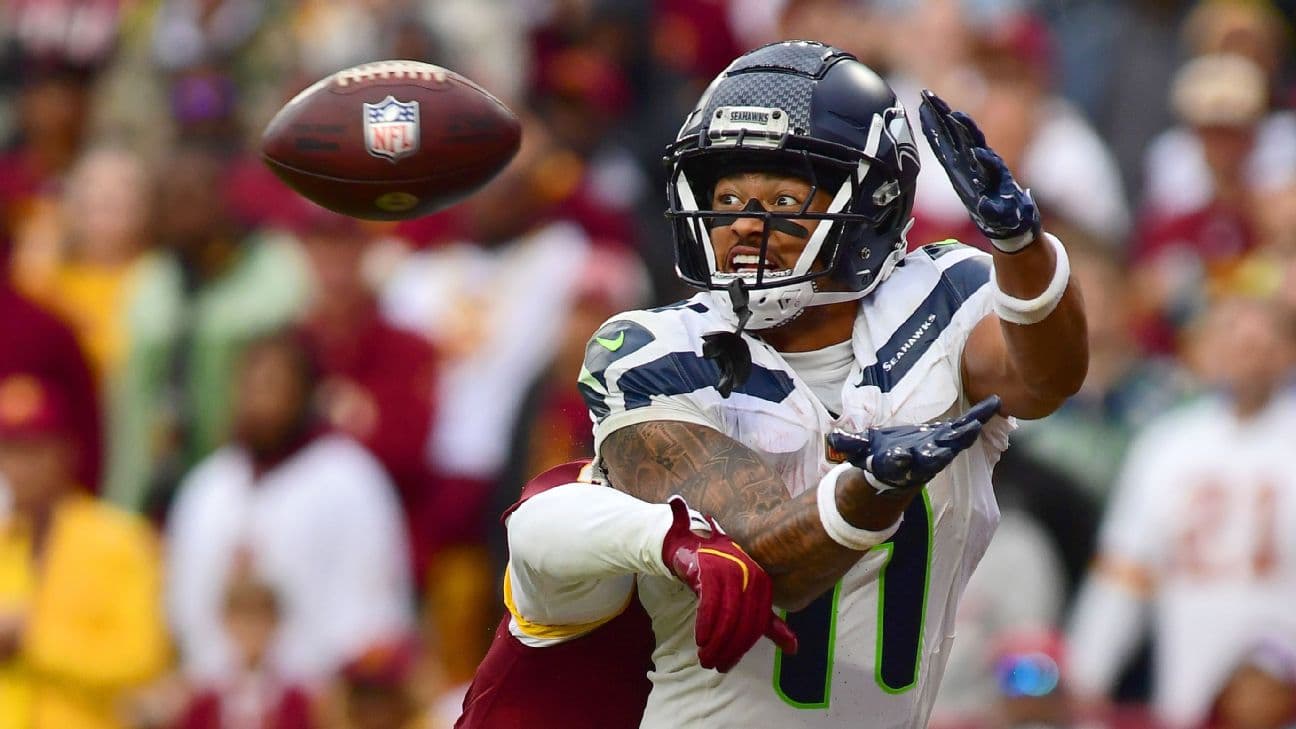
Jaxon Smith-Njigba caught eight of 11 targets for 122 yards and a touchdown in Seattle's 13-10 win over New England, and seven of those catches came from Drew Lock. Sam Darnold left the game after five snaps with a hip injury, which turned the season opener into an unplanned referendum on whether Smith-Njigba's fantasy value is quarterback-dependent.
The answer was no.
What happened on the field
New England cornerback Christian Gonzalez shadowed Smith-Njigba on 16 of his 26 routes and held him to one catch for five yards in coverage. That is elite corner play, and it is worth noting because it means the entire 122-yard line came on the other ten routes, against other defenders, when Seattle schemed him away from the matchup.
The signature play was a 45-yard catch-and-run touchdown in the fourth quarter that tied the game. Lock said afterward that the play was a product of the receiver making something out of a throw rather than the design producing it, which is the kind of comment that matters more than the box score. A backup quarterback who trusts his top receiver to win after the catch will keep throwing him the ball.
Seattle won the game on three fourth-quarter interceptions and a Jason Myers field goal with 5:50 remaining. The offense was not efficient. Smith-Njigba was, which is the exact split fantasy managers want from a receiver on a defense-first team.
The Darnold situation
Darnold underwent an MRI on the hip he injured on the opening series. Per the reporting that followed, he is expected to miss some time, but the injury is not considered season-ending and is not expected to cost him an extended stretch. That is the current state of the information, and the Seahawks have not committed to a Week 2 starter.
Fantasy managers should assume Lock starts until told otherwise, and should not treat that as a downgrade for Smith-Njigba.
The reason is structural. Smith-Njigba's value comes from route volume and target share, not from quarterback quality, and both of those are functions of how Seattle designs its offense rather than of who takes the snap. A team with one clearly superior receiving option funnels targets to that option regardless of the passer, and often funnels more of them when the quarterback is less confident, because a backup's checkdown hierarchy is shorter.
The honest caveat: a worse quarterback lowers the ceiling on explosive plays and on touchdown equity. Smith-Njigba with Lock is a WR1 with a slightly compressed upside range rather than a WR1 with an unlimited one. That is a downgrade of a few tenths of a point per game, not a reason to bench him.
Fantasy fallout
Start Smith-Njigba every week. Eleven targets in a game where he was shadowed by one of the league's better cornerbacks for most of his routes is the strongest possible signal that Seattle intends to feed him regardless of circumstance.
The rest of the Seattle passing game is where the caution belongs. A backup quarterback who locks onto one receiver produces almost nothing for everyone else, and Seattle's secondary pass-catchers should be treated as touchdown-dependent dart throws until Darnold returns.
The Seattle defense is the other asset worth owning. Three fourth-quarter interceptions, including a takeaway in the end zone to end the game, is the kind of performance that will keep the unit in the weekly streaming conversation and near the top of season-long defense rankings. Managers who took Seattle as their defense have the best version of that asset.
Betting angle
The market's instinct after a starting quarterback injury is to move the team total down and the spread against them, which is often correct and is sometimes an overcorrection when the team in question wins games with its defense.
Seattle is the second case. This is a roster that just held a playoff-caliber opponent to 10 points and won a game in which its offense produced 13. A defense that good makes a team's game totals lean under and makes the team itself a reasonable underdog price in any spot where the market has overweighted the quarterback change.
Smith-Njigba's receiving props are the individual market to watch. Books will shade his number down with a backup quarterback under center, and the Week 1 evidence argues the opposite: his target share went up, not down, once Lock entered.
The Verdexed model take
Wide receiver projections that separate target share from team passing volume handle quarterback changes cleanly. A downgrade at quarterback lowers team passing efficiency and raises the number of pass attempts slightly, because a less efficient offense plays from behind more often. For a receiver with a dominant target share, those two effects largely cancel.
The model's read is that Smith-Njigba's weekly projection drops by a small margin with Lock rather than by the large margin public rankings apply, and that he remains a top-six weekly receiver. His floor is actually more secure than it looks, because a shorter quarterback progression concentrates targets rather than distributing them.
The Darnold return date is the swing factor for the ceiling, not the floor.
What to do in your league
Start him, do not shop him, and buy him if a manager in your league is panicking over the quarterback situation. The price will never be lower than it is in the 48 hours after a starting quarterback gets hurt, and the underlying usage says nothing bad happened.
If you need a streaming defense for the next month, Seattle is not available in most leagues. If it is, claim it.