 NBA2026-07-26
James Harden's New Cavaliers Deal Is Still Unsigned: The Fantasy Read on Cleveland's Backcourt
By Verdexed NBA Desk
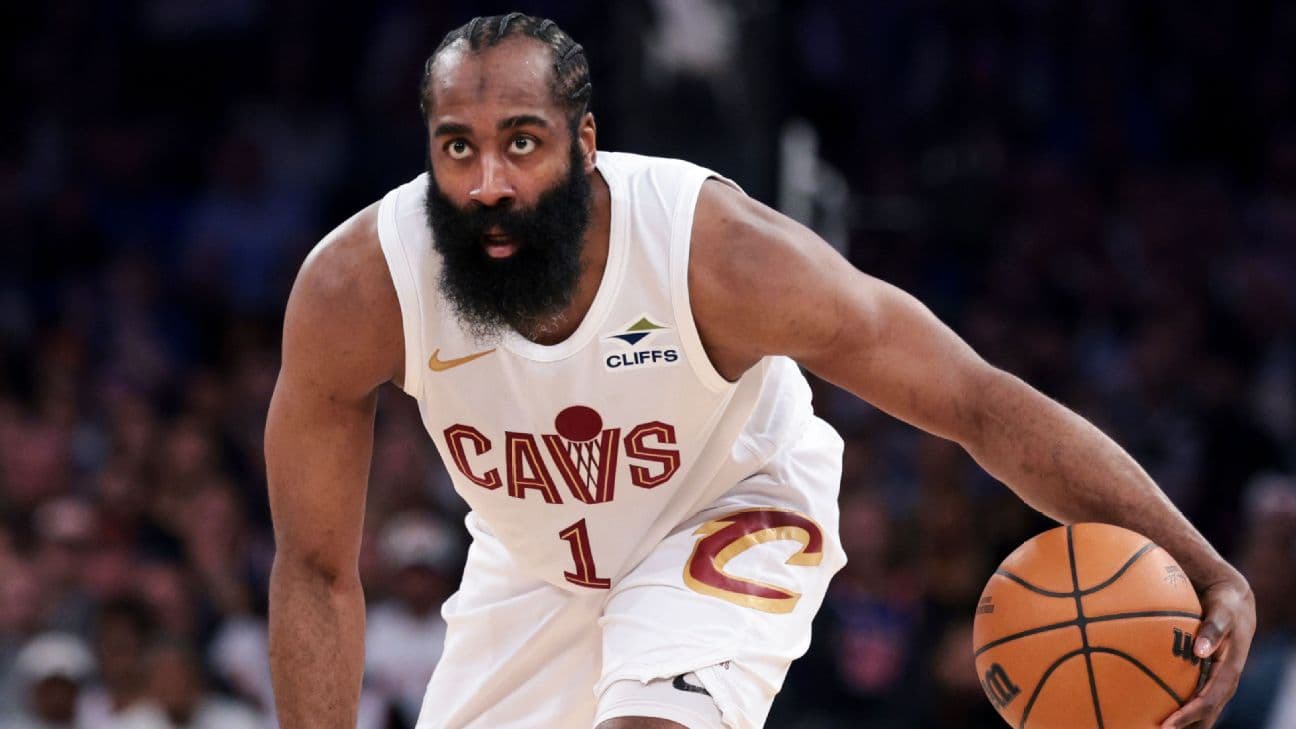
James Harden declined a $42.3 million player option on June 29 and entered negotiations with the Cleveland Cavaliers on a new multiyear contract. Nearly a month later, no signed agreement has been announced. Reporting indicates the framework and financial terms were settled between the sides in early July, with the most frequently cited structure being a two-year deal in the neighborhood of $60 million, and with Harden reportedly willing to spread the same money across three years to give Cleveland more room under the second apron.
The important qualifier: all of that is reported and expected, not confirmed and executed. Until the team announces a signing, the correct posture is that Harden is a free agent who intends to re-sign with the Cavaliers, and reporting has been consistent that Cleveland's plans were never contingent on the outcome of the LeBron James free agency that ended with James signing in Philadelphia.
Why the delay is about the cap, not the relationship
The reporting on this has been unusually clear about what is holding it up, and it is not a dispute. The delay appears tied to how the rest of the league's offseason dominoes fall and to the mechanics of structuring a contract that keeps Cleveland out of the second apron, rather than to any disagreement over dollars.
Second-apron restrictions are severe enough that they now drive contract shape across the league. A team over that threshold loses access to exceptions, loses the ability to aggregate salaries in trades, and faces draft-pick consequences. Spreading $60 million over three years instead of two lowers the annual cap hit and preserves flexibility that Cleveland would otherwise forfeit. A player agreeing to that structure is doing the team a favor, and it is the kind of accommodation that takes time to finalize precisely because it interacts with every other roster move.
The roster context that changed everything
Cleveland acquired Harden from the Clippers at the February trade deadline, sending Darius Garland and a second-round pick to Los Angeles. That is the transaction that governs the entire fantasy conversation here, because it removed the other high-usage guard from this roster.
A backcourt that previously split creation between two ball-dominant guards now runs through Harden alongside Donovan Mitchell. That is a fundamentally different distribution than the one Cleveland operated for years, and it is the reason Harden's projected role in 2026-27 is stronger than a casual look at his age and his recent Clippers seasons would suggest.
Fantasy fallout
Harden's fantasy profile in the late stage of his career is an assist-and-three-pointer engine with a strong free throw contribution and declining scoring volume. That is a genuinely valuable category mix in nine-category leagues, and it ages better than a scoring-dependent profile does, because playmaking is less athletically demanding than shot creation.
The Garland trade is what elevates the projection. Harden's assist numbers correlate almost linearly with his share of primary ball-handling duty, and there is no longer a second primary ball handler in this backcourt. In a full season as Cleveland's lead creator, his assist output should sit near the top of his recent range rather than the bottom of it.
The risks are the obvious ones. He is deep into his thirties, and load management on a contending team in the regular season is now standard practice rather than an exception. Managers should build in missed games, particularly in back-to-backs, and should not draft him as a set-and-forget anchor.
Mitchell's projection is largely unaffected by the contract news itself, which is worth stating because managers sometimes discount a second star when a playmaker is added. The historical pattern is the opposite: elite scorers paired with elite passers see their efficiency rise even as their usage falls slightly, which is a net positive in points-heavy formats and roughly neutral in category leagues.
The Verdexed model take
The model treats the signing as close to a certainty and prices Cleveland accordingly, which is the same thing the betting markets have effectively done. There is no scenario in the current reporting where Harden plays elsewhere, and building a projection around an outcome that no source has suggested would be modeling noise.
On the individual projection, the model has Harden as a top-40 fantasy asset in nine-category formats with a games-played discount that pulls him out of the top 30. The assist and three-point contributions carry the value. The scoring is a supporting category rather than a driver, and managers drafting him for points are drafting the wrong version of this player.
On the team side, the model's read is that Cleveland enters next season as a genuine contender in a conference that just absorbed significant movement, with LeBron James in Philadelphia and Giannis Antetokounmpo in Miami. That reshuffling raises the variance of every Eastern Conference projection, and the Cavaliers number is one of the more stable ones in a volatile field.
The betting angle
Eastern Conference futures are the market with the most movement left in them, because the conference absorbed two franchise-altering relocations this summer and the market has not fully settled on a hierarchy. Cleveland's number is worth monitoring rather than acting on immediately, since a formal Harden signing announcement is the kind of non-news that occasionally produces a small, irrational move in either direction. The edge, if there is one, comes from being positioned before the announcement rather than reacting to it.
What to do in your league
Draft Harden as a mid-round assist specialist and pair him with a high-volume rebounder or shot blocker, since his category profile leaves obvious holes. Do not pay a premium expecting a scoring renaissance. In dynasty, this is a sell-into-strength window: the contract news and the lead-guard role will support his price this fall, and the age curve does not.
What's next
The signing announcement itself is the only remaining formality, and the detail worth reading when it lands is the term. Two years signals a team preserving 2028 flexibility. Three years signals a team that expects this core to stay together and is willing to carry the cap hit. That distinction matters more for dynasty managers than the dollar figure does.