 NBA2026-07-22
Jalen Duren's Pistons Standoff Drags On: The Restricted Free Agent Whose Fantasy Value Is on Hold
By Verdexed NBA Desk
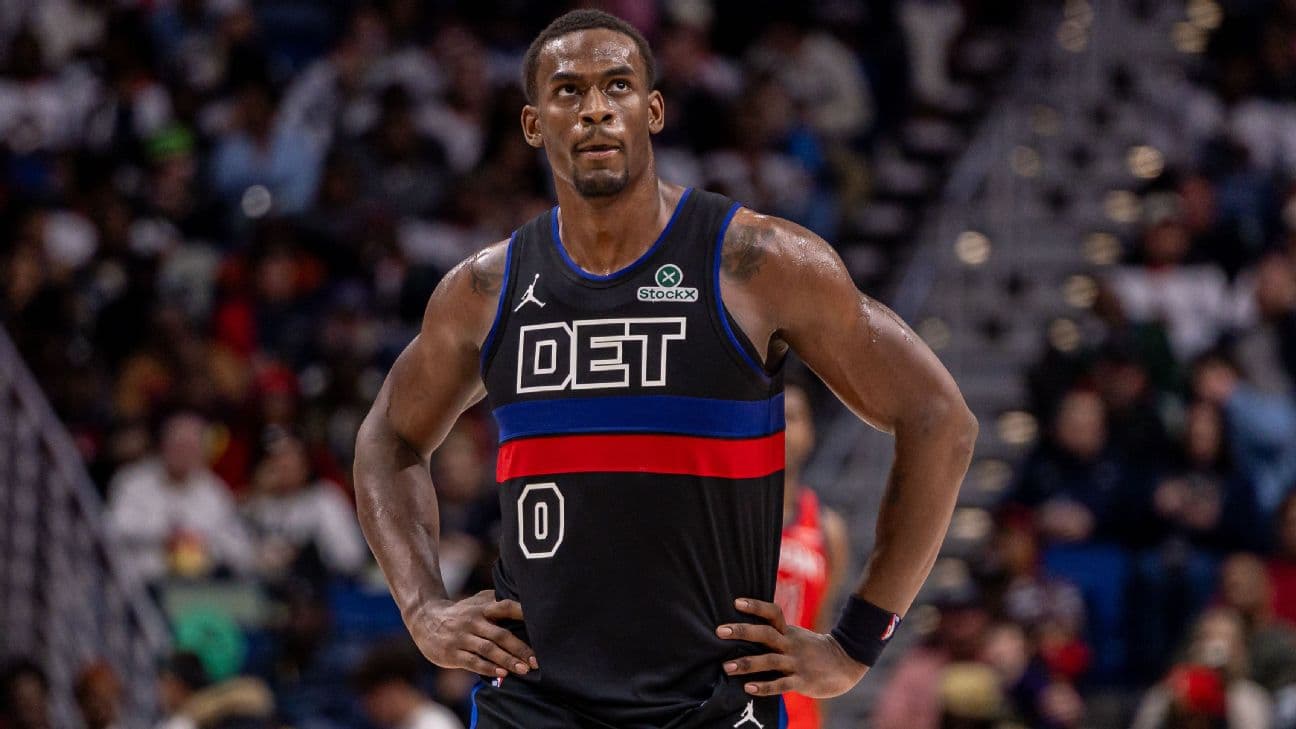
Jalen Duren is a restricted free agent, Detroit tendered him a $9.62 million qualifying offer, and the two sides remain far apart. Five weeks into negotiations, the Pistons and their young center have reportedly made only modest progress, and after a disappointing playoff showing Detroit is said to be reconsidering the max-level commitment it once seemed willing to make. For fantasy managers, the standoff itself is the story, because an unresolved contract situation adds a layer of risk to a center whose on-court trajectory is otherwise pointing up.
The Pistons have made clear that re-signing Duren is their top offseason priority and that they would rather keep him than facilitate a sign-and-trade. That is a fantasy-positive backdrop: the most likely outcome is still that Duren plays significant minutes for Detroit in 2026-27. But the path to that outcome is now less certain than it looked a month ago, and the timing of a resolution matters for draft season.
Duren's options and the fantasy stakes
Duren has completed his four-year rookie-scale contract and holds a genuine decision. He can accept the $9.62 million qualifying offer, play the season on a one-year deal, and become an unrestricted free agent next summer, which would give him full control of his destination but expose him to real risk: one injury or one uneven season could cost him far more than the gap currently separating him from Detroit. The alternative is to bridge the difference on a longer-term deal and lock in security now.
For fantasy purposes, the qualifying-offer path is actually an intriguing scenario. A talented young center playing on a one-year prove-it deal is a motivated player in a contract year, and contract-year motivation is a recognized fantasy tailwind. If Duren bets on himself and plays out the qualifying offer, he has every incentive to post the best statistical season of his career, which would be a boon for his fantasy value.
The on-court profile
Duren's game translates cleanly to fantasy value regardless of the contract outcome. He is a double-double machine with rebounding as his elite skill and shot-blocking as a secondary source of category value, the kind of center who produces boards, blocks, and efficient scoring at the rim without needing plays run for him. That profile is roster-able in every format, and it is why the contract standoff is a risk factor rather than a value-killer: the underlying production is real.
The primary fantasy risk is timing. A prolonged holdout that bleeds into the season, or a resolution that comes late enough to disrupt his ramp-up, could dent his early-season value and cloud his draft-day projection. Managers need to weigh the strong per-game profile against the small but real chance that the situation is not cleanly resolved by the start of the year.
The Verdexed model take
Verdexed's model keeps Duren as a roster-able fantasy center anchored by elite rebounding and solid shot-blocking, and it treats the contract standoff as a modest uncertainty rather than a downgrade to his per-game projection. Our framework's most interesting note is the contract-year angle: a young player on a one-year deal with something to prove is a scenario our model associates with elevated usage and effort, which supports a slightly more optimistic projection if the qualifying-offer path plays out.
The risk the model flags is availability timing, not talent. A messy or late resolution introduces early-season uncertainty, and that is the variable managers should watch through the summer and into the fall. The base case remains that Duren plays major minutes for Detroit, but the confidence band around when and under what terms is wider than it should be for a player of his profile.
The Detroit frontcourt context
The standoff also carries implications for the rest of the Detroit frontcourt. As long as Duren's situation is unresolved, the Pistons' other bigs carry a sliver of speculative value tied to the small chance that his availability is delayed to start the season. That is a thin thread to pull on, and it is not a reason to reach for a backup center in drafts, but managers in deep leagues should know who would absorb minutes if Duren's ramp-up were disrupted.
The more likely reality is that Duren is in the lineup and producing, which keeps the Pistons' frontcourt hierarchy intact and leaves little standalone value for the players behind him. Detroit's stated priority of re-signing him, and its preference to keep him rather than facilitate a sign-and-trade, both point toward a resolution that has him anchoring the middle. For fantasy purposes, the cleanest read is to draft Duren for his rebounding-driven floor, keep a loose eye on the contract timeline, and not overinvest in the backup-big lottery ticket unless the standoff genuinely drags toward opening night. The base case is a productive Duren in a Detroit uniform.
What to do in your league
Draft Duren as a category-friendly center whose rebounding gives him a stable floor, and treat the contract standoff as a reason to monitor rather than to avoid. If he signs a long-term deal, the uncertainty clears and his value is straightforward. If he takes the qualifying offer, lean into the contract-year upside, because a motivated young center on a one-year deal is exactly the kind of player who can outperform his draft slot. Just keep an eye on the resolution timeline, because the one real risk here is a situation that drags close to the season and clouds his early-year role.