 NFL2026-07-27
Jacoby Brissett's Reworked $15.5 Million Deal Settles the Cardinals QB Job: The Fantasy Read on Arizona
By Verdexed NFL Desk
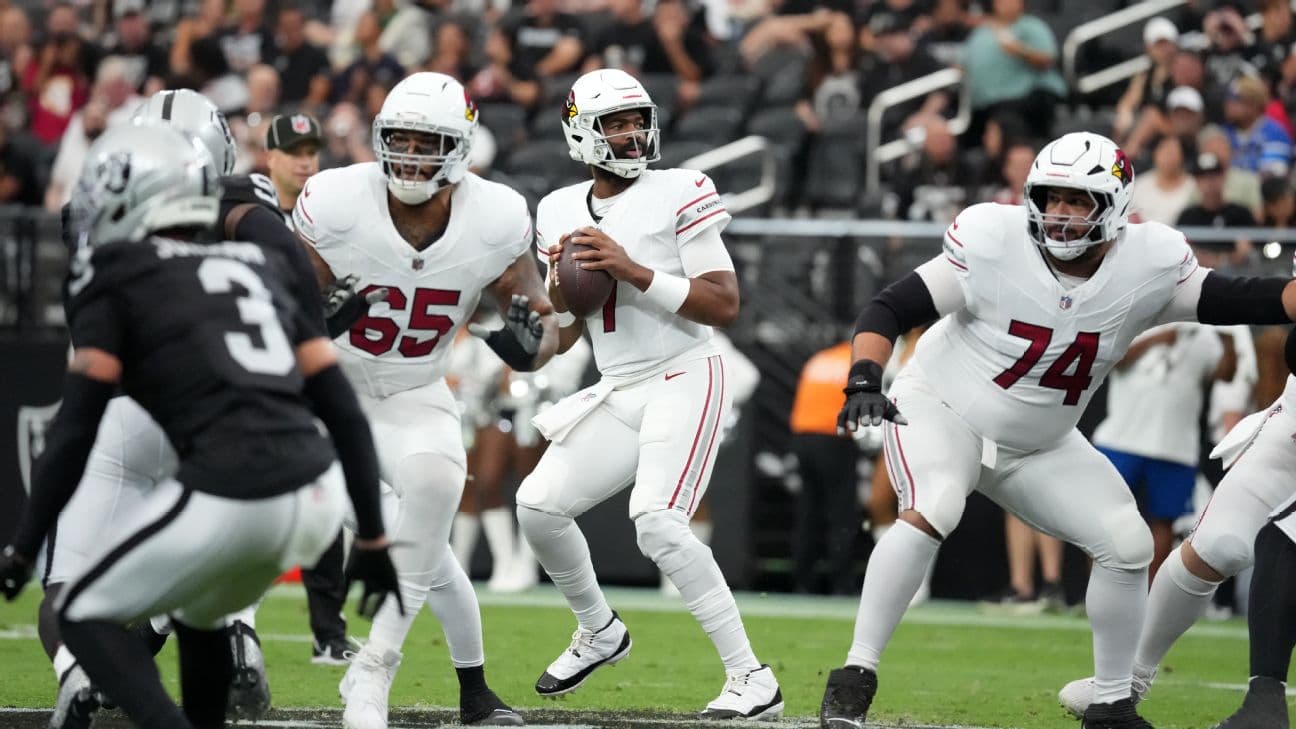
The Arizona Cardinals and quarterback Jacoby Brissett agreed on a reworked contract for the 2026 season, per multiple reports, ending a contract dispute that had shadowed the offseason and clearing the last real obstacle between Brissett and the Week 1 start. The revised deal is reported at $15.5 million in 2026 compensation with incentives that could push the total above $21 million. It is not an extension. Brissett is still scheduled to reach free agency after the season, which matters more for fantasy purposes than the headline number does.
For fantasy managers, the practical takeaway is simple: the ambiguity around Arizona's offense is now about scheme and health, not about who is taking the snaps. That is a meaningful shift for the draft prices of Marvin Harrison Jr., Trey McBride and rookie running back Jeremiyah Love, all of whom were carrying a quiet discount tied to quarterback uncertainty.
How Arizona got here
The Cardinals released Kyler Murray in March, a move that formally handed the offense to Brissett after he had already taken it over in-season. Brissett stepped in when Murray went down with a foot injury during the 2025 campaign and produced a career year, throwing for 3,366 yards and 23 touchdowns across 14 games. That is not superstar production, but it is competent, on-schedule quarterbacking, and it was enough for Arizona to reset the depth chart around him.
Brissett was originally set to earn a base salary in the neighborhood of $4.9 million, a backup's number for a player the team now expected to start 17 games. He stayed away from portions of the offseason program on the argument that a starting quarterback should be paid like one. Arizona ultimately agreed, at least for a single season, and the two sides landed on a raise that keeps the club's long-term flexibility intact while getting Brissett on the practice field.
The LaFleur factor is the real story
The quarterback resolution matters, but the more important change in Arizona is on the sideline. The Cardinals hired Mike LaFleur as head coach in February after three seasons as the offensive coordinator in Los Angeles under Sean McVay. That Rams offense was the most productive unit in football in 2025, leading the league in points per game, total yards per game and passing touchdowns.
That pedigree is the single strongest argument for buying Arizona pass-catchers at their current cost. The system LaFleur comes from is built on condensed formations, motion, play-action and defined reads, which is close to an ideal environment for a quarterback with Brissett's profile: quick processor, accurate in rhythm, limited as an off-script creator. A scheme that manufactures easy completions raises the floor of every skill player attached to it.
It also raises the volume ceiling. Offenses that stay on schedule run more plays and score more often, and Arizona has spent two years operating with the opposite problem.
Fantasy fallout
Trey McBride is the cleanest beneficiary. Tight ends who function as the primary underneath target in a McVay-tree offense are volume monsters, and McBride was already among the most heavily targeted tight ends in football. He does not need a downfield passer to hit his ceiling. He needs an offense that throws the ball in structure, and he now has one.
Marvin Harrison Jr. is the more interesting bet. His second season was wrecked by injury luck rather than talent regression: a concussion, a bout of appendicitis, and finally heel and foot issues that ended his year on injured reserve. He acknowledged during the spring program that he was still feeling the effects. That is the risk. The reward is that when he was on the field with Brissett throwing, his per-game production was solidly startable. He is being drafted as a WR3 with WR1 upside, and the price reflects genuine unresolved health questions rather than a market mistake.
Michael Wilson is the target-competition problem nobody wants to talk about. Between McBride, Harrison, Wilson and a rookie back who will catch passes, seven-plus targets a week is not guaranteed for anyone outside of McBride.
Jeremiyah Love sits atop the Arizona backfield, and a stable quarterback situation is quietly a running back story too. Backfields attached to competent offenses see more red-zone work and fewer negative game scripts.
The Verdexed model take
Our model treats quarterback stability as an input to team-level pass volume and scoring rate rather than as a standalone fantasy asset, and the Brissett resolution moves Arizona's projected offensive efficiency modestly upward from where it sat during the standoff. The bigger single-variable mover in our Arizona projection is not Brissett at all: it is the coaching change, which the model weights heavily when a staff arrives from a top-five offensive environment with a track record of scheme continuity.
Where that leaves us: Arizona projects as a middle-of-the-pack passing offense in raw yardage but above that in efficiency, which is the profile that produces one or two league-winning fantasy pieces rather than four startable ones. McBride is the piece our projections like most confidently. Harrison is the one with the widest range of outcomes on the board.
Brissett himself is a streamer, not a starter. A quarterback whose passing touchdown total lives in the low-to-mid twenties without meaningful rushing production is a QB2 in one-quarterback leagues, and our projections do not see a path to weekly QB1 status.
Betting angle
The Cardinals' win total has traded as a bottom-third number, and the market has been slow to price coaching changes at teams with unproven quarterbacks. That is the classic spot where a systemic edge lives. Our model is closer to the number than it was a month ago, but the more actionable derivative is Arizona's team total in individual games rather than the season win line. Offenses installing a new efficiency-first system tend to be undervalued early in the year and overvalued by November.
What to do in your league
Draft McBride at his cost without hesitation. Take Harrison as a WR3 with the explicit understanding that you are buying a health recovery, and do not spend a pick on him in a range where a miss ends your season. Let someone else pay up for Love on rookie-hype alone, but do not let him fall past the point where a starting-caliber backfield role is priced in. And leave Brissett on the waiver wire until a matchup makes him useful.
The Cardinals will report to camp with a settled quarterback room, a new play-caller from the best offense in football, and a young receiver room that has never been healthy at the same time. That is a fantasy situation worth monitoring closely over the next three weeks, because the first real practice reports out of Arizona are going to move ADP in one direction or the other.