Ethan Pecko Debuted for the Astros and Houston Set a Franchise Record Doing It
By Verdexed MLB Desk
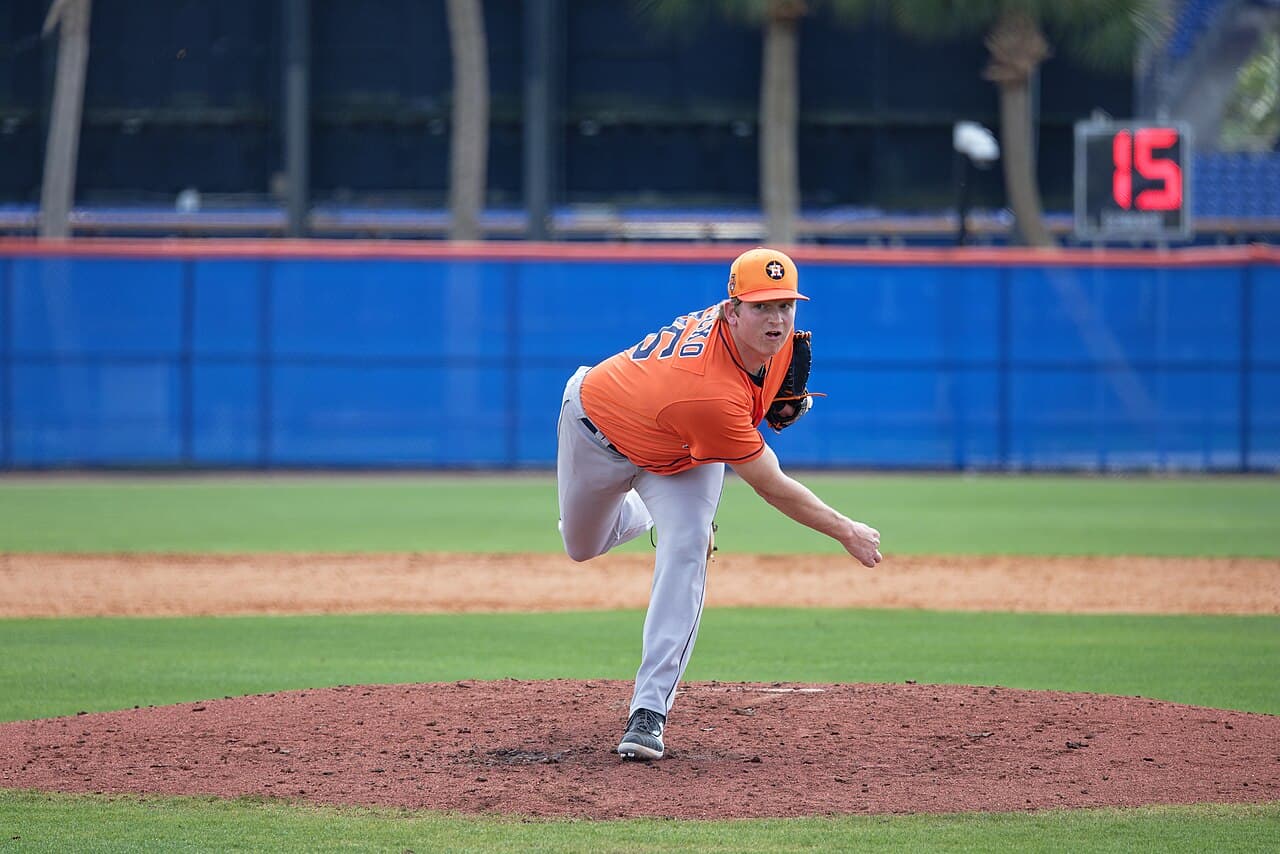
Ethan Pecko made his major league debut for the Houston Astros on Wednesday night, striking out four across 3 2/3 innings while allowing three hits, two runs and two walks in a 3-2 win over the Los Angeles Angels. Five Houston relievers covered the remaining five-plus innings without allowing a run, and Christian Vazquez homered to provide the difference.
The result was a win. The context was a franchise record nobody wanted. Pecko was the 17th starting pitcher Houston has used this season, tying a club mark set in 1965.
The road here
Pecko is not a conventional prospect story. The right-hander, who turns 24 on August 25, was a sixth-round pick in 2023 out of Towson. He lost his senior year of high school to the pandemic, committed to La Salle, missed his entire freshman season after Tommy John surgery, then watched the school cut its baseball program before transferring to Towson for 2022. He entered Wednesday ranked ninth among Astros prospects by MLB Pipeline.
His Triple-A line this season was solid rather than dominant: a 4.94 ERA across 17 appearances and 15 starts, with 74 2/3 innings, a 1.39 WHIP, 71 strikeouts and 28 walks. The stuff is a fastball and sinker combination that he throws roughly half the time, both averaging around 94 miles per hour with the ability to reach the upper 90s.
Houston opened a 40-man roster spot for him by transferring Brice Matthews to the 60-day injured list. Matthews had been on the 10-day list since mid-July with a left knee sprain.
The rotation that produced this
Seventeen starters in a season is not a development plan. It is a casualty report.
Houston lost Framber Valdez to free agency last winter, and he is now pitching for Detroit. Hunter Brown missed the first two-plus months of the season with a Grade 2 right shoulder strain before returning to the rotation in mid-June. Brandon Walter, Hayden Wesneski, Ronel Blanco and Cristian Javier have all spent time on the injured list at various points. The result has been a revolving door in which the Astros have essentially been auditioning arms since April.
That is the real story behind Pecko's debut. He is not being brought up because he forced the issue with Triple-A dominance. He is being brought up because Houston has run out of alternatives in a season where the rotation has been the defining problem.
The fantasy read
Be honest about what this is. A sixth-round pick with a 4.94 Triple-A ERA and a walk rate near four per nine innings is not a fantasy asset in a standard 12-team mixed league, and one four-strikeout debut does not change that.
What makes him worth tracking rather than ignoring is the underlying shape. A pitcher who works primarily off two fastballs at 94 with reach into the upper 90s has a foundation to build on, and the swing-and-miss he generated in his first look was encouraging relative to his minor league rate. The strikeout total in a debut is a weak signal, but the fact that he got there in under four innings is not nothing.
The bigger issue is opportunity, which cuts both ways. Houston's rotation churn means a rookie can hold a spot longer than his performance strictly justifies, because there is nobody obvious to replace him. It also means he could be optioned the moment a healthier arm is available. Neither situation supports a confident fantasy investment.
In deep leagues and AL-only formats, Pecko is a reasonable speculative add with a matchup-dependent usage plan. In dynasty formats, he is a name to file rather than a name to roster, unless your league is deep enough that late-blooming back-end starters have value.
The Verdexed model take
Our pitcher projections treat debut performances with heavy regression, because the sample is one start and the opposing lineup has never seen the pitcher before. First-time-through-the-league effects are real and they fade fast, typically within three to four starts, which is why rookie pitchers so often look sharp in their first outing and ordinary in their fourth.
The specific adjustment that matters here is the walk rate. Pecko issued two free passes in under four innings, which is consistent with his Triple-A rate rather than better than it. Command is the most predictive of the rookie indicators and the least likely to improve on the fly. The model weights it accordingly, and it is the reason his rest-of-season projection stays modest even after a solid debut.
For betting purposes, the useful angle is the Astros' team totals in games Pecko starts. Markets are systematically uncertain about rookie pitchers, and the resulting lines carry wider variance than they do for established starters. That works both directions and is not an automatic edge, but it does mean the Houston side in his starts should be evaluated on the bullpen behind him rather than on him. Five Houston relievers covering five scoreless innings on Wednesday is the more repeatable part of that win.
What's next
Watch whether Pecko gets a second start. In a rotation this depleted, the default is yes, and a second turn would give a much better read on whether the debut reflected stuff that plays or a lineup seeing him for the first time.
Watch the calendar too. Rosters expand on September 1, and Houston is one of the teams most likely to give extended looks to young arms in the final month. For a club that has already tied a 61-year-old franchise record for starters used, the last six weeks are as much about finding 2027 rotation pieces as about the 2026 standings.