 NBA2026-09-10
Cleveland Made the James Harden Deal Official and the Cavaliers Are All In on a 37-Year-Old
By Verdexed NBA Desk
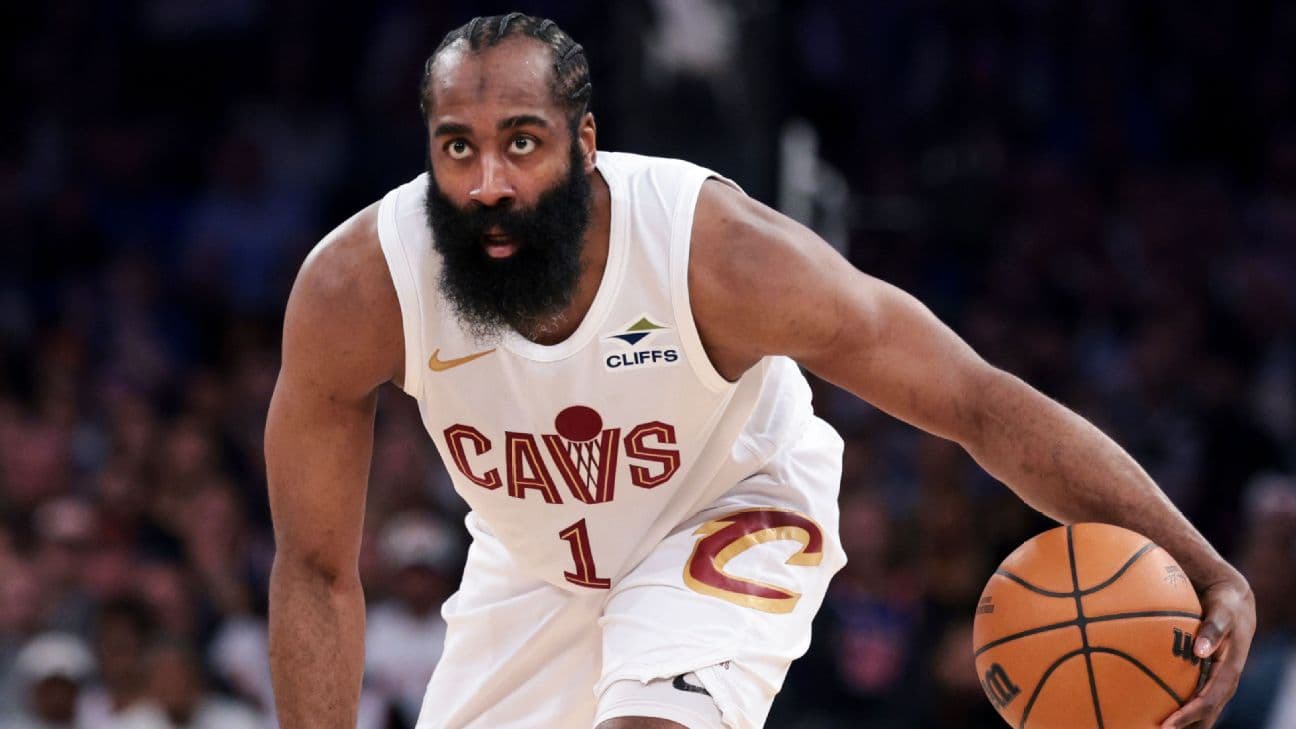
Cleveland announced on Tuesday that it had officially re-signed James Harden, completing a three-year, $97 million agreement that had been reached nearly three weeks earlier. The contract includes a player option for the 2028-29 season and a trade kicker. Harden declined a $42.3 million player option for the coming season to reach the new deal.
At 37, Harden becomes the second player in league history to sign for more than $90 million in guaranteed salary at that age or older. The Cavaliers acquired him during the previous season in the trade that sent Darius Garland to the Clippers, and Cleveland was swept in four games by the eventual champion Knicks in the Eastern Conference finals.
What Cleveland is actually buying
This is not a bet on Harden's peak. It is a bet on the specific skill that ages best in basketball: the ability to create shots for other people out of a live dribble without needing athleticism to do it.
Harden's game has been migrating in that direction for years. The step-back three and the drawn foul are less central than they were, and the pick-and-roll operation is more central. That is a skill set that holds up into a player's late thirties in a way that a downhill scorer's does not.
The risk is the term. A three-year commitment to a player entering his age-37 season means the final year covers his age-39 season, and there is no version of that contract that ages well on the books. Cleveland is accepting that cost to keep a competitive window open now.
Fantasy fallout
Harden's fantasy profile is one of the most stable in the sport, and that is the point. Assists, three-point volume and free throws are the three categories he has produced regardless of team, role or age, and all three are counting statistics that reward the high-usage, ball-dominant role he will retain in Cleveland.
The scoring average is where the decline shows. Managers drafting him should project a solid but unspectacular points total and value him primarily for the peripherals. In category leagues, that makes him a top-40 asset. In points leagues, it makes him closer to a fringe starter.
The bigger question is games played. A 37-year-old guard with a long injury history playing a heavy-usage role on a team with title expectations is a candidate for rest nights, particularly in the second half of the season. Cleveland has every incentive to protect him for the playoffs.
The Cavaliers' complementary pieces are the beneficiaries. Every night Harden sits, the players who absorb his ball-handling load produce inflated lines, and that is a specific pattern worth planning around in daily fantasy formats where late scratches create value.
The Verdexed model take
Cleveland's championship price is the market this affects, and the effect is smaller than the news volume suggests. The agreement was reported in August. The formal signing on Tuesday is a procedural step, not new information, and anyone treating it as a fresh input is trading on old news.
The more useful observation is what the sweep in the conference finals implies. A team that reached that round and was eliminated in four games has a specific problem, and it is rarely fixed by re-signing the players who were on the floor for the sweep.
Cleveland's win total should be treated as roughly correct. Its championship price should be treated as slightly short, because the market rewards continuity in a conference that just watched a team win a title with a different formula.
The interesting position is on the Eastern Conference field. Miami added a two-time Most Valuable Player over the summer, Toronto just completed its own star acquisition, and the Knicks are defending a championship. A Cleveland roster built around a 37-year-old guard is not obviously the second-best team in that group, and its conference price often implies that it is.
What it means for your draft
Draft Harden for assists and three-pointers, not for points. He is a category specialist at this stage of his career, and paying a top-25 price for him is paying for a scoring profile he no longer has.
Handcuff the situation if your league format rewards it. In deep leagues, rostering the Cleveland guard most likely to absorb usage on a Harden rest night is a cheap way to convert a predictable pattern into weekly production.
Avoid Harden entirely in leagues with strict games-played requirements. A player with this age profile and this role is going to miss nights, and a format that penalizes absences is the wrong place to own him.
The Darius Garland trade is the frame for all of this
Cleveland acquired Harden by trading Darius Garland to the Clippers during the previous season. That transaction is the context for the extension: having given up a younger guard to get him, the Cavaliers had limited leverage in a negotiation where the alternative was watching Harden leave for nothing.
That is not a criticism of the decision so much as an explanation of the price. Teams that trade meaningful assets for a player on an expiring or opt-out contract almost always end up paying above market to keep him, because the cost of the original trade is sunk and the cost of losing him is total.
The fantasy implication is straightforward and useful: Cleveland is committed to Harden as its primary ball handler, and there is no plausible scenario this season in which the Cavaliers reduce his role for basketball reasons. Whatever usage he has in October, he keeps.
The extension deadline context
The signing also lands in the middle of the league's remaining offseason business. The October extension deadline is the last date on the calendar with real consequences, and teams across the league are working through their own decisions on players approaching free agency.
For fantasy managers, that is a reason to hold off on finalizing draft rankings until the deadline passes. Extension news does not usually change a player's role, but it does change the probability that a player is traded mid-season, which is the single largest source of in-season fantasy volatility.
What is next
Training camp will tell you how Cleveland intends to use him. The number to listen for is the projected minutes load, because a team that plans to run him at his historical minutes is a team that has not learned from the sweep, and a team that plans to cut those minutes is telling fantasy managers to lower every counting-stat projection accordingly.