 NFL2026-07-28
Bijan Robinson and Jahmyr Gibbs Headline an RB Extension Market That Could Reset the Position
By Verdexed Fantasy Desk
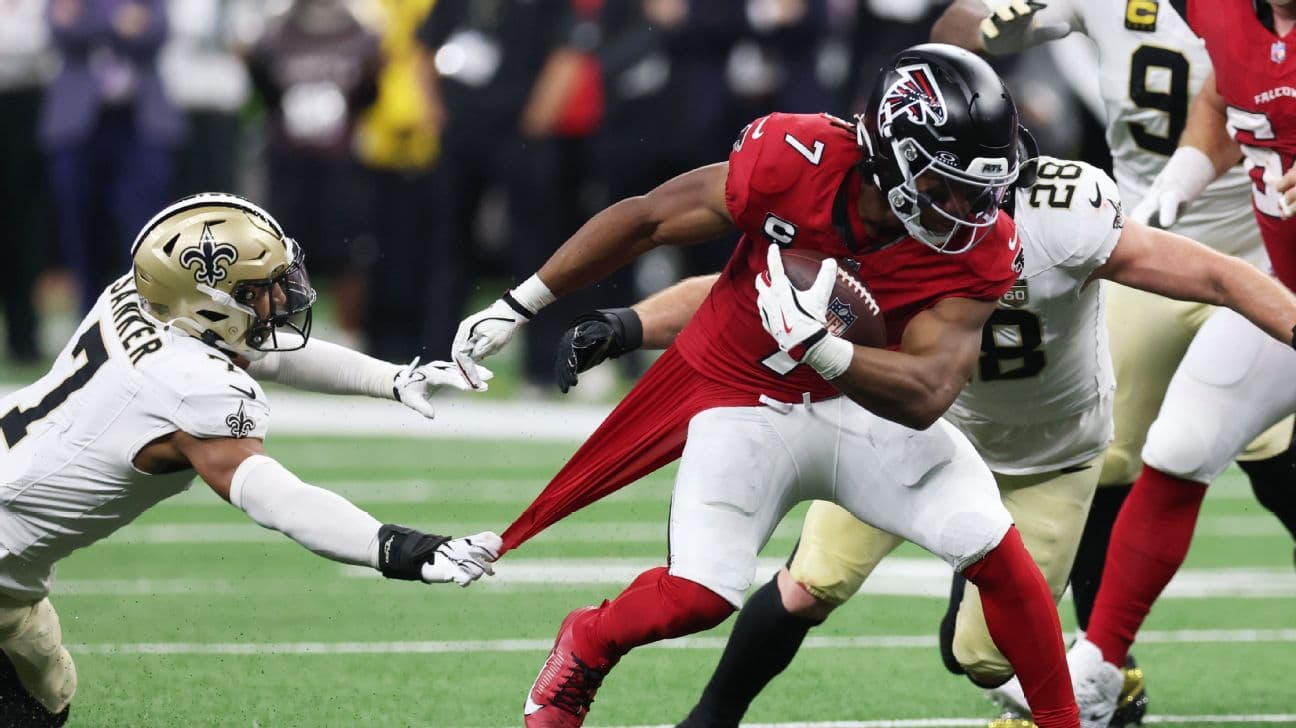
Bijan Robinson and Jahmyr Gibbs are the two most valuable non-quarterbacks in fantasy football, they are the consensus top two picks in 2026 drafts, and neither has a long-term contract. Both became extension-eligible this offseason. The Falcons have engaged Robinson's camp on a deal without completing one, and Detroit has been widely expected to make Gibbs the highest-paid running back in the league whenever it decides to act. Camps are open, and neither situation is resolved.
That matters to fantasy managers for a reason that has nothing to do with salary cap trivia. The single largest risk to a first-overall fantasy pick is a player who is not fully participating in camp, and the single most common cause of a star running back not fully participating in camp is an unsigned extension.
Where each situation actually stands
Atlanta has less pressure than Detroit does. The Falcons picked up Robinson's 2027 option earlier this offseason, which buys them a full extra year of control and removes the urgency that drives most of these negotiations. Atlanta also recently completed an extension with Drake London, which demonstrates both a willingness to pay and a finite pool of cash to pay with. Robinson and the Falcons return to Flowery Branch for camp practice on July 29, with the first open practice scheduled for July 31.
Detroit's timeline is looser still. Gibbs is entering camp on his rookie deal, which runs through the 2027 season, and he has made three Pro Bowls in three years. Reporting around the league has consistently pointed toward Detroit resetting the running back market when it moves, with four years being the customary structure for Lions extensions. Whether Gibbs participates fully to open camp has been framed as at least partly dependent on whether the deal gets done.
The production case for each
Robinson is coming off a career-best season in which he led the NFL in scrimmage yards. He rushed for 1,478 yards and seven touchdowns and added 79 receptions for 820 yards and four touchdowns, totaling 2,298 yards from scrimmage. That is a workload profile with no obvious weakness: he is the primary rusher, the primary passing-down back, and the offense's most reliable weapon.
Gibbs is the efficiency and touchdown case. He led the league with 16 rushing touchdowns in 2024 on 250 carries for 1,412 yards, then followed with 243 carries for 1,223 yards and 13 touchdowns in 2025. He finished third among running backs in both targets and receiving yards last season and was the overall RB3 in fantasy points per game, and he has never finished lower than RB8 in points per game in his career.
The debate that has split the fantasy industry since spring is essentially this: Robinson is a larger share of a worse offense, Gibbs is a smaller share of a better one. Robinson held the 1.01 in most consensus rankings through the spring, with Gibbs closing the gap as the higher-ceiling play at effectively the same cost.
Why the contract is a fantasy input, not a footnote
Running backs who hold in during camp almost never miss regular season games. What they miss is padded practice reps, install work, and preseason chemistry with a line that may have new pieces. The historical effect on Week 1 through Week 4 production is real but modest, and it is smaller for established veterans in stable systems than for young players learning new roles. Both Robinson and Gibbs are established veterans in stable systems, which caps the downside.
The larger risk is the tail. A hold-in that becomes an actual holdout, or a dispute that sours into the season, is the scenario that turns a 1.01 into a wasted first-round pick. That scenario is unlikely for both players, but it is not zero, and the price of the pick means the cost of being wrong is maximal.
The Verdexed model take
Verdexed's model prices contract disputes through availability and role rather than through sentiment, and on both counts these two situations look benign. Neither team has an incentive to let the standoff reach the regular season: Atlanta has a young offense built around Robinson's touch volume, and Detroit's offensive identity is difficult to reconstruct without Gibbs. The model's expected games played for both backs remains near the top of the position.
Where the model diverges from consensus is on the tiering. It reads the gap between the top two backs and the rest of the position as wider than the market prices it, which argues for taking either Robinson or Gibbs at 1.01 and 1.02 without agonizing over the order. The ordering decision is worth far less than the decision to secure one of them at all.
What to do in your league
Draft them. The contract noise is not a reason to fade either player, and any manager who slides one of them down the board for a healthy back at 1.03 is trading real production for imagined safety. If you are drafting in the next two weeks and one of the two has signed, take the signed player if you are genuinely torn: the tiebreaker cost is close to zero and the peace of mind is free.
For the rest of the position, the ripple effect is the story to watch. Whichever back signs first sets a number, and every running back extension for the next two years will be negotiated against it. In dynasty leagues, that raises the long-term security of every young workhorse back and lowers the odds that teams continue to treat the position as disposable. That is a quiet argument for buying elite young backs in dynasty at a moment when the market still discounts them on positional principle.
What's next
Both teams open camp this week. The first meaningful signal is participation: full pads, full reps, no manufactured rest days. If Robinson practices normally on July 31 in Atlanta's first open session and Gibbs does the same in Detroit, the story is over for fantasy purposes and the only thing left is the number.
If either player is conspicuously limited into August, the calculus changes for exactly one reason: an August that ends without a deal makes a September distraction more likely. That is the point at which a manager holding the 1.01 should start caring about a contract.