 NFL2026-07-07
Tuli Tuipulotu Contract Standoff: A Chargers Pass Rusher Eyes a Hold-In as Camp Nears
By Verdexed NFL Desk
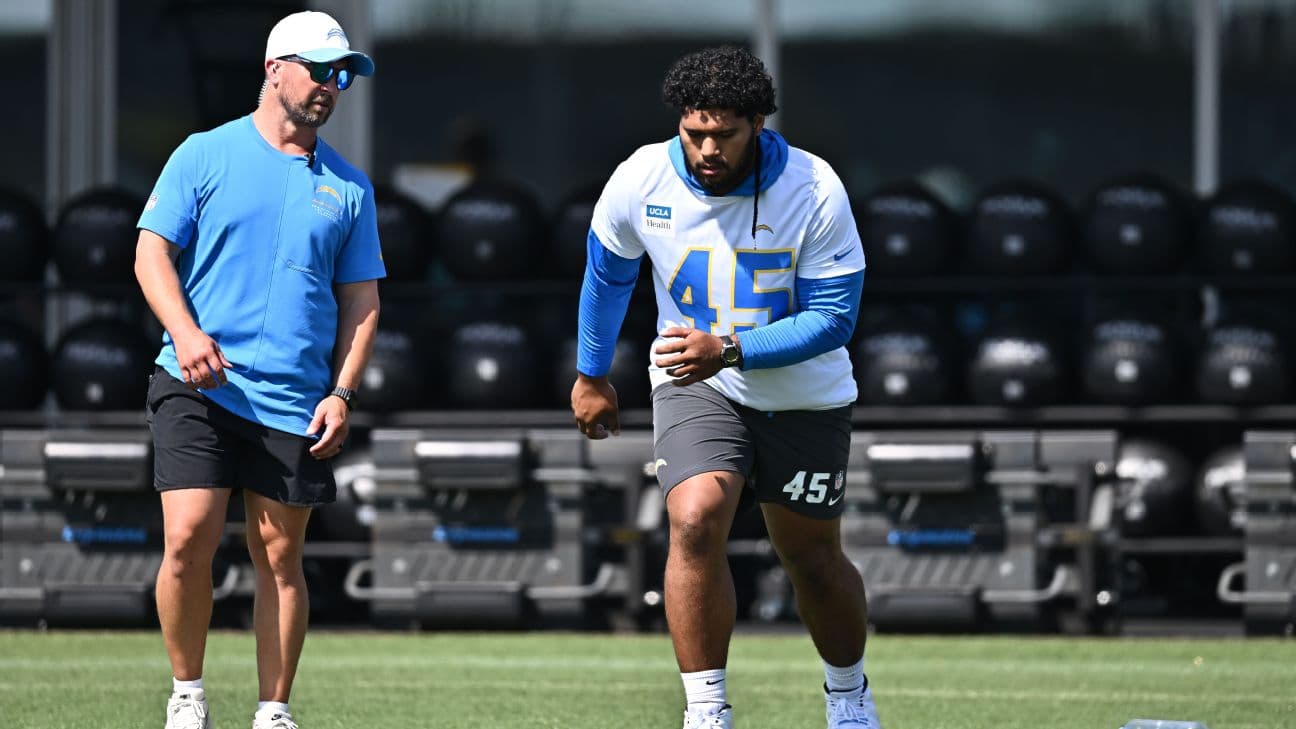
Los Angeles Chargers edge rusher Tuli Tuipulotu is entering the final year of his rookie contract without an extension, and he has not ruled out a training-camp hold-in if a new deal is not reached. Coming off a breakout season in which he posted 13 sacks and earned Pro Bowl honors, Tuipulotu is exactly the kind of ascending young pass rusher whose contract situation becomes a summer storyline, and one with real implications for the Chargers' defense, their team win total, and season-long sack markets.
A hold-in is distinct from a holdout: the player reports to camp and avoids fines, but participates in a limited capacity to protect himself while negotiations continue. It is the modern leverage play, and Tuipulotu keeping the option open signals a negotiation that has not yet crossed the finish line.
The state of the negotiation
Tuipulotu, a 2023 second-round pick, is playing on the final year of his rookie deal. Chargers management indicated extension talks were expected to pick up after the draft, and market estimates for a rusher of his production and age land in the range of a multi-year deal averaging north of $18 million per season. Tuipulotu himself has publicly said he intends to be with the team regardless of contract status, deferring the negotiation to his agent, which reads as a player who wants to be paid but is not looking to create a public standoff.
That framing matters. A player who says he will report and practice is not signaling a disruptive holdout, and the hold-in possibility is a fallback rather than a threat. The Chargers have already handled one significant defensive extension this offseason, and locking up a productive homegrown edge rusher on a second contract fits a roster building around its defense.
Why it matters for the defense and the betting board
Tuipulotu's production is central to the Chargers' pass rush. A player coming off a 13-sack season is a foundational piece of a defense that leaned on getting after the quarterback, and any reduction in his camp reps, even a temporary one, can affect a unit's timing and continuity heading into the season. For a team whose win total is priced with the expectation of strong defense, the health and readiness of its best young rusher is a genuine input.
The cleaner betting angle is Tuipulotu's own sack market. A rusher coming off a career year often sees his season-long sack total set at an ambitious number, and the questions around his camp participation and whether he takes a step forward or regresses toward his earlier production are exactly the variables that create value on either side of that line. A limited camp is not disqualifying for a proven player, but it is a factor to weigh before betting the over on an aggressive number.
The Verdexed model take
Verdexed's model treats the contract situation as noise that is unlikely to meaningfully dent Tuipulotu's on-field impact, given his own stated intent to report and practice. The more interesting modeling question is whether his 13-sack season is a new baseline or a spike. Sack totals are notoriously volatile year to year, tied heavily to pressure opportunity, scheme, and the quality of the pass rush around a player, and the model tends to project a modest regression from a career-best sack number even for a genuinely improved rusher.
Applied to the betting board, that means the model leans cautious on any sack prop set at or above his breakout total, while still valuing him as a high-end pressure generator whose underlying rush metrics support continued production. For team markets, the model sees the Chargers' defense as a strength that a resolved Tuipulotu deal would only reinforce, and a prolonged standoff as a mild downside risk rather than a season-altering one.
The IDP and dynasty angle
For managers in leagues that count individual defensive players, Tuipulotu is a legitimate asset, and the contract situation is worth tracking through that lens as well. A productive edge rusher entering a contract year is often extra-motivated, which can be a tailwind for his tackle and sack production, and IDP formats reward exactly the pressure and disruption he provides. A resolved extension would remove any lingering worry about his camp participation, while a prolonged hold-in is a minor caution for his early-season reps rather than a reason to fade him.
In dynasty IDP formats, a second contract that keeps Tuipulotu in a defense-first scheme is a mild positive, since role and scheme stability underpin long-term production. The likeliest outcome, a deal that keeps him in Los Angeles, would cement him as a reliable IDP starter with upside tied to how the Chargers generate pressure around him.
What it means
For bettors, the takeaway is to watch two things: whether the Chargers get an extension done before or during camp, which would remove any participation risk, and where the market sets Tuipulotu's season sack total. If the number chases his career-best mark, the model's regression lean makes the under worth a look; if it is set conservatively, his rush profile supports the over. Either way, treat the contract drama as a secondary factor rather than the headline.
For the Chargers, resolving this is straightforward roster management. Paying a productive, ascending edge rusher on his second contract is the cost of keeping a defense-first roster intact, and getting it done before camp would eliminate the one variable that could disrupt an otherwise clean preparation. The likeliest outcome remains a deal that keeps Tuipulotu in Los Angeles, with the hold-in serving as leverage rather than a real threat to his season.