The Rams Are Carrying Five Tight Ends Into Camp, and That's a Fantasy Fade for All of Them
By Verdexed Fantasy Desk
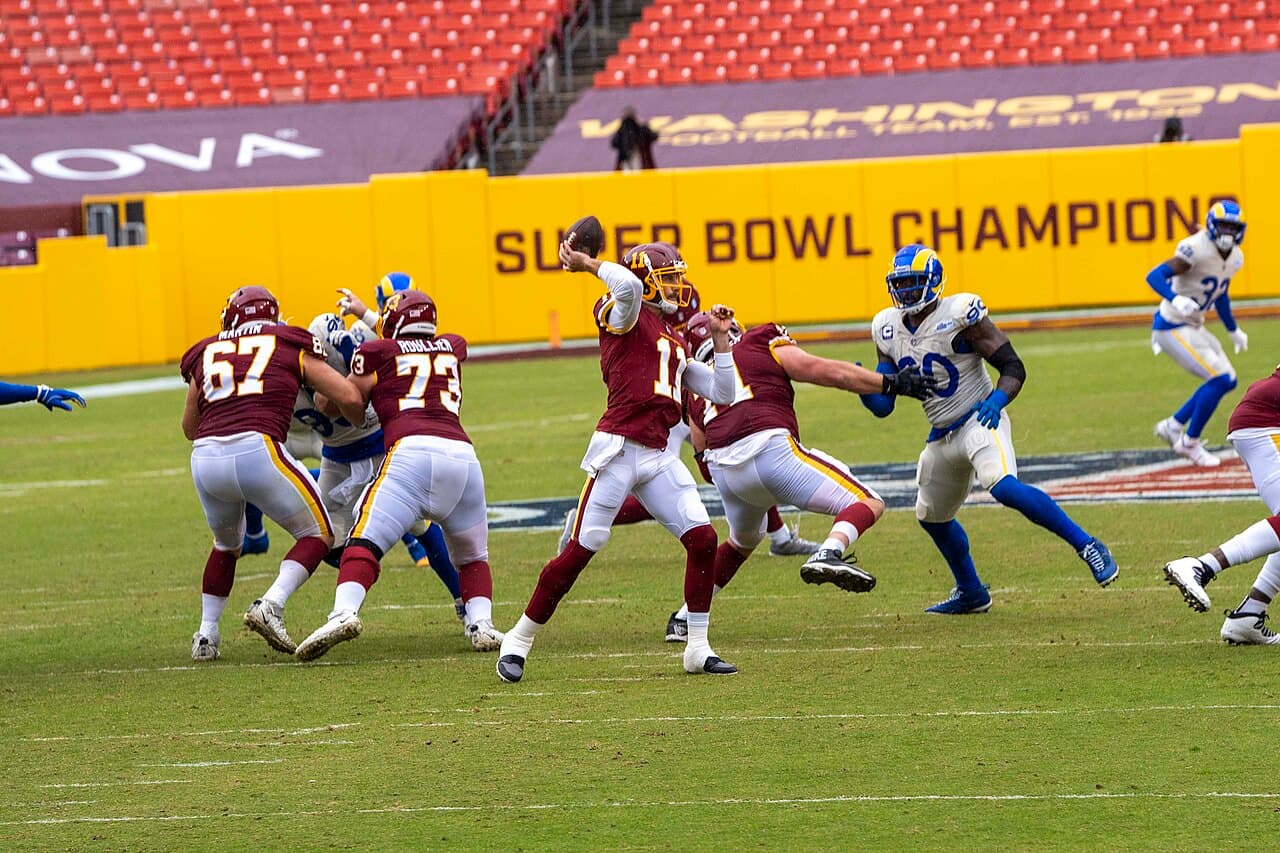
The Los Angeles Rams opened training camp with five tight ends who all have a credible case to make the 53-man roster, and the reporting out of camp suggests that is not an accident. Terrance Ferguson, Colby Parkinson, Tyler Higbee, Davis Allen and second-round rookie Max Klare are all in the building, and Los Angeles is the rare team that might actually keep the whole group.
The usage data explains why. The Rams ran 331 plays in 13 personnel last season, meaning one running back and three tight ends, which was more than twice as many as any other team in the league. That is not a tendency. That is an identity. A team building an offense around three-tight-end sets needs the bodies to run it, and Los Angeles has spent draft capital in consecutive years to get them, taking Ferguson and then Klare at No. 61 overall in April.
For a fantasy manager, all of that is a warning rather than an invitation.
Volume without a beneficiary
The instinct when a team leans this hard into a position group is to find the player who benefits. In most offenses that logic holds. A team that throws to tight ends produces a startable tight end.
The Rams broke that pattern last season, and the numbers show it plainly. Higbee, Parkinson, Allen and Ferguson combined for 103 receptions, 1,128 receiving yards and 17 touchdowns. That is a genuinely productive tight end room in aggregate. Split four ways, it is four players who each finished well outside the range where anyone starts them.
Seventeen touchdowns is the number that will tempt people, because touchdowns are what make tight ends usable. But touchdowns distributed across four bodies are worse than useless in fantasy: they are actively harmful, because they arrive unpredictably in the weeks you started the wrong one. A room that scores 17 times and never tells you who is scoring is a room to avoid entirely.
Adding a fifth body makes the distribution worse, not better.
Where each player actually stands
Terrance Ferguson is the one with the clearest path, and the reporting suggests he is best deployed in the slot or flexed wide, which is the alignment that produces targets rather than blocks. He is the only player in this group with a realistic route to a defined receiving role. He is also entering his second season, which is when tight ends typically make their leap.
Tyler Higbee remains the veteran with the longest relationship with the offense and the most reliable blocking assignment. That is valuable to the Rams and worth nothing in fantasy.
Colby Parkinson and Davis Allen occupy the middle of the room, competing for snaps that come with situational rather than volume roles.
Max Klare enters as the fifth tight end on the depth chart. Los Angeles has a well-established pattern of bringing rookies along slowly, and the local coverage is clear-eyed that Klare is unlikely to have a rookie-year impact and should instead develop alongside Ferguson. A second-round rookie fifth on a depth chart is a dynasty asset, not a redraft one.
Fantasy fallout
The actionable conclusion is simple: do not draft a Rams tight end in a redraft league. Not Ferguson, not Higbee, not Parkinson, not Klare. The position is deep enough in 2026 that there is no reason to take on a four-way or five-way split when players with defined roles are available at the same cost.
The secondary consequence is more useful. Every snap Los Angeles spends in 13 personnel is a snap not spent in three-receiver sets, and that suppresses the Rams' wide receiver volume relative to what a team with this passing reputation would normally produce. Managers evaluating Los Angeles receivers should apply a discount for personnel usage that most rankings do not.
It also means the Rams' running backs face lighter boxes less often than the raw play-calling suggests, because three-tight-end sets invite defenses to add bodies to the box. Los Angeles's rushing efficiency has to come from scheme rather than numbers advantage.
The Verdexed model take
Our projection system models tight end fantasy value as a function of route participation rather than snap count, and the distinction is exactly what the Rams expose. A team can lead the league in tight end snaps while producing no player who runs enough routes to matter.
Los Angeles has the widest tight end target dispersion of any team in our 2026 model, and Ferguson's projection is the only one in the room that clears replacement level. Even his projection carries a large downside tail, because a fifth body arriving via the second round is a signal that the Rams intend to keep rotating rather than consolidate.
The more interesting model output is on the team level. Our system projects the Rams to run fewer three-receiver sets than the market's implied assumption, which pulls their projected passing volume down slightly and their projected rushing rate up. That is a modest adjustment on its own, and it compounds when applied to individual receiver projections.
Betting angle
Season-long receiving props for Rams tight ends should be shaded to the under across the board, and the reason is structural rather than talent-based. Prop-setting for a position group this fragmented tends to anchor on the previous season's leader, which ignores that the leader changes.
The Rams' team rushing attempt total is the other side of the same coin. An offense that lives in 13 personnel is an offense that runs, and if that number posts at a level consistent with a modern pass-first team, the over is the value.
Anytime touchdown markets for Rams tight ends in individual games are unbettable in either direction. Five plausible scorers means no edge exists.
What to do in your league
Skip the room in redraft. There is no version of this that ends with a startable weekly tight end, and the opportunity cost of finding out is a roster spot you need elsewhere.
In dynasty, the calculus flips for two players. Ferguson is a legitimate hold, because a second-year tight end with slot usage in a high-volume offense is the standard profile of a year-three breakout. Klare is a buy at a discount, because rookie tight ends buried on depth charts are the cheapest they will ever be, and the Rams did not spend pick 61 on a career backup.
If you are in a best-ball format, the Rams room is more interesting than in managed leagues, because best ball rewards spike weeks and a five-way rotation produces plenty of them. Even there, the play is one shot on Ferguson at the back of the draft, not exposure to multiple players in the same room.
What's next
The number to watch through the preseason is not receptions. It is alignment. If Ferguson is lining up detached from the formation on the majority of his snaps, he has a receiving role and his projection moves. If the Rams keep rotating all five through in-line positions, the room stays what it was last season: productive in total, useless in parts.