 NFL2026-07-04
Raiders Expected to Start Kirk Cousins Over No. 1 Pick Fernando Mendoza: A Dynasty Buy-Low Is Forming
By Verdexed NFL Desk
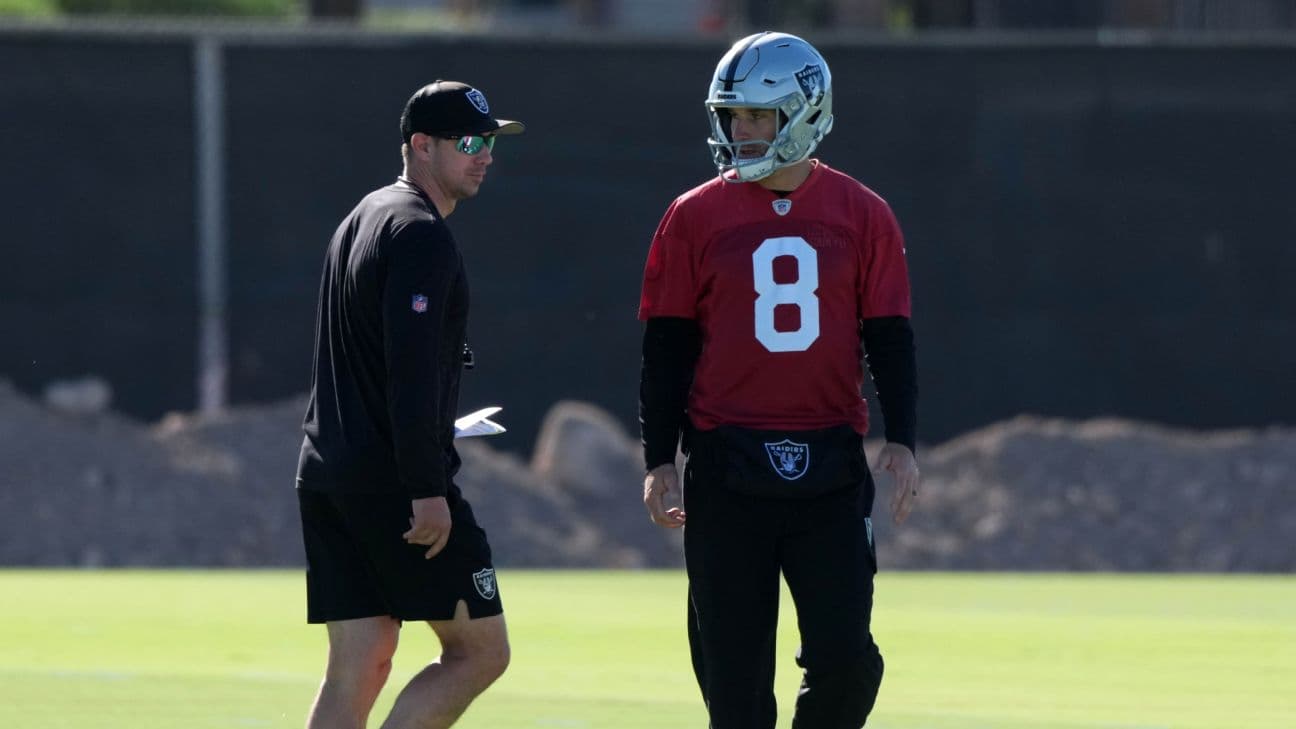
The Las Vegas Raiders appear set to open the season with veteran Kirk Cousins under center rather than Fernando Mendoza, the quarterback they made the first overall pick of the 2026 draft. Per reporting from Adam Schefter, the Raiders are expected to want Cousins to start the year, an unusual plan that sits the top pick to begin his career. Cousins took first-team reps at OTAs, and head coach Klint Kubiak has reportedly said all three of Cousins, Mendoza, and Aidan O'Connell will get first-team work in camp while stopping short of naming a starter. For fantasy managers, this shapes up as a classic bridge-quarterback situation with a clear dynasty angle underneath it.
The setup
Cousins signed with Las Vegas in free agency and immediately became the veteran presence in a room that also includes Mendoza, O'Connell, and Jacob Clark. Kubiak has framed the competition as genuinely open, saying he would be comfortable with any of the top three starting, but the practical signal, veteran first-team reps in the spring plus reporting that the club wants Cousins to open, points toward the rookie sitting to begin the year. Cousins has publicly rejected the idea that he is simply a mentor, describing the room as a collective approach rather than a handoff in waiting.
That framing matters because it tells you the Raiders are not committing to a fixed timeline out loud. A veteran-over-rookie plan is inherently unstable, especially when the rookie was the first pick in the draft. The moment the veteran struggles or the team falls out of contention, the pressure to see the future begins to build.
Why this is a dynasty story
Mendoza is the reason to pay attention. A No. 1 overall quarterback who sits to open his career is exactly the kind of asset whose dynasty value dips in the short term and spikes the instant he is named the starter. Managers who believe in the long-term profile can often acquire that type of player at a relative discount during the window when a veteran is holding the job, then reap the payoff when the switch is made.
Kubiak's scheme is the added wrinkle. A run-heavy, play-action system shapes the value of everyone around the quarterback, which means the Raiders backfield and pass-catchers project through the lens of a ground-based offense regardless of who starts. That is context for evaluating the skill players as much as the quarterbacks.
Fantasy fallout
In redraft, Cousins is a deep-league streamer at best if he opens as the starter, the kind of quarterback you use in a plus matchup rather than roster every week. His fantasy ceiling is capped by both his age-related mobility limits and Kubiak's run-leaning approach. Mendoza has essentially no redraft value while he sits, but he becomes a relevant streaming and upside option the moment he takes over, particularly given the rushing juice a younger quarterback can add.
The skill players are the steadier bets. A run-heavy scheme supports the Las Vegas backfield and gives the lead back a workload worth targeting, while the pass-catchers project as volume-limited in a ground-first attack. None of that changes dramatically based on which quarterback starts, which is why the model treats the Raiders skill group as more stable than the quarterback room.
The betting angle
Week 1 starter props are the live market, and any camp momentum for Mendoza would move that line quickly given the instability of benching a top pick. Bettors should also watch the Raiders team total, which is sensitive to both the quarterback plan and Kubiak's pace and pass-rate tendencies. A rookie taking over midseason would raise Las Vegas's offensive variance, which matters for game totals down the stretch. The base case, a veteran opening behind a run-heavy scheme, points to a lower-variance, lower-ceiling offense early.
The Verdexed model take
The model treats Cousins as the likely Week 1 starter but assigns meaningful probability to a Mendoza takeover during the season, which is the standard arc for a bridge-veteran plan in front of a first overall pick. It prices Cousins as a low-ceiling streamer and Mendoza as a dynasty and best-ball buy whose value is suppressed now and set to climb on a starting nod. The skill players are graded through Kubiak's run-first scheme, which supports the backfield and tempers the pass-catchers.
The practical read: in dynasty, this is a buy-low window on Mendoza, whose price is depressed by the sitting plan and whose upside pays off when he plays. In redraft, stream Cousins only in favorable matchups and keep Mendoza on the watch list as a mid-season addition.
What to do in your league
Dynasty managers should be making calls on Mendoza now, while the veteran plan holds his price down. Redraft managers should let the room settle and treat Cousins as a matchup-based streamer rather than a roster staple. And anyone rostering Raiders skill players should lean into the run-heavy context, which favors the backfield over the passing game regardless of who lines up at quarterback.
What is next
The first checkpoint is the Week 1 starter decision, which reporting suggests will be Cousins but which camp could still complicate. The second, and more important for dynasty, is how long the leash on the veteran lasts once games begin. A slow start or a fading playoff picture is what typically accelerates the timeline for a No. 1 pick, and the model keeps Mendoza flagged as a rising asset the whole way.