Porter Martone Opened as the Calder Favorite and the Flyers Second Line Is Why
By Verdexed NHL Desk
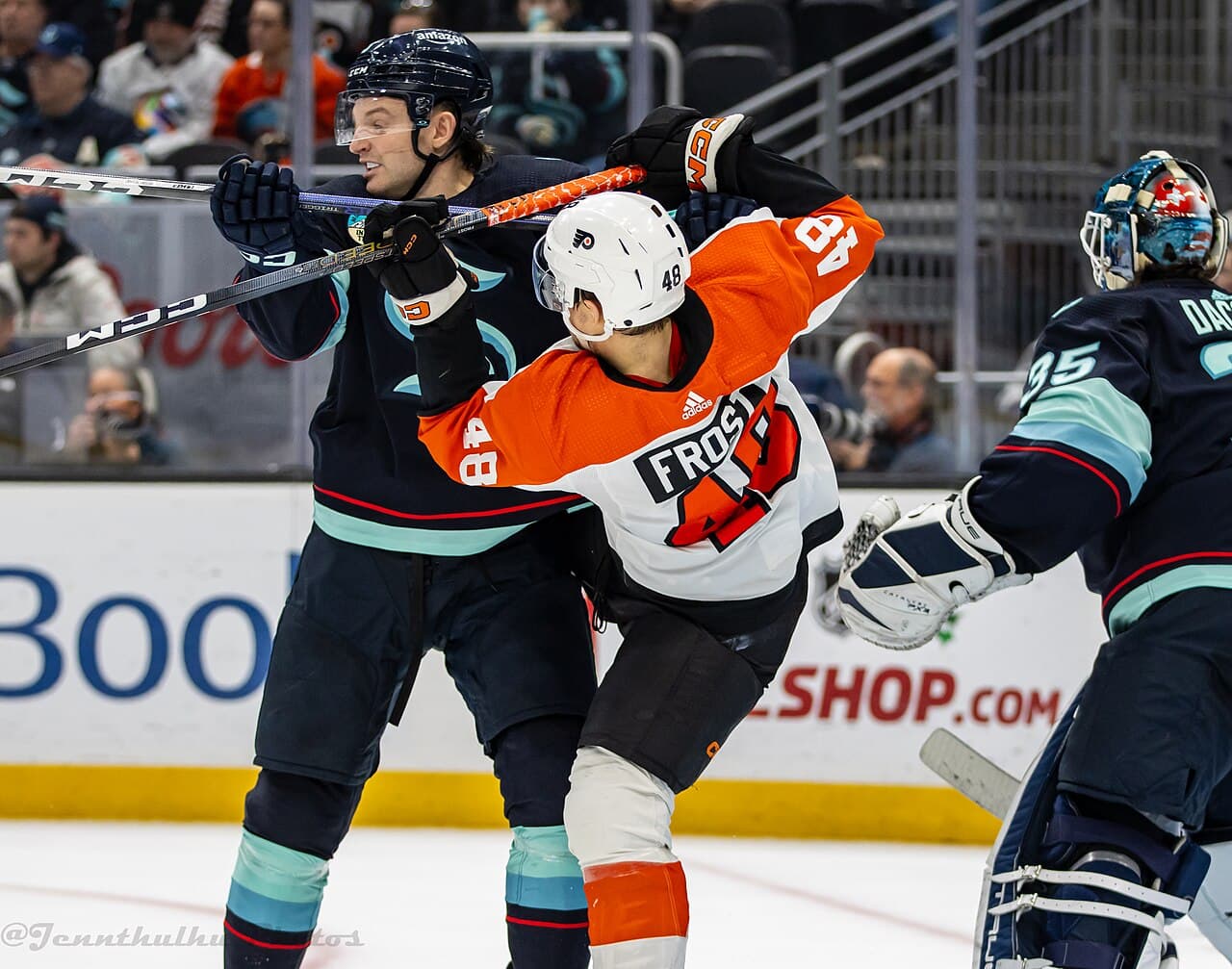
The early market for the 2026-27 Calder Trophy has a favorite, and it is not the player who went first overall. Philadelphia Flyers winger Porter Martone opened as a narrow favorite in publicly posted sportsbook markets, sitting just ahead of Toronto Maple Leafs No. 1 pick Gavin McKenna, with San Jose's Ivar Stenberg, Chicago's Anton Frondell and Washington defenseman Cole Hutson forming the next group.
That ordering says something specific about how rookie awards actually get decided, and it is worth understanding before fantasy hockey drafts open.
Why Martone and not McKenna
McKenna is the better prospect. Toronto selected him first overall in the 2026 draft after a season at Penn State in which he set or tied nine school records, was the only unanimous selection to the Big Ten All-Freshman Team, and topped Central Scouting's final ranking of North American skaters. He added 14 points in seven games for bronze medal-winning Canada at the World Junior Championship before closing his college season with 33 points in his final 19 games.
None of that is in dispute. The Calder is not a best-prospect award, though. It is a counting-stats award, and counting stats are a function of ice time, linemates and power play deployment.
That is where Martone has the edge. He is a year further along, having already played nine NHL regular season games after leaving Michigan State, where he produced 25 goals and 50 points in 35 games as a freshman. In that brief NHL look he registered four goals and 10 points with 32 shots and 16 hits, which is a rate of production that translates to a real top-six role rather than a sheltered one.
Philadelphia's projected lineup reinforces it. With Trevor Zegras expected to center a top line alongside Tyson Foerster and Travis Konecny, the second line is where Martone slots, and a second-line winger on a team with that top-six structure gets meaningful five-on-five minutes and a legitimate case for power play time.
The fantasy read
The market ordering and the fantasy ordering are not the same thing, and confusing them is the most common rookie-draft mistake.
Martone is the better fantasy asset in one-year leagues for the same reason he is the Calder favorite: role clarity. A winger with an established NHL sample, a defined line assignment and a physical game that produces hits and shots has a floor in multi-category leagues that a rookie without those things does not. His hit and shot volume in a nine-game sample is the underrated part of his profile, because those categories are far more stable year over year than goal-scoring rate is for a teenager.
McKenna is the better dynasty asset by a wide margin, and it is not close. He is the more talented player, he is on a team that has every incentive to build around him, and one season of Calder voting has no bearing on a decade of production.
The players in the next tier are where the actual value sits. Frondell is a particularly interesting case, since he produced 20 goals in 43 games before finishing the year in Chicago with nine points in a dozen games, and he profiles as the second scoring option behind Connor Bedard. Cole Hutson is the defenseman of the group, having posted 32 points in 35 games at Boston University before joining Washington in mid-March and closing with 10 points in 14 NHL appearances. Rookie defensemen who produce at that rate in a late-season audition tend to be badly underdrafted, because fantasy managers apply a blanket discount to first-year blueliners.
The Philadelphia lineup question
Everything about the Martone case rests on where Philadelphia plays him, and that is not yet settled.
Projections of the Flyers lineup have Trevor Zegras centering the top line with Tyson Foerster and Travis Konecny, which is a functional first unit that does not require Martone to carry it. The second line is the one to watch, with Christian Dvorak among the candidates to center it after averaging a career-high in ice time last season.
That arrangement is close to ideal for a rookie winger. A top line that can handle the toughest matchups frees the second unit to play against softer competition, which is where young scorers accumulate points. It also puts Martone in position to earn power play time without having to displace a veteran on the first unit immediately.
The risk is the reverse scenario, in which Philadelphia opens him on the third line to manage his workload. That would not be unusual for a 19-year-old, and it would take him out of the Calder conversation quickly. Camp reporting in late September will settle it.
The Verdexed model take
Our rookie projections weight three inputs above draft position: projected time on ice, projected power play unit, and the quality of the players directly ahead of the rookie on the depth chart. Draft position correlates with all three, but it does not determine any of them, which is why the first overall pick is frequently not the best rookie fantasy asset in his first season.
Martone grades well on the second and third factors. Philadelphia's forward group is good enough to give him quality linemates and thin enough at his position that his path to a scoring role is unobstructed. McKenna's projection is more uncertain, not because of talent but because Toronto's established forward corps means his deployment is genuinely unknown until camp.
The market read follows from the same logic. Calder markets in August are priced almost entirely on name recognition and draft position, and they reprice sharply in October once opening-night lineups are announced. That creates a repeatable pattern: rookies whose training camp reporting confirms a top-six role and power play time see their odds shorten dramatically in the first two weeks of the season, while rookies who open on a third line drift out.
The value, therefore, is not in betting the favorite now. It is in identifying the players in the second and third tier of the market whose projected deployment is better than their odds suggest, and acting before camp reporting closes the gap. Hutson is the name that stands out on that screen, because defensemen are systematically underpriced in Calder markets despite the award having gone to blueliners with regularity.
What to do in your draft
In redraft leagues, take Martone as the highest-floor rookie and do not reach for McKenna above his production projection, however good the long-term outlook is.
In dynasty leagues, the order inverts completely. McKenna first, and it is not a debate.
In every format, keep an eye on the last week of September. Training camp line combinations and power play unit reports are the single most valuable piece of information available for pricing any rookie, and they arrive after most drafts have already happened. The managers who hold a roster spot open until those reports land will get the best rookie value in their league.