 NFL2026-09-11
Patrick Mahomes Will Start Monday Night in a Knee Brace Nine Months After Tearing His ACL
By Verdexed NFL Desk
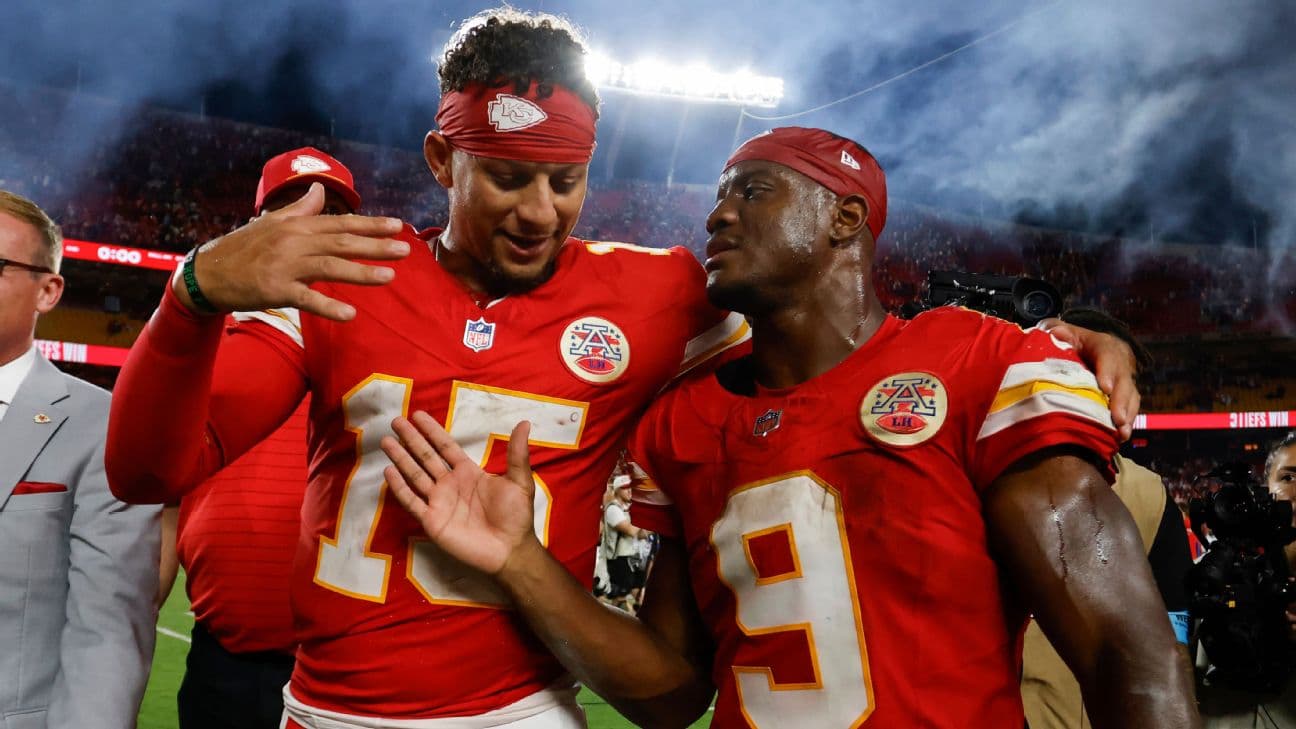
Patrick Mahomes is set to start Kansas City's Monday night opener against Denver, roughly nine months after tearing the ACL and LCL in his left knee during Week 15 of the 2025 season. Andy Reid confirmed this week that Mahomes is on track to play barring a late setback, and that he will wear a knee brace.
The Chiefs have indicated he will play without snap limitations. That is the significant part. A quarterback returning from a multi-ligament knee injury who is cleared for a full workload in Week 1 is a materially different fantasy and betting asset from one being eased back in.
Nine months is fast, and the brace is the tell
An isolated ACL reconstruction typically puts an athlete nine to twelve months from a return to competition. Adding LCL damage usually extends that window, because the lateral structures govern rotational stability and the rehabilitation protocol is more conservative. Mahomes returning at the front of that range, for an opener, is aggressive by any standard.
The brace is standard practice for a first season back and should not be read as a red flag on its own. Plenty of quarterbacks have played entire seasons in a functional brace without any measurable loss of production. What it does signal is that Kansas City is protecting against a valgus force rather than against a straight-ahead athletic limitation, which is consistent with the LCL component of the injury.
The realistic performance expectation is that the arm is fine and the legs are not, at least early. Quarterbacks returning from major knee surgery almost universally throw the ball at their established level while scrambling less, sliding earlier, and taking fewer designed runs. Mahomes' fantasy value has always included a meaningful rushing component, and that is the piece most likely to be missing in September.
Fantasy fallout
Mahomes should be treated as a high-end QB2 or a low-end QB1 for the next month, not as the top-three quarterback his name implies. The passing floor is secure. The rushing upside that historically separated him from the pocket-bound tier is the question, and it will not be answered until he is put in a situation where he has to run.
For managers in superflex or two-quarterback leagues, he is a clear starter, because the replacement level is low and his passing volume alone clears it. In single-quarterback leagues with a healthy alternative, streaming a quarterback with a better matchup is a defensible Week 1 decision.
The downstream effect on Kansas City's pass catchers is more favorable. A quarterback who is less willing to extend plays with his legs throws on schedule more often, which benefits the receivers who work the intermediate area and the tight end who runs option routes. Travis Kelce's usage in particular tends to rise when the quarterback plays in structure.
The running backs benefit as well. If Kansas City leans slightly more on the run early in the season to protect Mahomes, that is a volume boost for a backfield that has been difficult to project.
Betting angle
Denver and Kansas City close Week 1 on Monday night, and the Chiefs are laid at a short number for a home divisional game, which is itself informative. The market is not fully convinced by the Mahomes return, and it is not fully convinced by Denver either.
The most interesting market is the game total rather than the side. A quarterback in his first game back from a major knee injury, in a divisional game against a defense that has given Kansas City trouble, is a profile that argues for a slower, more conservative offensive script. Books tend to set totals for Chiefs games off the offense's historical ceiling, and that ceiling requires the version of Mahomes who creates outside the pocket.
Mahomes' rushing yardage prop is the cleanest individual angle. The under is the play if the number has been set anywhere near his career norms, because everything about a nine-month multi-ligament return argues for fewer designed runs and earlier slides.
Passing props are less clear. If Kansas City is protecting him with a run-heavier plan, attempts fall. If Denver's defense forces the Chiefs to throw, they rise sharply. That is a genuinely two-sided market and it should be left alone.
The Verdexed model take
Quarterback projections that separate passing production from rushing production handle this situation far better than composite rankings do. Mahomes' passing projection is essentially unchanged from his established baseline, because arm talent and processing do not degrade with a knee injury and his supporting cast is intact.
The rushing projection is where the model applies a heavy discount, on the order of a substantial cut to both attempts and yards for the first month. Stacking those produces a weekly fantasy projection several points below his career average, which is exactly the gap between a top-three quarterback and a top-ten one.
The model also applies a small downgrade to Kansas City's implied team total for the same reason. Mobile quarterbacks convert third downs at higher rates, and a mobile quarterback who cannot move is a worse third-down offense regardless of how well he throws.
What's next
The information that matters comes Monday night, not from any practice report. Watch what Mahomes does on third down when the pocket collapses. If he steps up and runs, the discount disappears immediately and he is the quarterback he was. If he throws the ball away, the brace is doing more than protecting a ligament, and his fantasy managers should plan accordingly through September.