 NFL2026-07-21
George Kittle's Achilles Return Is the 49ers' Camp Watch: The Fantasy Read on an Ambitious Timeline
By Verdexed NFL Desk
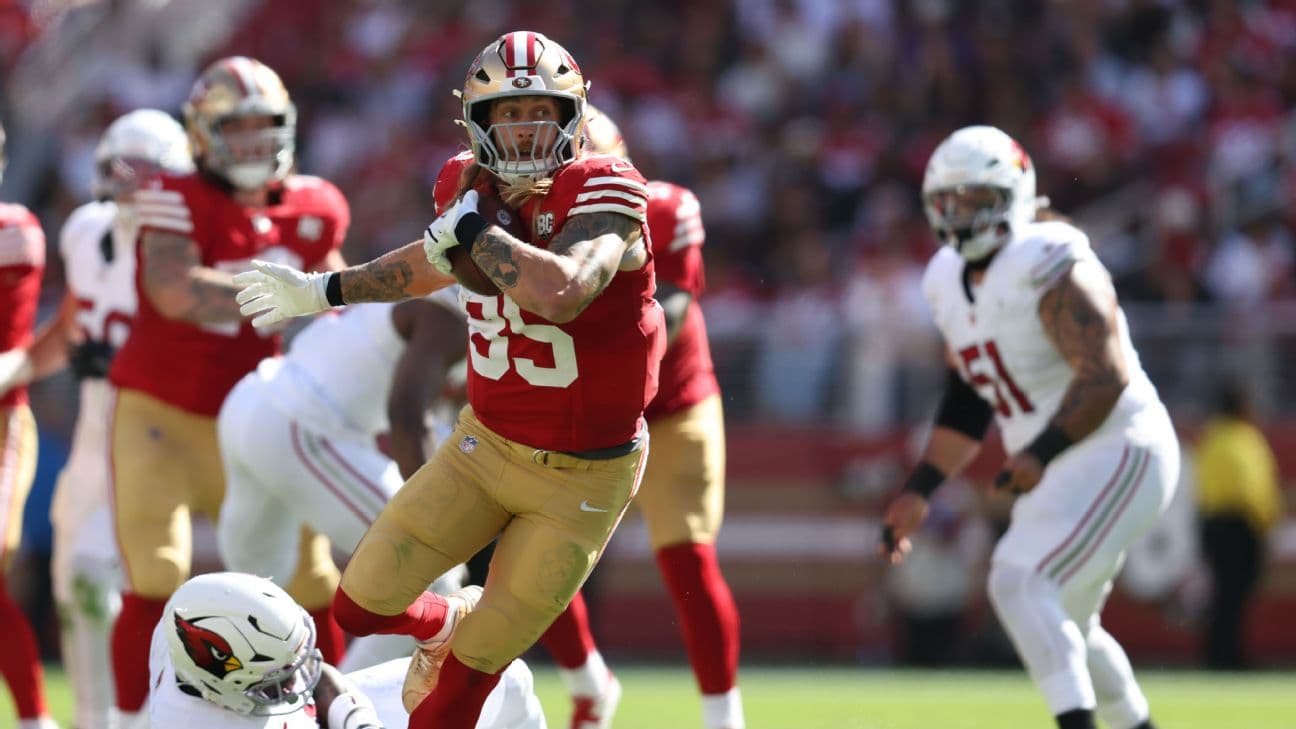
George Kittle is the story to watch as the San Francisco 49ers open training camp, and his recovery from a torn Achilles is the single injury that moves a fantasy price this summer. Kittle suffered the tear on January 11 during the 49ers' playoff win over the Philadelphia Eagles and had surgery shortly after. Six months later, he is publicly pushing an aggressive return timeline, telling reporters he expects to be back well before November and that he has a chance to play in the Week 1 opener. General manager John Lynch has echoed the optimism. For drafters, that turns Kittle into one of the most consequential board decisions at tight end: an elite ceiling attached to a recovery that is not yet finished.
The distinction that matters here is simple. Kittle is not out for the season. He is a player rehabbing an Achilles on an ambitious schedule, and the range of outcomes runs from a Week 1 return to an opening stretch spent on the Physically Unable to Perform list. Getting that nuance right is the difference between a smart discount and a costly overreaction.
The injury and the timeline
The medical picture, by the accounts made public, has been about as favorable as an Achilles tear allows. Reports described the tear as clean and located higher near the soleus, meaning surgeons did not have to drill into the heel, a detail multiple outlets framed as a best-case version of a serious injury. That matters because Achilles recoveries vary widely, and a cleaner repair can shorten the runway.
Kittle himself has fed the optimism. He has described being months out from surgery while already running at speed, doing single-leg box jumps, and cutting with no reported setbacks. His language has been consistent: he is on track, he has a chance at Week 1, and he scoffed at the idea of a midseason return. At the same time, he has been careful to add that nothing is guaranteed and that he intends to push hard without, in his words, being an idiot about it.
The counterweight to the player's optimism is the calendar. A standard Achilles timeline of roughly nine to twelve months would push a return toward the middle of the 2026 season, and even a favorable recovery leaves real risk of a limited camp, a ramp-up rather than a full workload, and the possibility of a PUP designation that would cost him at least the first four games. None of those outcomes is season-ending, but each one changes his early-season fantasy value. The Verdexed model treats an ambitious self-reported timeline as a signal, not a settled fact, and prices the re-injury and limited-camp risk into the projection rather than assuming the best case.
Kittle's fantasy standing when healthy
The reason this recovery is worth tracking is that a healthy Kittle is one of the most valuable tight ends in fantasy football. In 2025 he posted an elite efficiency profile even while missing time, and his chemistry with quarterback Brock Purdy keeps him firmly in the TE1 conversation whenever he is on the field. He is the kind of player who can win a week by himself, and at a position where the drop-off below the top tier is steep, that ceiling is rare and expensive.
That is the drafter's dilemma in one sentence. A fully healthy Kittle profiles as a top-tier tight end, but the Achilles rehab caps the confidence on his early-season availability and workload. The market response has been predictable: he is being valued as a top-12 tight end with a discount attached, a player whose price reflects both the upside and the uncertainty. For managers who can absorb a slow start, that discount is where the value lives. For managers who need week-one production, it is a reason for caution.
The drafter's dilemma: ceiling versus discount
The practical read depends on roster construction and league format. In a one-tight-end league, Kittle at a discount is a defensible swing precisely because the position is so top-heavy; if he returns near full strength, a manager gets elite production at a reduced cost, and the downside is a few missed or limited weeks that a decent streaming plan can cover. The key is to pair the pick with a contingency, whether that is a late-round tight end who can hold the position for a month or the flexibility to stream the spot until Kittle is confirmed at a full workload.
In a format that rewards weekly floor over ceiling, the calculus tightens. A player who might open the season on PUP, or who might return but on a managed snap count, carries early-season variance that not every roster can afford. The disciplined approach is to know the exit ramp before drafting him: a clear backup plan at tight end and a willingness to be patient rather than reactive if the 49ers ease him in.
Who benefits if Kittle misses time
Any Kittle absence redistributes targets in a San Francisco passing game that runs through Purdy. The most direct beneficiaries are the other tight ends on the depth chart, who would inherit the in-line and move roster snaps if Kittle opens on PUP or is limited, making them speculative streaming options in deeper leagues during any absence. The value there is entirely opportunity-driven, so the players to watch are whoever the staff elevates into Kittle's role during camp and the preseason.
The wide receiver room is the other place the targets go. With Kittle's volume off the board, the 49ers' perimeter and slot pass catchers would see a larger share of Purdy's throws, particularly in the intermediate middle of the field where Kittle does his damage. That is a modest but real bump for the pass catchers who stay healthy and hold defined roles. The Verdexed model reallocates projected targets rather than assuming they simply vanish, which is why a Kittle absence nudges the surrounding pass catchers upward even as it lowers his own line.
The Verdexed model take
Verdexed's projection for Kittle is built around availability probability, not just per-game upside. The model separates two questions that the market tends to blur: how good is Kittle when he plays, and how many games does he realistically play at a full workload in the first half of the season. On the first question, the framework keeps him in the top tier of tight ends. On the second, it applies a haircut for the Achilles rehab, the possibility of a PUP start, and the chance of a managed ramp-up even in a Week 1 return.
The result is a ranking that lands Kittle in the top-12 tight end range with a wider band of outcomes than a typical player at that cost. The Verdexed projections treat him as a discounted elite asset rather than a safe every-week starter, and the edge for a reader is to draft him at the point where the discount overpays for the risk. That means letting the market absorb the injury tax, taking him a tick below his healthy price, and building a tight-end contingency into the same roster so an early-season absence is an inconvenience rather than a hole.
What's next
The next signals are concrete and close. Watch the 49ers' first camp practices for whether Kittle is a full participant, on a pitch count, or held out on PUP to open the summer, because that designation is the clearest tell on his Week 1 availability. Any language from the team about easing him in, any report of a setback, and his own practice reps will move his projection in real time. The distinction to keep front of mind is that a PUP or limited tag is a timing question, not a season-ending one. Verdexed will update Kittle's ranking as camp clarifies whether the ambitious timeline holds, and the actionable takeaway is to draft the discount with a plan rather than chase the name or flee the risk.