 NFL2026-07-03
NFL Contract Watch: Kyren Williams Cashes In and the Next Holdout Battles Loom as Camp Opens
By Verdexed NFL Desk
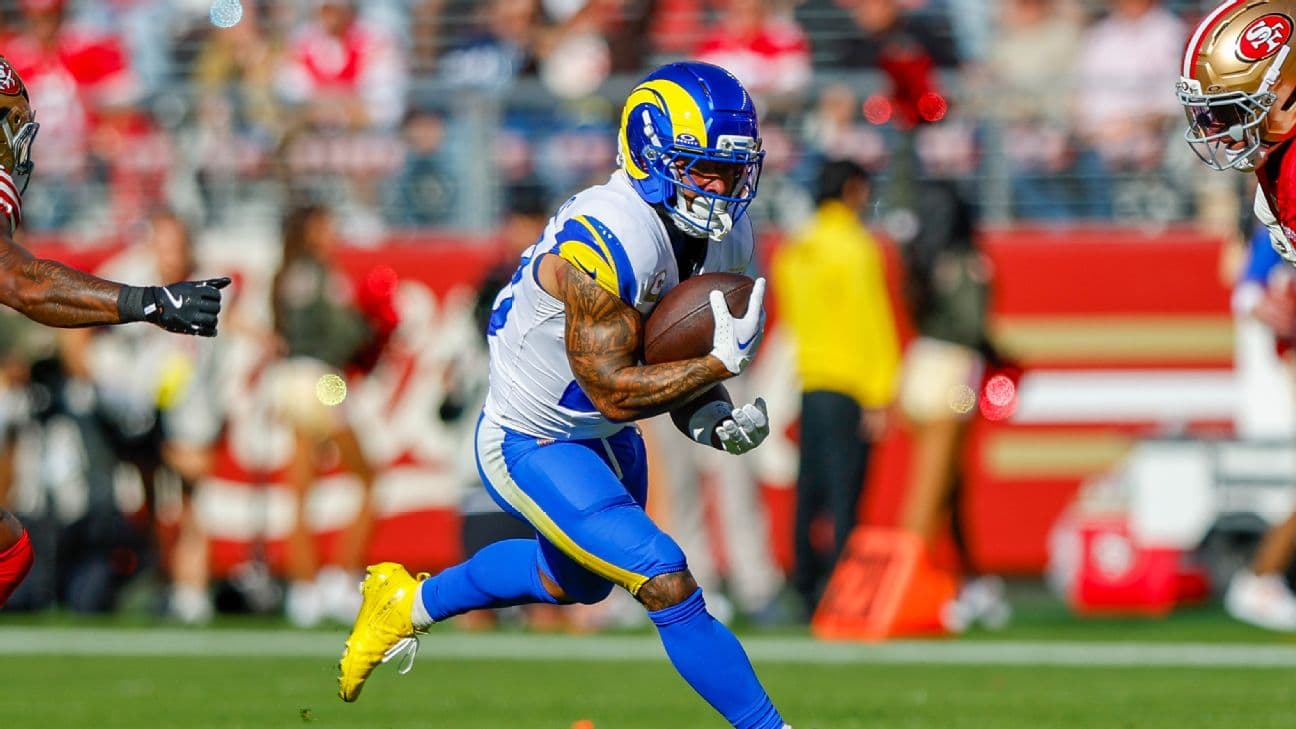
Training camp is the season's first leverage point, and the 2026 contract board is starting to resolve. Rams running back Kyren Williams got his deal, a reported three-year, $33 million contract that includes $23 million guaranteed, removing one of the summer's clearest holdout candidates from the board. But with most veterans set to report in the final week of July, several unresolved situations are about to turn into hold-in risks that fantasy managers need to track.
Contract drama is not just a business story. A holdout or hold-in can cost a player camp reps, cloud a depth chart, and in extreme cases shift touches to a backup, all of which move draft-day values.
Williams gets paid, and the fantasy read is clean
Williams's extension is the cleanest outcome for fantasy purposes: he is locked in as the Rams' lead back with no lingering leverage fight to distract from camp. His workload has been among the heaviest at the position, and a multi-year deal with real guarantees signals the team's continued commitment to him as a bell-cow. Draft him as the clear early-down and goal-line back he has been, with the contract question now off the table.
The broader significance is what the deal establishes. Every running back extension resets the market a little, and Williams cashing in gives the next tier of backs a data point to point to in their own negotiations.
The market has already moved at the top
The offseason has produced several landscape-shifting deals. Jaxon Smith-Njigba and Trent McDuffie each became the highest-paid players in football at their respective positions, and Patrick Mahomes signed the largest contract in NFL history, reportedly becoming the first player to ink a deal worth more than half a billion dollars. These extensions do not change fantasy value directly, but they reset the ceilings that every subsequent negotiation is measured against, which is exactly what fuels the next round of holdout leverage.
For Smith-Njigba specifically, the security of being paid as a premier receiver reinforces his standing as a foundational fantasy asset in Seattle. A player who has just been made the highest-paid at his position is a player his team intends to feature.
The situations still simmering
The one to watch is Jacoby Brissett, who held out of parts of the Cardinals' offseason program while seeking a new deal. Quarterback contract friction rarely carries fantasy weight for the veteran himself in a backup or bridge role, but it can signal uncertainty about a team's quarterback plan, which matters for the pass-catchers around him.
The calendar is the pressure valve. The next real checkpoint arrives in the final week of July, when most veterans are scheduled to report. Any player without a resolved deal by then faces a choice: report and risk playing on the old contract, or become a hold-in who shows up but sits out practices to protect himself while still avoiding fines. By the end of July, the league will have a much clearer picture of who is genuinely disgruntled enough to disrupt his own camp.
Fantasy fallout
The practical impact of contract standoffs is uneven. A star who holds in but ultimately signs before Week 1 usually suffers little, because elite players do not need a full camp to produce. The bigger risk is at running back, where missed reps can cost a player early-down work and open the door for a backup to seize a role that sticks.
The draft-day approach is to distinguish noise from signal. A holdout that is clearly headed toward a resolution should not scare you off a talented player at a discount; that is where value hides. A genuine, unresolved standoff that lingers into August, especially at a position with a capable backup waiting, is a reason for caution. Monitor camp reports, and specifically track which players are actually practicing versus holding in.
The Verdexed model take
Verdexed's model treats resolved contracts as a small positive signal for a player's projected usage, because a paid player is a featured player with organizational buy-in. Unresolved standoffs introduce variance the model accounts for by widening the range of outcomes, particularly for backfields where a holdout could redistribute touches.
For bettors eyeing season-long props and win totals, the timing edge is late July. A team that gets its key extension done before camp removes a distraction and firms up its projection, while a lingering holdout adds uncertainty that the market sometimes underprices in either direction. Williams signing is a quiet plus for the Rams' offensive stability; the next few weeks will tell us which teams follow suit and which head into camp with unfinished business.
Why the calendar creates leverage
Understanding the fantasy stakes means understanding why late July is the pressure point. A player under contract who wants a raise has one real form of leverage: withholding his participation. Early in the offseason, skipping voluntary work carries little cost. But once training camp opens and mandatory reporting arrives, the stakes rise sharply. Report and you risk playing another year on the old deal; hold out fully and the fines pile up; hold in and you preserve leverage while avoiding the financial penalty, at the cost of camp reps that can matter for timing and role.
That is why the reporting date functions as a deadline for so many negotiations. Teams and agents both know the clock, and deals tend to cluster around it. For fantasy managers, the takeaway is to watch not just whether a player is unsigned, but how he is behaving as camp opens. A quiet reporting is a sign of a deal near completion or a player content to bet on himself. A public hold-in is a sign of a fight that could linger, and lingering fights are where fantasy risk lives, especially at running back.
What's next
Watch the final week of July. That is when veterans report, when hold-in decisions get made, and when the difference between a signed star and a disgruntled one becomes real. For now, Williams is paid and startable without hesitation, the top of the market has reset, and the smart fantasy move is to separate the holdouts headed toward resolution from the ones that could actually cost a player his role.