Jaylen Waddle Is the Broncos' No. 1 Receiver, and Courtland Sutton's Draft Price Is Late to Admit It
By Verdexed Fantasy Desk
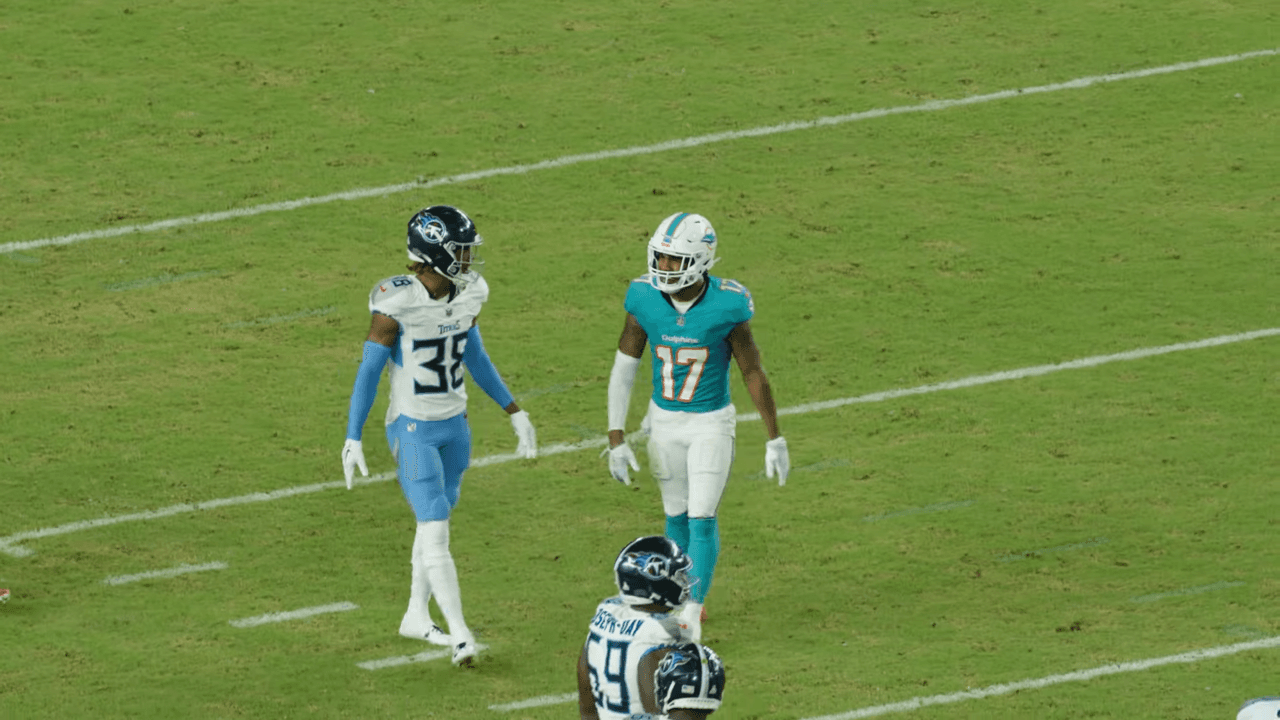
Courtland Sutton has been the Denver Broncos' primary receiver since 2019. He is not going to be in 2026, and the fantasy market has been slow to fully price it.
Denver acquired Jaylen Waddle from Miami in mid-March in a trade that cost the Broncos a 2026 first-round pick along with third- and fourth-round selections, with Denver receiving Waddle and a fourth-rounder back. That is a substantial price for a receiver, and teams do not pay it to add a complementary piece. Waddle was brought in to be the focal point of the passing game, and Broncos beat coverage through camp has been close to unanimous in describing him as the team's new No. 1.
What Sean Payton is actually building
The reporting out of Denver's camp has been specific in a useful way. Payton has been installing packages designed to get Waddle snaps from both the slot and the boundary, which is the tell that separates a real role change from a nominal one.
A receiver who is only deployed in the slot has a capped target ceiling because he is off the field in heavy personnel. A receiver who plays inside and outside is a full-time player whose usage can be schemed week to week against whichever coverage the defense presents. Payton has built offenses around that kind of movable piece before, and Waddle's separation ability from the slot is the trait that made him worth a first-round pick to acquire.
Sutton, for his part, has publicly framed the addition as a positive and said he is willing to sacrifice targets for wins. Take that at face value or not, but the fact that the question is being asked of him at all is the story.
The receiver room math
Denver's receiver group now includes Waddle, Sutton, Troy Franklin, and Marvin Mims Jr., with additional depth behind them. That is four players with legitimate claims to snaps, and only one football.
The historical pattern for a team that trades premium capital for a receiver is that the acquired player leads the room in targets in year one by a comfortable margin. That is what teams are buying. The secondary pattern is that the displaced veteran does not simply drop to a 50 percent share; he drops further than expected, because target distribution is not linear. When a defense's coverage priority shifts, the vacated attention does not distribute evenly across the remaining players. It concentrates on whoever the scheme is designed to feed.
Sutton is also 31, which is the age at which boundary receivers who win with size rather than separation typically begin to decline. He has been a volume-dependent producer for several seasons, which is a fine profile when the volume is guaranteed and a bad one when it is not.
Fantasy fallout
Sutton's ADP has been falling, which is correct, but the direction of travel matters less than the destination. He should be priced as a WR3 with WR2 upside in a good week, not as a WR2 with WR1 upside. If he is going ahead of receivers who are the clear No. 1 on their own team, that is a mispricing.
Waddle is the more interesting play. He carries an ADP built partly on his Miami production, which came in an offense with a very different structure and a very different quarterback. Buying him at that price is buying a player whose role is likely to be larger than it was, in a scheme that has historically produced high-volume receivers, with a coach who has a track record of feeding his best player. That is a positive asymmetry.
Troy Franklin and Marvin Mims Jr. both become harder to trust. Mims has always been a big-play, low-volume producer whose fantasy value depends on touchdown variance, and adding a high-usage receiver above him in the pecking order does not help. Franklin's path to a meaningful role narrowed the moment the trade was made.
Betting angle
The Broncos team total and their season win total both reflect an offense that has been rebuilt around Waddle. The market is broadly aware of the trade, which happened in March, so there is no arbitrage in the headline numbers.
Where the value tends to hide is in receiving props. Season-long receiving yardage props for displaced veterans are among the most consistently mispriced markets in football, because they are set with substantial weight on prior-season production and the public bets the name. Sutton's season-long receiving yards number is worth checking against a realistic projection of his new target share, and if it is anchored near his recent output, the under is the side.
The same logic runs the other direction on Waddle. A receiver moving into a larger role on a team that paid a first-round pick for him is a candidate for an over on receptions in particular, since Payton's offenses tend to generate high-volume, short-area target profiles for their primary slot option.
The Verdexed model take
Verdexed's model prices target share as the dominant input in receiver projections, ahead of efficiency and well ahead of prior-season fantasy finish. Its read on Denver is that Waddle projects to the largest share in the room by a clear margin, with Sutton settling into a distant second and the remaining receivers splitting what is left.
The model also applies a scheme adjustment for coaching continuity, and Denver gets a favorable one here. Payton has been in place, the quarterback situation is stable, and the offense is not being rebuilt from scratch. That reduces the uncertainty band on Denver's projections relative to teams that changed coordinators this offseason, which in turn makes the model more confident in the target-share split than it would ordinarily be in August.
The practical output is a ranking gap between Waddle and Sutton that is wider than the market's. That gap is the bet, in both directions: buy Waddle at his current cost, sell or fade Sutton at his.
What to do in your league
Move Sutton down a full tier. He is a flex starter with a real floor and a limited ceiling, and he should be drafted accordingly rather than as a set-and-forget WR2.
Move Waddle up modestly, particularly in PPR formats where his reception volume is the point. He is not a first-round pick and nobody should be treating him as one, but he is the receiver in this room whose usage is going up rather than down.
And avoid Franklin and Mims outside of best ball, where their spike-week profiles at least have a format that rewards them. In redraft, the fourth-most-targeted receiver on a team that just added a No. 1 is not a roster spot worth spending.