 NFL2026-09-02
James Conner Opens on IR and Tyler Allgeier Inherits the Cardinals Backfield
By Verdexed Fantasy Desk
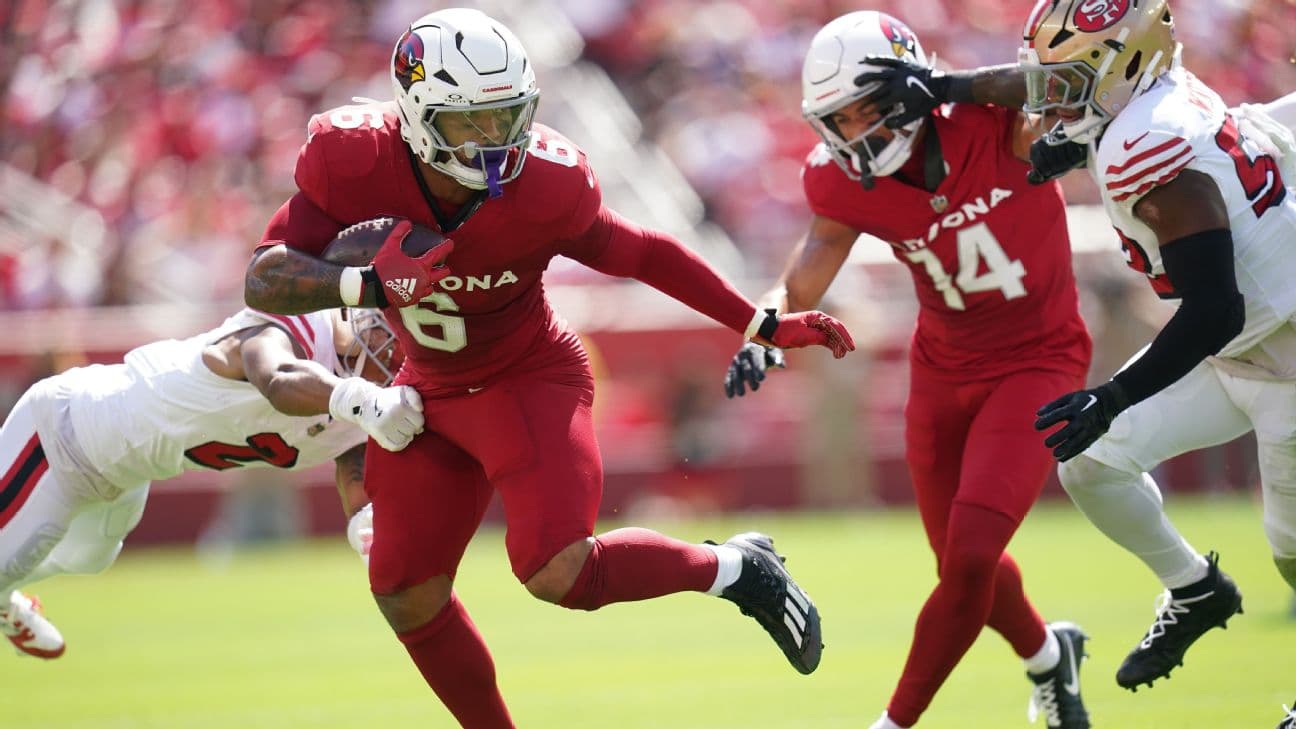
The Arizona Cardinals placed James Conner on injured reserve with a designation to return as part of their 53-man roster cutdown, a move that rules the veteran running back out for at least the first four games of the 2026 season. Conner is still working back from the surgery that followed the injury that ended his 2025 season in Week 3, and Arizona chose to bank a roster spot rather than carry him through September at partial capacity.
That decision has been coming since March. The Cardinals signed Tyler Allgeier to a two-year deal worth roughly $12.25 million in free agency and then used a top-five pick on Notre Dame running back Jeremiyah Love in the spring draft. Neither move is what a team makes when it plans to keep a 31-year-old on a full workload. Conner's IR placement just made the succession official four months early.
Who actually gets the carries
Allgeier is the answer for Week 1, and possibly for longer. Love suffered a high ankle sprain in Arizona's preseason game against the Las Vegas Raiders on August 13, and while the injury did not require surgery, head coach Mike LaFleur has been deliberately noncommittal about the rookie's availability for the opener. LaFleur has described Love as progressing well and taking a step forward each day, which is coachspeak that leaves every door open.
High ankle sprains are the injury type fantasy managers consistently misjudge. The recovery window runs anywhere from two to six weeks, and the players who return at the front of that window are frequently the ones who need the longest to look like themselves. Even a Week 1 activation for Love does not mean a Week 1 workload.
Behind those two is Bam Knight, who profiles as the change-of-pace and passing-down option rather than a threat to early-down volume. Trey Benson, who would have been the most obvious beneficiary of Conner's absence, is out for the season after clearing waivers.
Fantasy fallout
Allgeier is the clearest waiver-wire and late-round add of the week in any league that has not drafted yet. His profile has never been about explosiveness: he is a downhill, contact-balance runner whose value in fantasy is almost entirely a function of touches. Give him 15 to 18 carries and goal-line work in an offense that will be trailing often, and he is a weekly RB2 with RB1 spike weeks in the games Arizona keeps close.
The caveat is the passing game. Allgeier has never been a heavy receiving back, and in negative game scripts, which Arizona will see plenty of, the third-down back gets the volume. That splits Allgeier's ceiling in the exact games where his raw touch count would otherwise spike.
Love is the tougher call. In redraft, his price never fully accounted for a September absence, and managers who drafted him in the first six rounds are now looking at a player whose first month is a question mark and whose lead role, whenever it arrives, arrives on a bad offense. He is a hold, not a sell at a discount, because the talent case is real and the Cardinals did not spend a premium pick to split a backfield in November. In dynasty, nothing about this changes his valuation.
Conner himself is a stash in leagues with IR slots and a drop everywhere else. He is eligible to return in Week 5, but a 31-year-old coming off major surgery returning to a backfield with a top-five rookie in it is not a player you hold a bench spot for through four byes.
The betting angle
Arizona opens the season against the Los Angeles Chargers, and the Cardinals are the only team facing a double-digit Week 1 spread, sitting near 11.5-point underdogs. That number was set before Conner's IR placement was official and before Love's ankle became a genuine Week 1 question, which is worth noting: the market has already priced Arizona as the weakest side on the board and still may not have fully absorbed the backfield situation.
Our model's read is that the spread is close to fair but the total is the live number. A Cardinals offense running Allgeier behind a line that will be playing from behind is a run-heavy, clock-consuming operation by necessity, and the Chargers have every incentive to do the same with a lead. The under is the cleaner side of this game than the double-digit favorite.
The Verdexed model take
Our projections now slot Allgeier as a top-30 running back for the first four weeks and outside the top 40 from Week 5 onward, which is exactly the shape of a player you should be drafting in the middle rounds and actively shopping in October. That mid-season sell window is the actionable piece here. Managers who add Allgeier now and trade him in Week 4 to a team that just lost a starter are capturing the entire value of this news.
The model is more cautious on Love than the consensus rankings are, and the gap is not about talent. It is about the compounding effect of a soft-tissue and joint injury on a rookie who has not taken a professional regular-season snap, combined with an offense our simulations project to be among the bottom five in the league in points scored. Rookie running backs on bad teams need volume to hit their draft price, and Love's volume is now uncertain in both directions.
What's next
Arizona releases its first official injury report of the season on the Wednesday before its opener, and that document is the one that matters for Love. A full participation designation would change the Week 1 calculus meaningfully. Anything short of that, and Allgeier is a confident start in every format.
Conner's Week 5 return date is the other thing to watch. The Cardinals control that timeline, and a team that is 1-3 in early October has very different incentives than one sitting at 3-1. Verdexed's playoff-odds model gives Arizona one of the league's lowest postseason probabilities, which argues for patience with Conner and a longer runway for the rookie.