 NFL2026-08-29
J.J. McCarthy Sat Out the Preseason Finale and Kyler Murray's Grip on Minnesota Got Tighter
By Verdexed NFL Desk
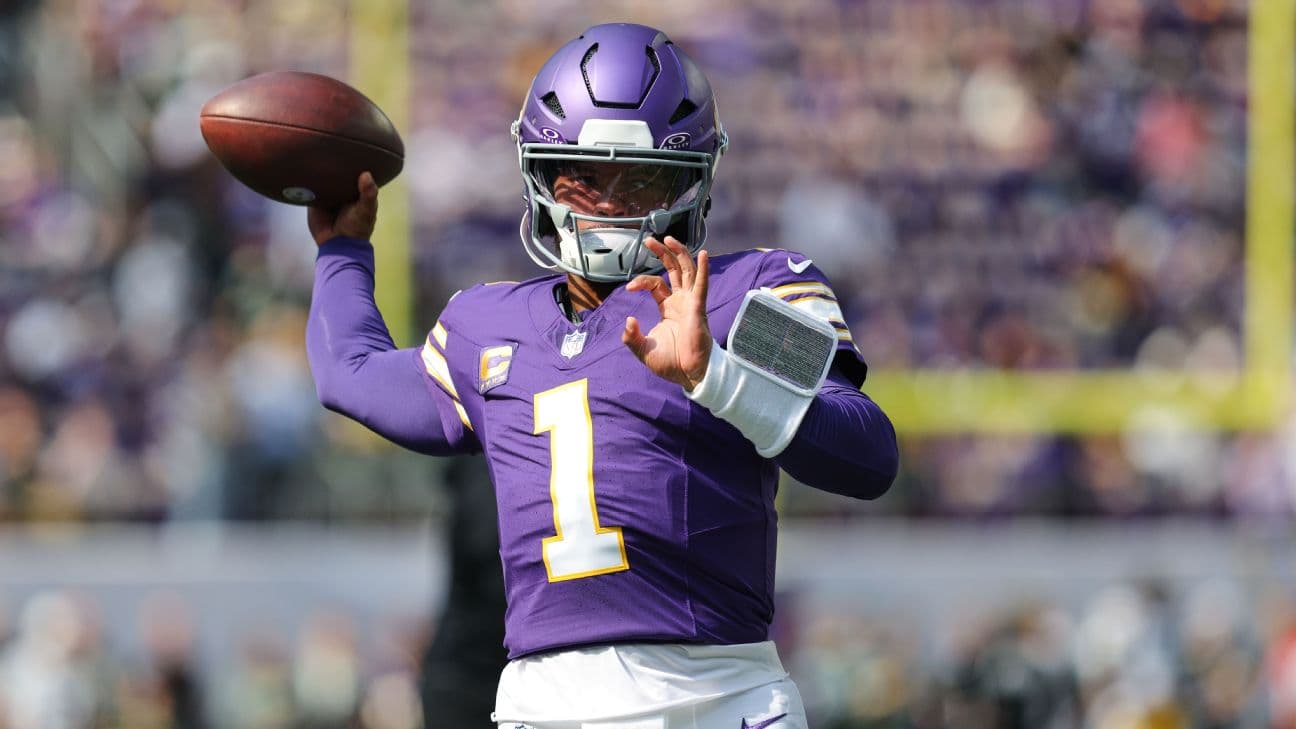
J.J. McCarthy did not play in Minnesota's preseason finale at Denver on Friday night because of an ankle injury, and the Vikings do not consider it a long-term problem. McCarthy hurt the ankle last weekend against Baltimore and told team officials he did not feel comfortable enough to go, per multiple reports out of Denver. He is being treated as day-to-day.
That is the medical story, and it is a small one. The fantasy story is bigger, because it removes the last plausible path to McCarthy taking snaps that matter in September.
The depth chart was already settled
Kevin O'Connell named Kyler Murray the Week 1 starter earlier this month, with McCarthy listed second and Carson Wentz third. Murray signed with Minnesota after his release from Arizona and won the job outright. With Murray and most of the front-line starters resting Friday, the reps in Denver went to Wentz and second-year quarterback Max Brosmer, who has been dealing with a right thumb issue of his own.
So the finale told Vikings fans nothing new about the quarterback room, and that is the point. Minnesota had a chance to give McCarthy a long look with the second unit, in a game with no stakes, in front of a coaching staff that drafted him. It did not happen, and it will not happen again before Week 1.
McCarthy is now a backup quarterback with an ankle injury and no path to the field absent a Murray injury. In redraft leagues, that makes him irrelevant. In dynasty and superflex, it makes him a hold rather than a buy, because the developmental clock in Minnesota has effectively stopped for a year.
Why Murray changes the Vikings' skill-position math
Justin Jefferson finished last season as the PPR WR21, the worst full-season finish of his career, and the quarterback situation was the reason. The splits from 2025 were stark: Jefferson's per-game production with McCarthy under center was dramatically lower than his production with everyone else. Talent was not the issue. Ball placement, depth of target and the willingness to throw into contested windows were.
Murray fixes at least two of those. He has thrown to a genuine No. 1 receiver before and he pushes the ball outside the numbers at a rate McCarthy never approached in his limited sample. He also creates off-schedule, which extends plays and manufactures the scramble-drill targets that inflate a No. 1 receiver's volume.
The projection community has responded accordingly. Jefferson is being drafted as a top-five wide receiver again after a year in the wilderness, and the argument for him is almost entirely a quarterback argument.
The running back situation is the one to watch
Minnesota's backfield remains the least resolved piece of this offense. Jordan Mason finished last season as the PPR RB36 in a split role, and the committee structure has carried into 2026. Mason profiles as a competent early-down back with limited receiving work, which is the exact archetype that fantasy managers overpay for in August and cut in October.
The upside case is straightforward: Minnesota's backfield has repeatedly produced a 70 percent snap-rate back when one of its options goes down. The downside case is that until that happens, nobody in the room is startable in a 12-team league.
Murray matters here too, and not in a helpful direction. A mobile quarterback who takes short-yardage and goal-line carries suppresses running back touchdown equity. That is a real cost for anyone drafting Mason expecting scoring volume.
The Verdexed model take
Verdexed's model has moved Minnesota's offense up meaningfully since the quarterback decision, and the gain is concentrated in the passing game rather than the run. The single biggest input is target quality: Jefferson's expected points per target improve when the quarterback throwing to him is willing to attempt intermediate and deep throws into coverage, and that is a documented difference between the two quarterbacks Minnesota had available.
The model is more cautious on Murray himself. He is a top-12 fantasy quarterback almost entirely on rushing floor rather than passing ceiling, and his career has been defined by games missed. A one-year deal for a quarterback with that injury history is the reason McCarthy retains any redraft relevance at all, even as a QB2 stash in superflex formats.
On the team side, the model's win-total lean on Minnesota sits modestly above where the market opened, driven by the schedule and by the assumption that the 2025 passing offense was a quarterback problem rather than a personnel problem. That is the bet in one sentence.
What to do in your league
Draft Jefferson at his current price without hesitation. The market has already moved him back toward the top of the board, and the remaining discount versus his pre-2025 cost is the last piece of value in the profile.
Fade Mason at his ADP unless he falls into the late double-digit rounds, where the injury-contingent workhorse case becomes worth a roster spot.
Do not draft McCarthy in a one-quarterback league. In superflex, he is a bench stash whose value is entirely tied to a Murray absence, and that is a real possibility rather than a remote one.
What is next
Minnesota cuts to 53 on Sunday evening, and the quarterback room is the one place where the decision is already made. Watch instead for whether the Vikings carry three quarterbacks or move Wentz, because that choice tells you how the staff actually feels about McCarthy's ankle.
The more important date is Week 1, when Murray takes the first meaningful snap of a season that will determine whether Minnesota's 2025 collapse was about the quarterback or about everything else.