 NFL2026-07-05
George Kittle's Achilles Recovery Clouds His Week 1 Status: A Fantasy Discount Is Forming at Tight End
By Verdexed NFL Desk
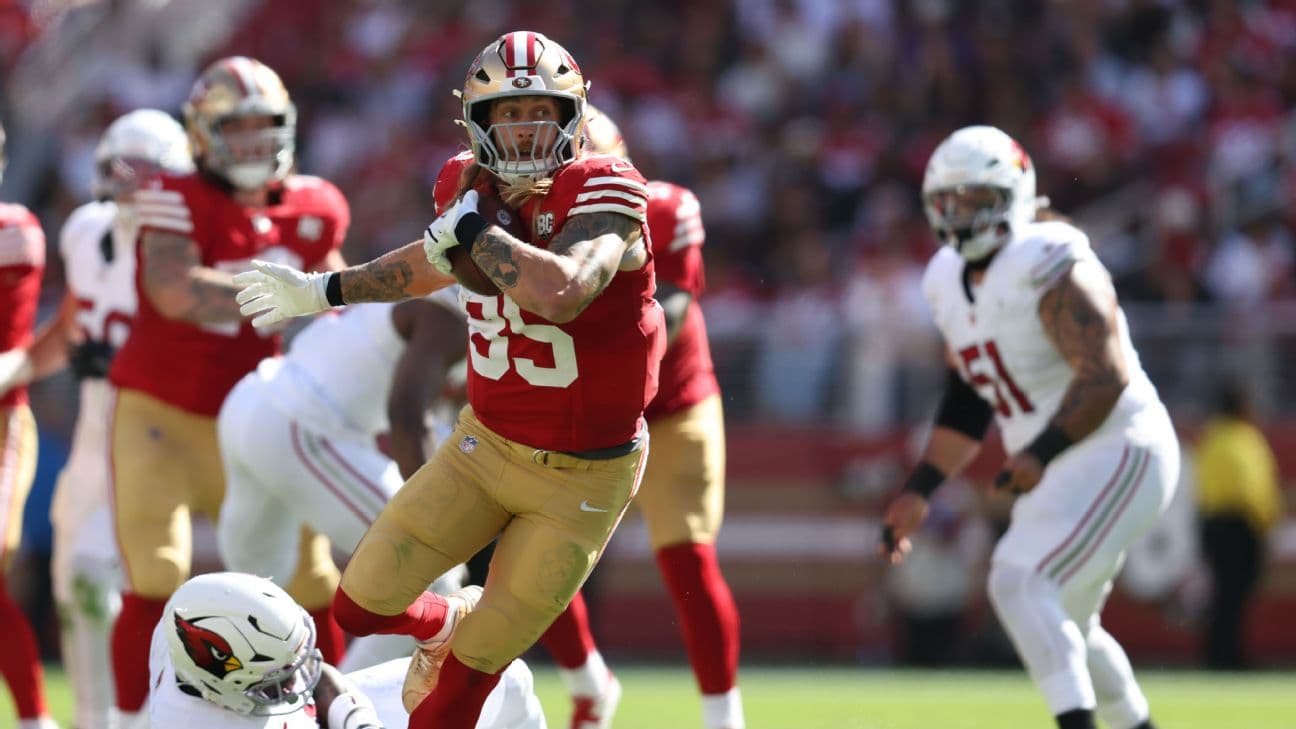
George Kittle is optimistic about his return from a torn Achilles, but the San Francisco 49ers are not ready to promise him for Week 1. Kittle, who suffered a high Achilles tear in January during the 49ers' playoff win over the Philadelphia Eagles, says he is ahead of schedule in his rehab and has not ruled out playing in the season opener. His availability, though, remains a genuine question, and that uncertainty is beginning to shape his fantasy price.
For fantasy managers, an ambiguous timeline on a premium tight end is exactly the kind of situation that creates value, in both directions. Here is the Verdexed read on Kittle's status, the 49ers' broader health picture, and how to play the tight end position around it.
The injury and the timeline
Kittle tore his Achilles on January 11 in San Francisco's playoff win over the Eagles. He has described it as a high Achilles tear, which he framed as closer to a best-case version of a serious injury. Since surgery, he has repeatedly said the rehab is tracking ahead of schedule, and he has not closed the door on suiting up for the 49ers' opener against the Los Angeles Rams in Australia on September 10.
The organization has been more measured. General manager John Lynch has said Kittle will be ready at some point, if not for the first game, which is front-office language for optimism without a guarantee. The realistic read is a game-time decision for Week 1, with a return somewhere in the season's opening month if he is not cleared to open.
The 49ers' broader health picture
Kittle is not the only 49er working back from injury. San Francisco's defense, which finished last in the league in defensive success rate a year ago despite an 11-win season, is leaning on the returns of several key players, including linebacker Fred Warner from an ankle issue and pass rusher Mykel Williams from an ACL injury. That defensive rebuild matters for game scripts: a unit that struggles to get off the field tends to produce higher-scoring, more pass-heavy games, which is a tailwind for the offense's fantasy producers.
That context cuts in Kittle's favor when he plays. A 49ers offense that may have to keep pace on the scoreboard is one where a healthy Kittle sees a heavy target load.
Fantasy fallout at tight end
Tight end is a position defined by scarcity, and Kittle when healthy has been one of the few every-week difference-makers. The Achilles uncertainty does not change his ceiling; it widens his range of outcomes and, crucially, softens his draft price. Managers who believe in the ahead-of-schedule reports can land a top-tier tight end at a discount to his usual cost.
The risk is real: a game-time decision in Week 1 can mean a scramble for a streaming replacement, and any setback in a soft-tissue-adjacent recovery would push the timeline back. The counter is that the tight end position is shallow enough that even a Kittle who misses a game or two and returns to form can still finish as a positional difference-maker.
Managers targeting Kittle should also secure a viable backup plan, whether that is a late-round tight end with early-season upside or a willingness to stream the position for the first few weeks. Within the 49ers' offense, any early-season snaps at tight end would carry marginal streaming appeal while Kittle ramps up, but the target concentration returns to him the moment he is fully cleared.
The Verdexed model take
Verdexed's model treats Kittle as a high-value asset with an availability discount rather than a talent discount. The projection blends his elite per-game production when active with a probability-weighted games-missed estimate, and the output lands him as a strong value at a cost that has drifted below his healthy-season baseline.
The model's posture is to buy the discount in formats where you can absorb an early-season absence, and to be more cautious in shallow, win-now leagues where a Week 1 zero is costly. It also nudges the 49ers' team total slightly upward relative to a defense-carries-them profile, because the unit's struggles point toward shootout-friendly game scripts that benefit the entire San Francisco skill group.
The Achilles context that gives reason for optimism
The nature of the injury matters to the projection. Kittle has described his as a high Achilles tear, a version of the injury that some in the medical community view as more favorable for return timelines than a rupture lower in the tendon. Combine that with a January injury date, which gives him a full offseason and training camp to rehab, and the calendar works in his favor more than it would for a player hurt in the spring. Modern Achilles recoveries have also trended better than the position's historical reputation, with several skill players returning to form within a season.
None of that guarantees a Week 1 return, and the 49ers are right to keep the language cautious. But it does support the case that Kittle's lost time, if any, is measured in a game or two rather than a chunk of the season, which is the scenario that makes his discounted draft price a bargain rather than a trap.
What to do in your draft
If you are comfortable with a game-time decision hanging over Week 1, Kittle is one of the best values at tight end, a top-tier producer available below his usual price. Pair him with a cheap contingency tight end or a plan to stream early, and you capture most of the upside while covering the downside. If your league is shallow and you cannot stomach an early absence, let another manager take the risk and target the tight ends with clean bills of health.
Kittle's talent was never the question. The question is the calendar, and the market is handing patient managers a discount on one of the position's true difference-makers.