 NFL2026-07-23
Browns QB Battle Reopens Under Todd Monken: Deshaun Watson vs. Shedeur Sanders and the Fantasy Fallout
By Verdexed NFL Desk
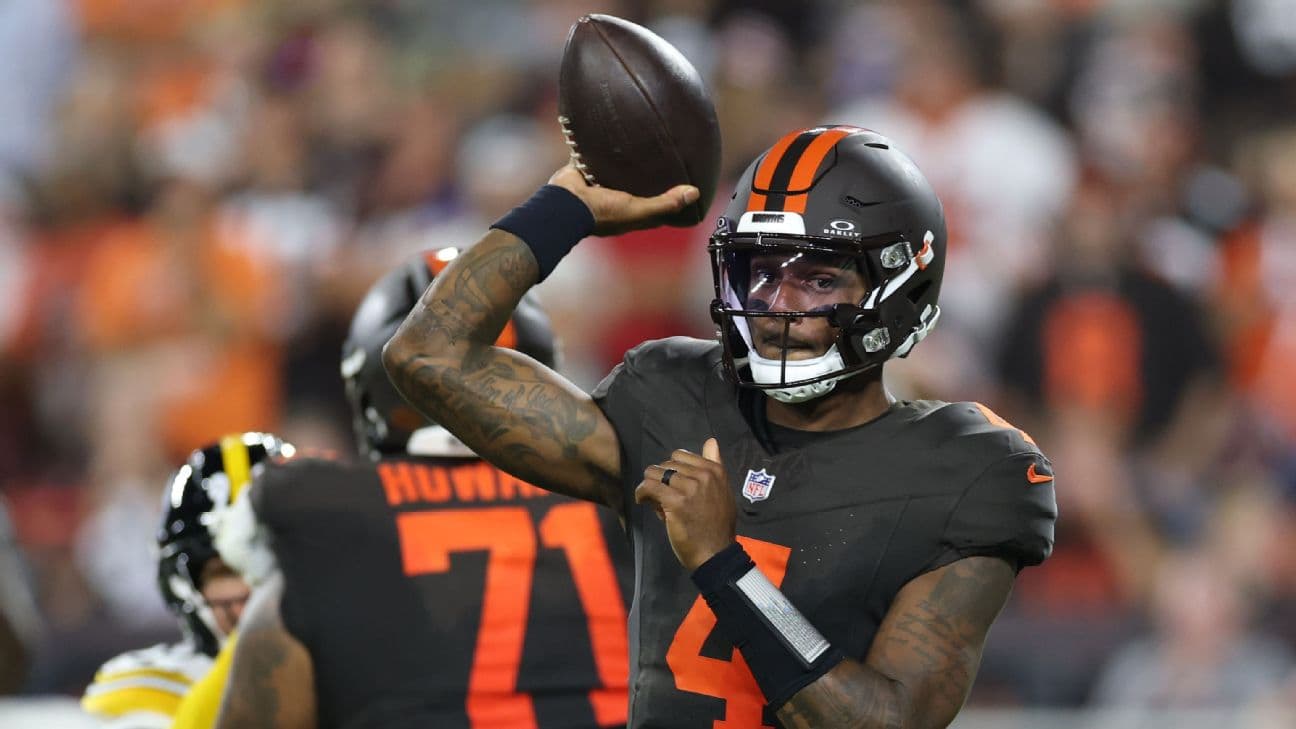
The Cleveland Browns' quarterback competition resumes when veterans report for training camp on July 28, this time under new head coach Todd Monken, who was hired after the team fired Kevin Stefanski and watched him land the Atlanta Falcons job. Deshaun Watson, now cleared after a twice-torn Achilles, holds an early inside edge over second-year passer Shedeur Sanders, per reporting from cleveland.com, with 2025 draftee Dillon Gabriel and a rookie also in the room. For fantasy managers, the resolution of this battle determines whether any Browns pass catcher is draftable at all.
Monken, a first-time NFL head coach who will call his own plays, inherits the league's most-watched quarterback question. The Browns replaced Stefanski specifically to get more out of a massive quarterback investment now that Watson is healthy, and Monken's offense will be built around whoever wins the job. The competition is real, but the early signal points to Watson getting the first crack at reclaiming the role.
The state of the competition
Watson enters camp with the inside track, a function of experience, his contract, and a coaching staff hired in part to maximize him. But the leash is the story. Cleveland has cycled through quarterback uncertainty for years, and a slow start or a health setback would open the door quickly. Sanders used the offseason program to remind the building why he generated buzz coming out of college, and he represents the more intriguing long-term option.
Gabriel and the rookie are competing for developmental and emergency roles behind the top two, and one of them could become a notable roster casualty in a crowded room. Expect Monken to give Watson the early first-team reps while rotating Sanders enough to keep the competition honest. The realistic outcome is Watson opening as the starter with Sanders a snap or a stumble away.
Why this matters for fantasy
The hard truth is that Cleveland's quarterback situation has suppressed the fantasy value of every pass catcher on the roster, and an unsettled competition does not fix that. Fantasy managers need target certainty and offensive efficiency to trust a receiver, and a Browns passing game splitting reps between a veteran returning from a serious injury and an unproven second-year player offers neither in the short term.
That makes the Browns' skill players late-round dart throws rather than reliable starters heading into drafts. A pass catcher's outlook improves meaningfully if Watson holds the job and the offense finds rhythm, or if Sanders wins it and the staff builds around his mobility. Until the competition resolves, though, the safe play is to treat Cleveland's receivers as upside stashes, not roster anchors.
The Watson factor
Watson's clearance after a twice-torn Achilles is the linchpin. A quarterback returning from that specific injury history carries both mobility questions and durability risk, and his fantasy ceiling as an individual asset is capped until he proves the legs and the arm in game action. For managers in superflex or two-quarterback formats, Watson is a wait-and-see option whose value hinges entirely on holding the job and staying upright.
Sanders, by contrast, offers the tantalizing upside of a young passer who could energize the offense if given the reins. His fantasy appeal is speculative but higher-ceiling, which is why deep-league and dynasty managers are watching the competition closely. The winner of this battle inherits an offense that has been starved for stability.
The run-game read
One indirect fantasy angle is worth flagging: quarterback uncertainty tends to push a team toward the run, which can lift the value of the backfield even as it suppresses the passing game. If Monken leans on the ground game to protect whichever quarterback wins the job, Cleveland's lead back becomes a more interesting fantasy target than the pass catchers. Managers looking to invest in the Browns offense at all may find the safer value in the run game rather than the aerial attack, at least until the quarterback picture stabilizes.
That dynamic is common for teams breaking in a new play-caller with an unsettled quarterback room. A conservative early script protects the passer, shortens the field, and funnels touches to the backfield. It is not a glamorous fantasy angle, but it is a more reliable one than betting on a receiver whose quarterback has not been named.
The Verdexed model take
Verdexed's model treats the Browns' passing game as a low-confidence projection until the quarterback picture clears, applying a wide range of outcomes to every Cleveland pass catcher. The system gives Watson the higher probability of opening as the starter but assigns meaningful weight to an in-season change, which is why it caps the ceiling on any single Browns receiver in the early weeks. The model reads this as a situation to underweight, not one to chase.
On the team level, the model projects a below-average passing environment until proven otherwise, which drags Cleveland's implied team totals in the passing game. For bettors, that argues for patience on Browns passing props until the competition resolves and the offense shows it can move the ball. The quarterback battle is the single biggest variable in the entire Cleveland projection.
What to do in your league
Avoid drafting Browns pass catchers as anything more than late-round upside plays, and let the competition resolve before committing real roster capital. In superflex formats, treat both Watson and Sanders as speculative rather than reliable, with Watson the safer early bet and Sanders the higher-ceiling gamble.
The actionable move is patience. Monitor how Monken distributes first-team reps through camp, because the moment the job is settled, the Browns' skill players become far easier to evaluate. Until then, Cleveland is a fantasy situation to watch, not to buy. The winner of the Watson-Sanders battle will decide whether this offense produces a single startable fantasy asset in 2026.