 NFL2026-07-01
Bhayshul Tuten Has the Inside Track on the Jaguars' Backfield: A Second-Year Breakout Bet Under Liam Coen
By Verdexed Fantasy Desk
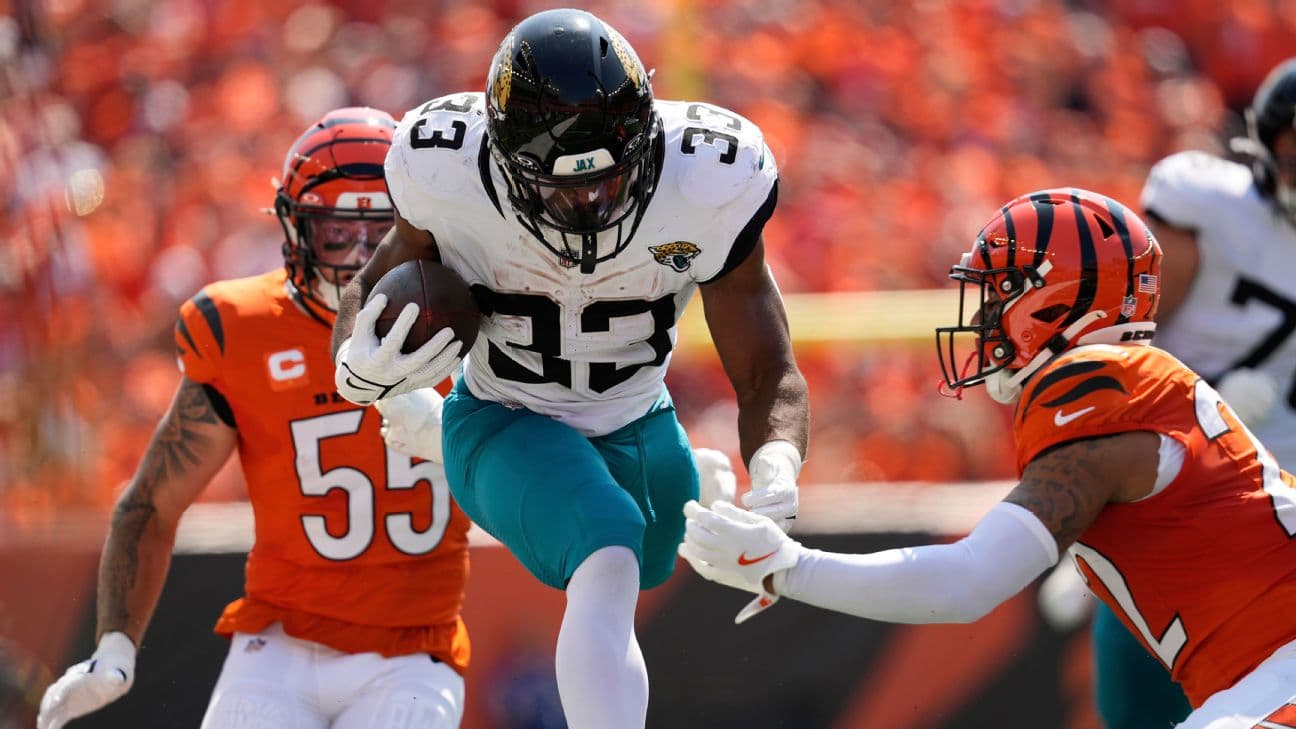
Bhayshul Tuten holds the inside track on the Jacksonville Jaguars' starting running back job. With Travis Etienne no longer anchoring the backfield picture and the depth chart reshuffled under head coach Liam Coen, the second-year back has spent the spring taking first-team reps and positioning himself as Jacksonville's lead runner heading into training camp. For fantasy managers, that development turns a late-round dart throw into one of the more intriguing breakout bets on the summer board.
The story is not just about opportunity. Tuten flashed real efficiency as a rookie despite a mid-season injury, and the offseason chatter has followed. His draft cost is climbing, and the question for redraft and best-ball rooms alike is whether the market has already priced in his upside or whether there is still value to be had before the committee questions get answered.
The depth chart
The clearest reason for optimism is the runway in front of him. Etienne is out of the equation as the every-down centerpiece, and the primary competition for early-down and receiving work is Chris Rodriguez Jr., who signed with the Jaguars this offseason after a stint in Washington. Rodriguez is recovering from offseason foot surgery. He is expected to be back for training camp, but his rehab has kept him off the field this spring, and that absence matters.
While Rodriguez recovers, Tuten has been the back working with the first team. Those reps are not a formal depth-chart decree, but in a new staff's first full offseason, they are the closest thing to a signal that exists in June. Coaches build timing, protection assignments, and route packages around the players who are actually on the grass, and Tuten has been that player. When Rodriguez returns, he will be doing so from behind, both in terms of conditioning and in terms of the mental reps that Tuten has been banking.
That does not guarantee a clean three-down role. Rodriguez profiles as a legitimate committee threat once healthy, and Coen's staff has not committed publicly to a bell-cow approach. But the current arrangement gives Tuten first crack at defining the job on his own terms, and incumbency inside a new scheme is a meaningful edge.
The efficiency profile
What makes the opportunity worth chasing is that Tuten did not simply survive as a rookie. He was productive on a per-play basis. Among running backs with a real workload, he graded out with one of the better success rates in the league, a mark that put him near the very top of the position in that category. Success rate rewards backs who consistently stay on schedule, avoid negative runs, and turn early downs into manageable situations, and it tends to travel better year over year than raw yardage totals that can be inflated by a handful of long runs.
The mid-season injury cut his sample short and likely suppressed his rookie counting stats, which is part of why his name did not dominate the offseason conversation until recently. But the underlying tape and the efficiency markers pointed to a back who can handle a lead role. When a player pairs that kind of profile with a suddenly open depth chart, the fantasy community notices, and it has.
Liam Coen's scheme fit
The scheme context amplifies the case. Coen's offenses lean on a zone-based rushing attack, the kind of system that prizes vision, patience, and one-cut decisiveness over pure gap-scheme power. Backs who read blocks well and hit the crease at the right moment thrive in that structure, and Tuten's success-rate profile suggests exactly that skill set.
Just as important for fantasy purposes is how Coen tends to deploy running backs in the passing game. His system has historically funneled targets to the backfield through checkdowns, screens, and designed routes, which is the difference between a two-down grinder and a weekly PPR asset. A back who commands even a modest but steady target share gains a floor that pure rushing volume cannot provide, and it is the receiving work that most often separates a fantasy RB2 from a fringe starter.
If Tuten earns that pass-game trust, the ceiling rises considerably. Zone rushing volume plus third-down snaps plus red-zone touches is the recipe for a genuine every-week starter, and the scheme is built to support that outcome rather than fight against it.
Fantasy fallout
The practical effect is that Tuten's ADP has been rising through the offseason. He is no longer a forgotten late-round name. He now sits closer to a mid-round cost as managers price in both the opening on the depth chart and the efficiency profile underneath it. That climb is rational, but it also means the deep discount is gone.
The upside case is straightforward. If Tuten opens the season as a three-down back in a zone-heavy Coen offense with real receiving usage, he carries top-24 potential and possibly better, the kind of value that would make his current price look like a bargain by October. Lead backs in friendly schemes are among the most valuable commodities in fantasy, and Tuten has a credible path to becoming one.
The risk is the committee. If Rodriguez returns to full health early in camp and reclaims a meaningful share of early-down or passing work, Tuten's ceiling compresses into flex territory, and the mid-round cost becomes fair rather than cheap. His floor is tied directly to how cleanly he holds the receiving downs. A back who cedes third downs is far more matchup-dependent, and that volatility is the central bet a manager makes when drafting him.
The Verdexed model take
The Verdexed read frames Tuten as a high-variance value with a favorable range of outcomes rather than a safe pick. The signal worth weighting most heavily is the combination of first-team spring reps and a strong rookie efficiency profile inside a scheme that historically elevates running back production. That is a rare stack of positive indicators for a back still available outside the early rounds.
The discount is the risk that this becomes a timeshare. Rodriguez's health timeline is the single biggest swing factor, and his surgery recovery is worth monitoring closely through the first week of camp. If reports out of Jacksonville continue to feature Tuten with the ones once Rodriguez is cleared, the breakout thesis strengthens and the price becomes easier to justify. If the staff signals a rotation, the projection should be trimmed toward a committee outcome.
On balance, the model treats Tuten as a back whose expected value clears his current ADP because of the shape of his upside, not the certainty of it. He is the kind of pick that can return a league-winning ceiling for a mid-round cost while still carrying a real chance of settling into a flex role.
The draft-strategy takeaway
For redraft, Tuten is a target in the middle rounds, ideally as a manager's RB3 or high-upside flex rather than a piece being counted on for weekly RB2 production out of the gate. Drafting him there lets the upside pay off without forcing an overpay that his committee risk does not support. Managers who already hold two stable backs are the best-positioned buyers, since they can absorb the volatility while chasing the ceiling.
For best-ball, the case is even cleaner. Tuten's spike-week potential in a zone scheme with pass-game usage is exactly what best-ball formats reward, and the format's built-in tolerance for down weeks neutralizes his biggest drawback. He fits well as a mid-round selection in those builds, where his ceiling can be captured without the penalty of having to guess his weekly workload.
The actionable line is this: target Tuten in the mid rounds, treat his floor as flex and his ceiling as a top-24 back, and let the Rodriguez recovery reports in early camp confirm or shrink the bet. Buy the runway now, and be ready to adjust the moment the committee picture clarifies.