Baker Mayfield Will Play Out His Contract in Tampa: The Fantasy Case for a Contract-Year Quarterback
By Verdexed NFL Desk
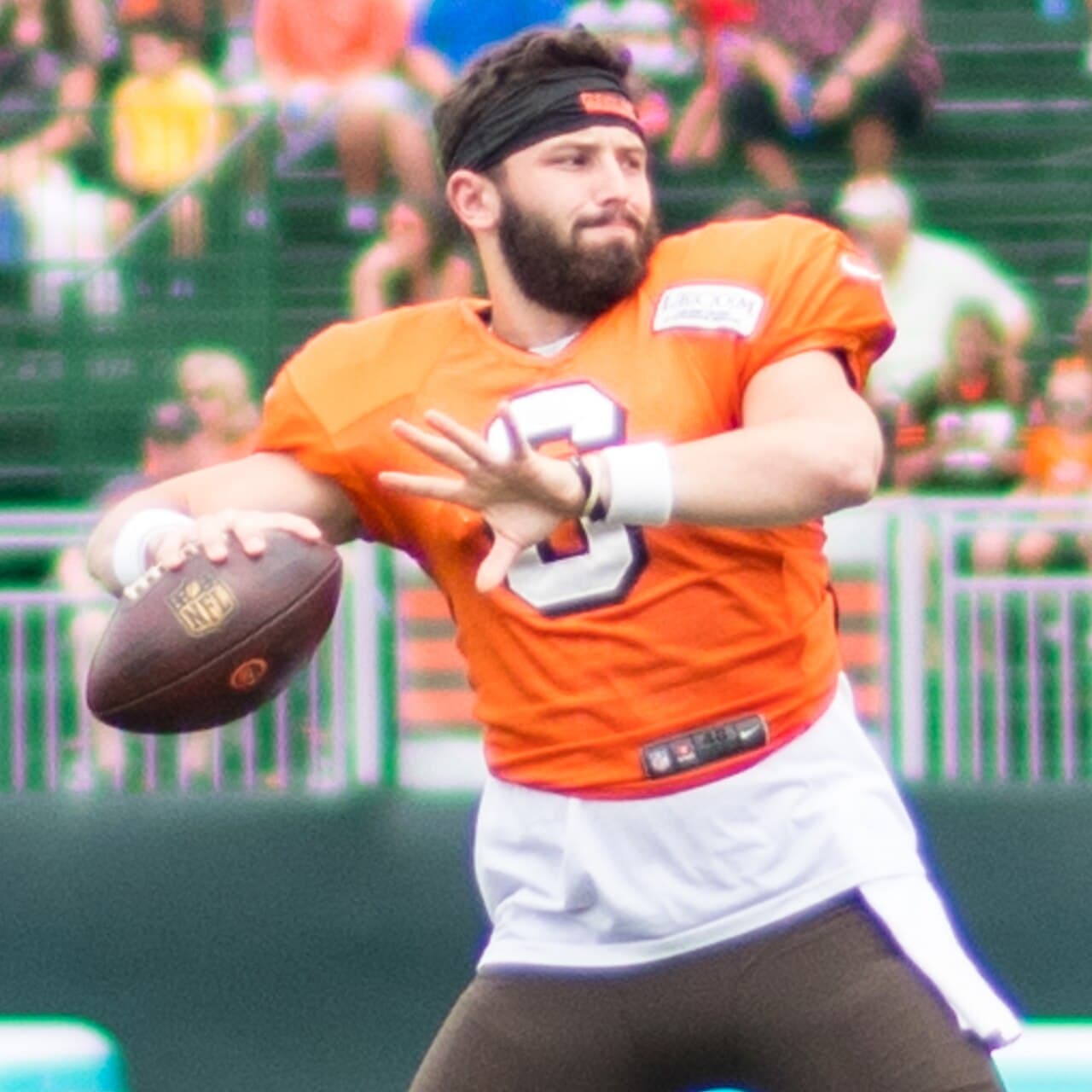
Baker Mayfield reported to Buccaneers training camp without a new contract, and reporting indicates there was no real progress in extension talks before his self-imposed deadline of camp's start. He will play the 2026 season on the final year of his existing deal and become a free agent afterward, with Tampa Bay retaining the option to apply the franchise tag in the 2027 offseason.
The financial specifics are already public. Mayfield carries a 2026 cap number reported at just under $40 million, with his compensation structured as a base salary plus a large roster bonus. A 2027 franchise tag at quarterback would land near $48 million on a one-year tender.
None of that is a fantasy input on its own. What is a fantasy input is that a quarterback entering a contract year is operating in a new offensive system he personally lobbied to install, throwing to a receiver room that just lost its franchise leader.
The scheme change is the story
Tampa Bay fired first-year offensive coordinator Josh Grizzard in January after the offense fell from third in total offense in 2024 to 21st in 2025, with scoring dropping from 28.6 points per game to 21.4. Head coach Todd Bowles replaced him with Zac Robinson, previously the Falcons' offensive coordinator, and reporting at the time credited Mayfield with pushing for the hire.
Robinson's coaching lineage runs through the Los Angeles Rams, where he came up as an assistant quarterbacks coach, wide receivers coach, and eventually quarterbacks coach and pass game coordinator. That system is built on condensed formations, motion, play-action, and defined reads, and it has historically been quarterback-friendly in terms of completion percentage and yards per attempt.
A quarterback who advocated for his own coordinator, in a contract year, in a scheme designed to raise efficiency, is a specific and favorable combination. It is not a guarantee. It is a reason to price Mayfield above where a 21st-ranked offense from the prior season would suggest.
The receiver room without Mike Evans
Mike Evans signed with San Francisco in March on a three-year deal reported at $60.4 million, ending a 12-year run in Tampa Bay as the franchise's all-time leading receiver. He was limited to eight games in his final Buccaneers season, so the on-field subtraction is smaller than the symbolic one, but it is still a subtraction.
What remains is a young and genuinely deep group. Chris Godwin is the veteran anchor and, by most accounts, the leader of the room. Emeka Egbuka, the 19th overall pick in 2025, is projected to work primarily as the Z receiver in Robinson's system. Jalen McMillan and Tez Johnson round out a rotation with real depth behind them.
That depth cuts both ways in fantasy terms. It raises Tampa Bay's offensive floor and lowers the ceiling of any individual receiver, because targets get distributed rather than concentrated. Godwin's slot usage gives him the most stable role. Egbuka has the clearest path to a target share increase in year two.
Fantasy fallout
Mayfield is a streaming quarterback with QB1 weeks rather than a set-and-forget starter, and that is where he should be drafted. The combination of a new scheme, a contract year, and no clear alpha receiver produces a high-attempt, moderate-efficiency profile. That is a useful fantasy quarterback in a two-quarterback league and a fine late-round target in single-quarterback formats.
Godwin is the safest Buccaneers receiver to draft. Egbuka is the one with the most upside relative to his cost. McMillan is a bench dart.
The player nobody should overpay for is any Tampa Bay receiver drafted as a locked-in WR2. Deep rooms with a new coordinator are the single most common source of frustrating fantasy weeks, because the coordinator spends September figuring out the same thing you are trying to project in August.
The Verdexed model take
Verdexed's model applies a small positive adjustment to quarterbacks in contract years, not because of effort or motivation, but because of usage. Contract-year quarterbacks in offenses without an established running identity tend to see higher pass rates, and pass rate is the input that drives fantasy quarterback scoring more than any other single variable.
Applied to Tampa Bay, that produces a projection modestly above consensus for Mayfield and a Buccaneers team passing volume estimate near the top third of the league. The model is more cautious on the receiver side, where the distribution of targets is genuinely unresolved.
On the betting side, the Tampa Bay season win total is a hold. The interesting market is the team's total passing attempts and Mayfield's passing yardage prop, both of which are exposed to the same pass-rate assumption. If the market prices Tampa Bay as a run-first team based on the 2025 collapse, the over on Mayfield's yardage is the side that reflects the coordinator change.
What it means
The absence of an extension is not a distraction story. Mayfield reported on time, said his negotiating deadline was camp, and moved on. What matters for fantasy purposes is the offense around him, and that offense has a new play-caller he asked for, a deep young receiver room, and no Mike Evans to command the red zone.
Draft Mayfield late, draft Godwin as your third or fourth receiver, and treat Egbuka as the Tampa Bay pass catcher most likely to outperform his summer price.
The franchise tag question hanging over 2027
Tampa Bay retains the ability to apply the franchise tag next offseason, which would come in near $48 million on a one-year tender at the quarterback position. That is expensive, but it is also the mechanism by which the Buccaneers avoid losing their starting quarterback for nothing.
The practical effect for 2026 is that Mayfield is not actually a flight risk in the way an unrestricted free agent normally would be. Both sides know the tag exists, which lowers the temperature on the negotiation and makes the reported lack of progress less dramatic than the headline suggests.
That matters to how fantasy managers should read the situation. A quarterback playing out a contract with a realistic path back to the same team next year is not a distraction risk. A quarterback in an acrimonious dispute with his employer might be. Nothing about the reporting on Mayfield's situation suggests acrimony. He set a deadline, the deadline passed, and he reported to camp on schedule.
The one scenario worth watching is a slow start. If Tampa Bay's offense stumbles in September under a new coordinator, the contract becomes a storyline again, and storylines around quarterbacks have a way of turning into benchings on teams that fall out of contention early.