 NFL2026-09-12
Tua Tagovailoa Is Out in Pittsburgh and Cooper Rush Inherits a Falcons Offense Built Around Bijan Robinson
By Verdexed NFL Desk
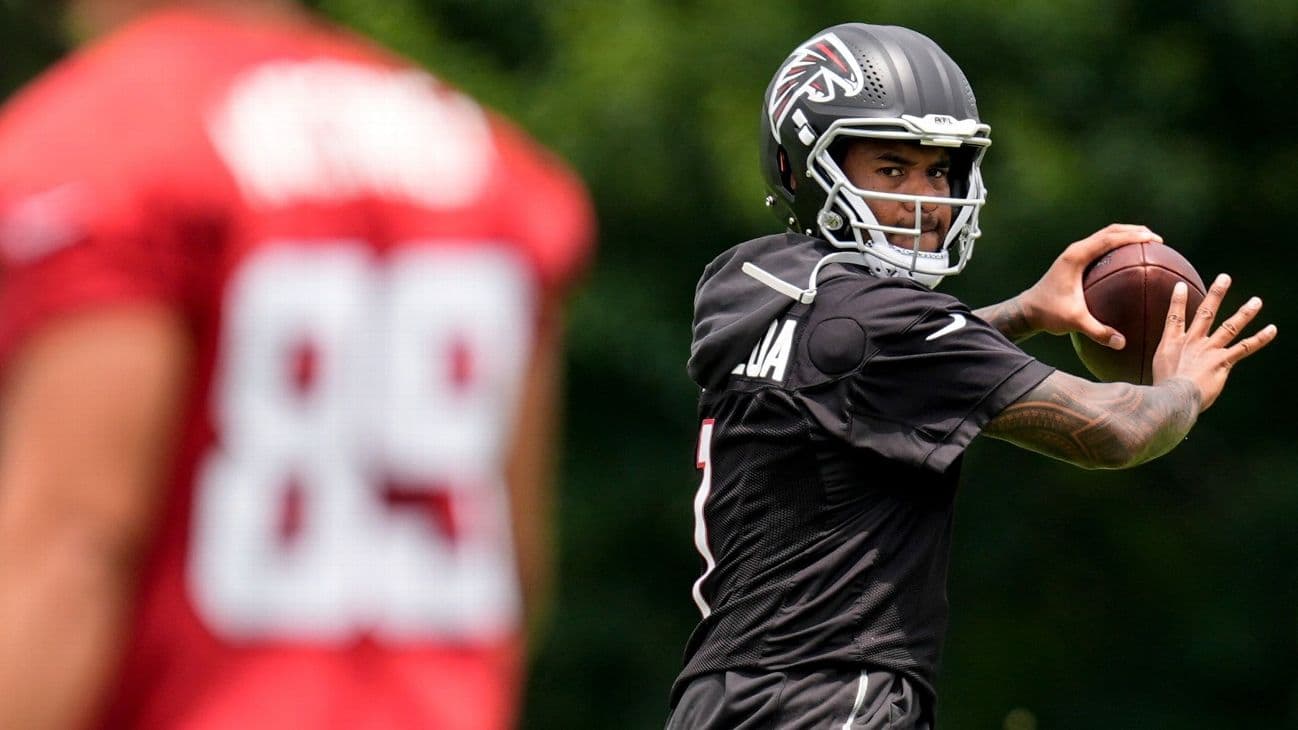
Atlanta ruled Tua Tagovailoa out of Sunday's season opener at Pittsburgh with an oblique injury he suffered in Thursday's practice, and Cooper Rush will start in his place. The team has described Tagovailoa as week to week, which means this is not a one-game problem, and it lands on a Falcons roster that had already spent the summer answering quarterback questions.
The news arrived less than a week after Atlanta named Tagovailoa the Week 1 starter over Michael Penix Jr., who is still working back from a torn ACL and is not expected to be available. That leaves Rush, a veteran backup with a long history of exactly this assignment, running an offense that finally has its skill talent in place. For fantasy managers holding Bijan Robinson or Drake London, and for anyone who bet an Atlanta number earlier in the week, the question is not whether this matters. It is which direction it cuts.
What actually happened
Tagovailoa was limited in Thursday's session after aggravating the oblique, and by Friday the Falcons had moved him to out on the final injury report. Oblique injuries are notoriously unkind to throwers. They rarely respond to a single week of rest, and the recurrence rate is high enough that teams tend to be conservative even when a player insists he is ready. Week to week in this context should be read as a genuine multi-week range, not a formality.
Penix remains the complicating factor. Head coach Kevin Stefanski's staff has been consistent that Penix is the longer-term answer at the position once healthy, and Atlanta's handling of the opener suggested they were unwilling to rush a quarterback coming off a major knee reconstruction. If Tagovailoa misses two or three weeks, the Falcons could be choosing between a backup on a short leash and a young starter whose timeline they have deliberately protected.
Cooper Rush is not the problem, but he is not the solution
Rush has built a career out of being competent in emergencies. He protects the football relative to his arm talent, he gets the ball out on time, and he does not generate the kind of explosive plays that lift an entire offense. That profile has a specific fantasy signature: the running game holds its value, the alpha receiver holds most of his, and everyone below them on the target tree gets squeezed.
Expect Atlanta to lean run-first and situational. Stefanski's offensive history in Cleveland was built on outside zone, play action and a heavy dose of condensed formations designed to protect the quarterback, and that is an easier system to hand to a backup than a timing-based spread attack. The Falcons will try to win this game on the ground and on early downs.
Fantasy fallout
Bijan Robinson gets more valuable, not less. He was already a locked-in RB1, and a backup quarterback in a road opener pushes Atlanta further toward the exact usage pattern that makes Robinson elite. He is a genuine three-down back who has cleared 18 touches in nearly every September game of his career, and he catches passes, which matters more when the quarterback is checking down. The Steelers were roughly a middle-of-the-pack run defense by yardage allowed a year ago and were stingier in the red zone than the raw numbers suggest, so this is not a soft matchup. It is also not the kind of matchup that keeps a workhorse off a lineup card. Start him.
Drake London takes a modest haircut. Target share tends to concentrate with a backup quarterback, not disperse, because the offense simplifies and the quarterback looks for his safest read. London should still see a heavy share of the work. What he loses is the ceiling: fewer downfield shots, fewer contested throws that Tagovailoa was willing to make, and a lower touchdown probability if the Falcons stall in scoring range. He stays a WR2 start in twelve-team leagues, with the boom outcomes priced out.
Everyone else in Atlanta's passing game is a fade this week. Secondary pass catchers in a Rush-led offense are the first casualties. If a player was already a flex-or-bench decision, this settles it.
Betting angle
A confirmed quarterback downgrade of this size is a real market event, and the Atlanta side and the game total are the two places it shows up. Rush is a downgrade in expected points added per dropback from a full-season starter, and the effect on a team total is usually worth a point and a half to three points depending on the replacement.
The more interesting question is whether the market overcorrects. Public money reliably overreacts to a backup quarterback announcement, particularly when the backup is a name associated with spot duty rather than starting. The Falcons still have the better skill group in this game, they still have a defense that was competitive last season, and they are facing a Pittsburgh team opening a new era under Mike McCarthy with a quarterback in his forties. The underdog value in games like this usually appears after the initial move, not before it.
The Verdexed model take
Verdexed's game model treats a quarterback substitution as an adjustment to expected offensive efficiency, not as a blanket penalty on the team. That distinction matters here, because Atlanta's projected edge in this game was never built primarily on quarterback play. It came from the run game, from the receiving talent, and from a defense that generates enough negative plays to keep totals low.
Run through that lens, the model's read on Falcons at Steelers is that the game total should fall further than the side should move. Two run-leaning offenses, a backup quarterback who will not push the ball vertically, and a Pittsburgh attack that was middling in explosive-play rate last year is the recipe for a low-scoring, clock-heavy opener. Under bettors get the cleaner angle. On the side, the model's preference is to wait for the number to settle and then look at Atlanta if the market pushes the Steelers past a field goal and a half.
The player-level projection is where the model is most confident. Robinson's projection barely moves. London's comes down a tier. Everything else in the Atlanta passing game drops below a startable threshold. That is the standard shape of a backup-quarterback week, and it is the shape most managers get wrong by discounting the running back along with the passing game.
What's next
Watch Atlanta's Wednesday practice report next week for the first real read on Tagovailoa's timeline, and watch whether the team opens the door for Penix as the bridge rather than Rush. If Penix is cleared in the next two weeks, London's outlook changes again, this time upward, and Atlanta's season-long win total becomes a live number.
For Sunday, the actionable version is short. Start Robinson without hesitation. Start London with lowered expectations. Bench the rest of Atlanta's pass catchers. And treat the total as the side of this game where the Tagovailoa news is most likely to be mispriced.