 NBA2026-09-09
The NBA Built Opening Night and Christmas Around Three Trades, and the Betting Markets Already Agree
By Verdexed NBA Desk
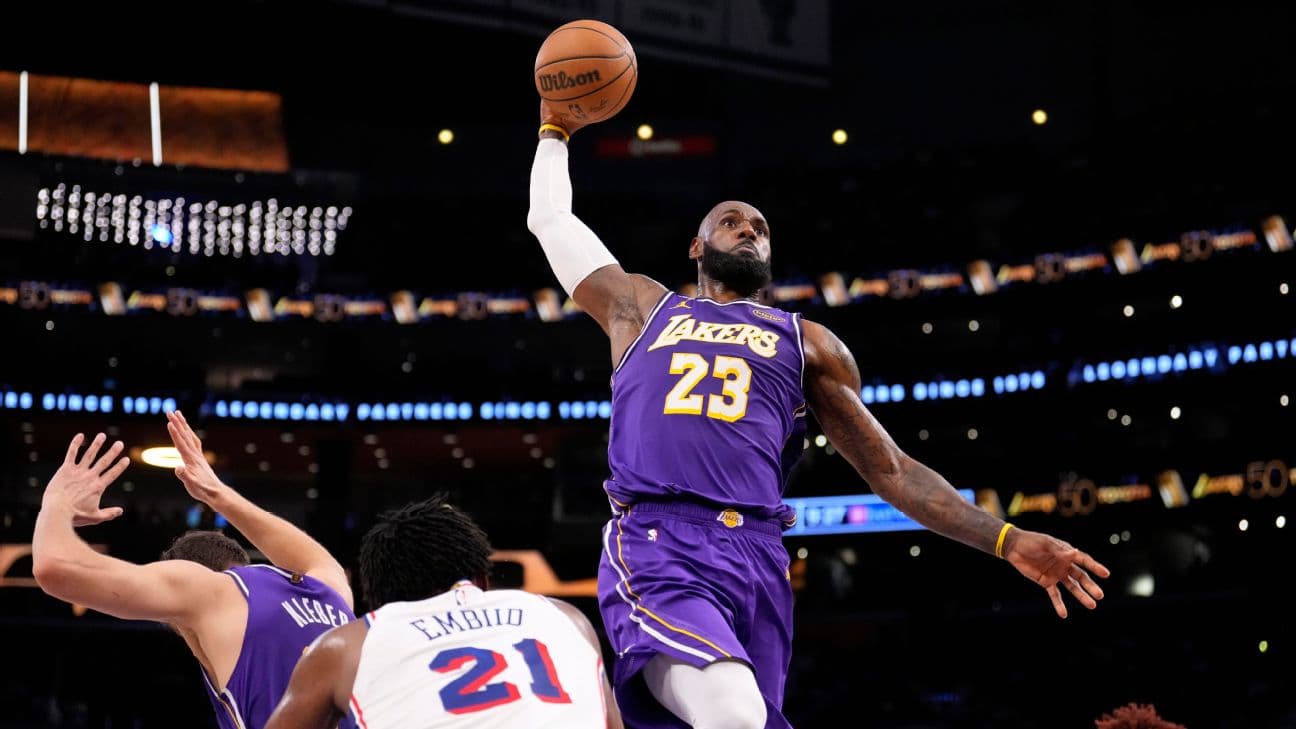
The NBA released its 2026-27 schedule with a set of marquee dates that read like a summary of the offseason, and the placement tells you exactly which franchises the league believes moved the needle.
Opening night on October 20 runs three games. Detroit hosts Boston at 3 p.m. Eastern to start the day. The 76ers visit the defending champion Knicks at Madison Square Garden at 7 p.m. Oklahoma City visits San Antonio at 9:30 p.m. to close it.
The middle game is the statement. Philadelphia added Jaylen Brown from Boston and LeBron James over the summer, and the league put that roster in the Garden on opening night against the team that just won the title. New York will raise a banner and then immediately face the East's most reconstructed contender.
The Christmas slate
The five-game Christmas card is built around the same theme. San Antonio visits New York at noon Eastern. Boston hosts Miami at 2:30 p.m., which puts Giannis Antetokounmpo back in TD Garden as a member of the Heat. Philadelphia visits the Lakers at 5 p.m., sending LeBron James back to Los Angeles. Oklahoma City visits Minnesota for the Timberwolves' first home Christmas game. Denver at Golden State closes the night with Nikola Jokic against Stephen Curry.
Three of the five games exist because of trades that happened between June and August. That is a schedule built for the offseason the league just had, not for last year's standings.
Where the futures markets sit
The market has already priced the reshuffle. Oklahoma City opened with the league's highest win total in the neighborhood of 60, with San Antonio just behind around 59. New York, as the defending champion, sits third-highest in the league and highest in the East around 52.
Philadelphia's number opened around 50.5, tied for third in the East with Detroit, after a 45-win season. That is roughly a five-and-a-half game bump priced entirely on the arrivals of Brown and James alongside Tyrese Maxey and VJ Edgecombe.
The gap between Oklahoma City and San Antonio at the top and the rest of the league is the defining feature of the board. Both are Western Conference teams, both are priced above 59, and both are on the opening night schedule against each other. The market believes the West is a two-team race and the East is a five-team scramble.
The fantasy angle
Schedule matters more in fantasy basketball than in any other fantasy sport, because weekly head-to-head formats reward games played above almost everything else. The specific dates worth noting are the ones clustered around the marquee windows.
Nationally televised games are the ones where rest is least likely. A team playing on Christmas or opening night is not sitting its stars, which makes those weeks slightly safer for load-managed veterans. That is a small effect but a real one for players like James and Curry, whose availability is the largest variable in their fantasy value.
The inverse consideration is the compressed stretches around those dates. Teams playing showcase games often have unbalanced rest around them, and the back-to-backs adjacent to a Christmas game are precisely where load management shows up.
The Miami frontcourt is the specific fantasy situation worth watching on Christmas. Antetokounmpo and Bam Adebayo share the floor in a configuration that has spacing questions, and a nationally televised game against Boston is the kind of setting where a coaching staff shows its actual preferred lineup rather than an experiment.
The Verdexed model take
Verdexed's model prices the East as considerably more open than the market does. New York at 52 as the defending champion and Philadelphia at 50.5 after adding two All-Stars are numbers that imply the market expects both to be roughly equivalent, and the model sees a wider gap in Philadelphia's favor once the roster's ceiling is accounted for.
The counterargument the model respects is fit. Adding Brown and James to a backcourt built around Maxey and Edgecombe creates a shot distribution problem that does not resolve itself automatically. Teams that add star talent without addressing role clarity frequently underperform their preseason numbers in the first two months.
On the Western side, the model is comfortable with the Oklahoma City and San Antonio pricing and sees no value on either. The value in the West is further down the board, on teams whose offseason additions have been priced conservatively.
For bettors, the actionable read is that Eastern Conference win totals carry more uncertainty than Western Conference win totals this year, which argues for taking positions on the East's overs and unders and staying away from the top of the West entirely.
The dates that matter for fantasy managers
Beyond the marquee windows, the schedule's structural features are what decide head-to-head matchups. Weeks with four games are the ones that win fantasy weeks, and weeks with two are the ones that lose them, regardless of how good the roster is.
The practical approach is to identify the four-game weeks for your core players before the draft rather than after, and to prioritize schedule diversity across a roster so that a single team's light week does not sink an entire lineup.
The other feature worth mapping is the back-to-back distribution. Teams with veteran-heavy rosters and high back-to-back counts are the ones where load management bites hardest, and that is where the gap between a player's talent and his fantasy value is widest.
Los Angeles, Golden State and Miami all have significant load-management exposure this season given their roster construction. Factor that into draft decisions rather than discovering it in November.
What's next
Training camps open September 22 for teams playing preseason games overseas and September 29 for everyone else. Preseason games begin October 3. The regular season tips off October 20.
The three weeks between camp opening and opening night are when the fit questions get their first answers. Watch Philadelphia's starting five, Miami's frontcourt pairing, and whether Minnesota's guard rotation resolves into something coherent. All three are situations where the summer's transactions created talent surpluses without creating role clarity, and all three will determine whether the marquee dates the league just scheduled live up to the billing.