Quinnen Williams Gets $105.9 Million From the Cowboys and Dallas Locks In Its Defensive Core
By Verdexed NFL Desk
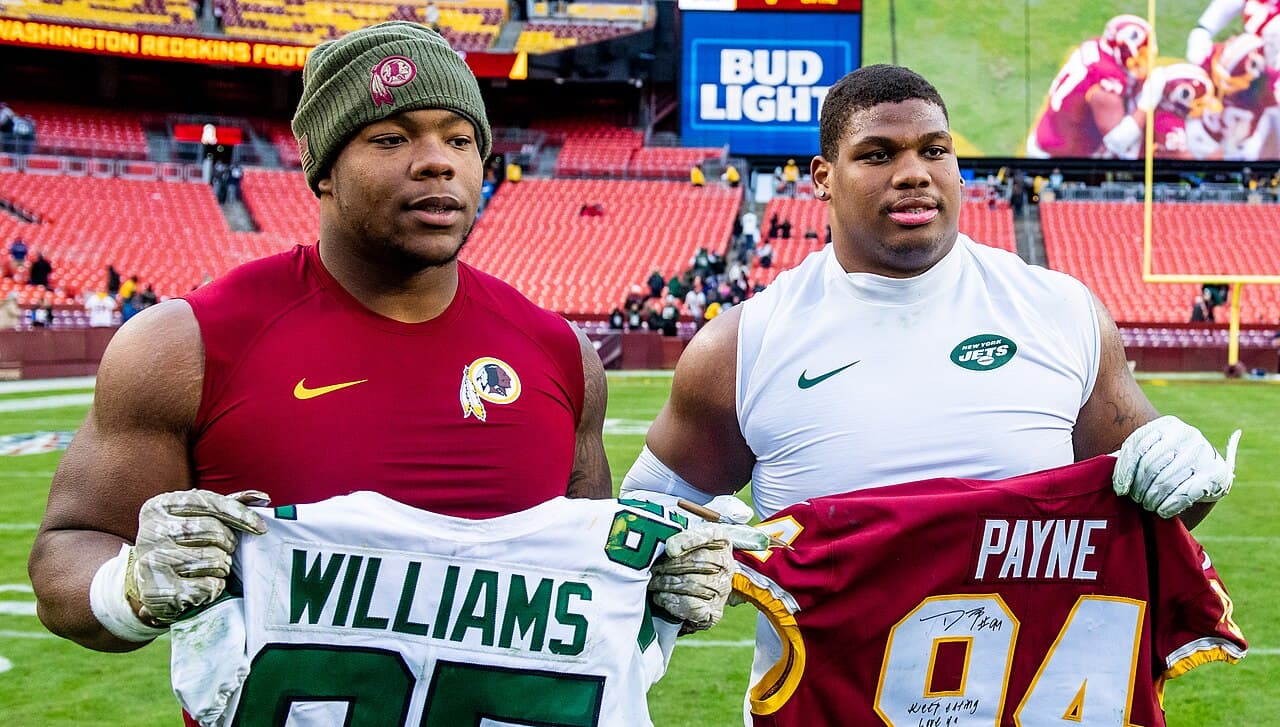
The Dallas Cowboys and defensive tackle Quinnen Williams agreed Monday on a three-year, $105.9 million extension, a deal that multiple outlets reported includes roughly $101 million guaranteed and tacks onto the two years already left on his contract. The reported guarantee is the largest ever given to a defensive tackle at signing, and the roughly $35.3 million average annual value on the new money slots second at the position behind Jalen Carter, who signed his own record extension with the Eagles last week.
Williams arrived in Dallas at the 2025 trade deadline in a deal with the Jets. The Cowboys gave up real assets for a player entering his 30s, then spent the following offseason deciding whether he was a rental or a foundation. Monday answered that question in the most expensive way available.
What Dallas actually bought
The Cowboys did not pay for sack totals. They paid for the thing that shows up on every down: interior pressure that collapses a pocket before a quarterback can climb it, and a run defense that does not have to send an extra defender into the box to hold up.
That matters more in Dallas than it would in most places. The Cowboys have spent recent seasons funneling money to the edges and the secondary while asking the interior to hold serve. Williams is the first true difference-maker on the inside they have paid since the Aaron Donald era began pricing the position out of reach for teams without a plan. He is now under contract through the back half of the decade, which means the defensive investment is no longer a one-year window tied to a trade-deadline gamble.
The structural read is just as important. Guaranteeing north of $100 million at signing on a defensive tackle means the Cowboys are treating the next three seasons as a competitive window, not a retooling one. Front offices do not commit that kind of cash to a 2029 roster they expect to be bad.
The NFC East math
The division just added two of the three biggest defensive tackle contracts in league history inside of a week. Philadelphia extended Carter. Dallas extended Williams. Washington and New York now have to build offensive lines that can handle elite interior rushers twice a year each, which is the single hardest problem in offensive line construction.
For bettors, this is where the news actually lands. The Cowboys' win total has been priced as a function of the offense for years, with the defense treated as a variable that could sink them. Locking in Williams narrows the downside on that variable. A team that can generate pressure with four is far more resistant to the shootout script that has cost Dallas games in recent seasons, and it stabilizes the second-half performance that win-total markets are most sensitive to.
Fantasy fallout
The direct fantasy application is defense and special teams. Cowboys DST has been a streaming asset rather than a season-long hold, largely because the pass rush ran hot and cold and the run defense leaked. A healthy Williams playing next to the edge talent Dallas has assembled raises the floor on sacks and, more importantly, on the third-and-long situations that produce turnovers.
There is a second-order effect worth tracking in individual defensive player leagues, where they exist. Interior linemen who command double teams inflate the production of everyone around them. If Dallas' edge rushers post career sack numbers this season, Williams is why, and the market will price those edge players up next summer.
The most useful fantasy takeaway is about opponents. Offenses that face Dallas twice a year now have a tougher script for their interior-dependent skill players. Running backs whose value is concentrated in between-the-tackles volume, and quarterbacks who need clean pockets to work the intermediate middle of the field, are worse plays in those matchups than they were in July.
The Verdexed model take
Verdexed's model treats interior defensive line quality as one of the most stable inputs it has, because unlike coverage metrics it is relatively noise-free from season to season. A defensive tackle who wins consistently keeps winning, and the effect on team-level expected points allowed is measurable.
Retaining Williams pushes Dallas' projected defensive efficiency up and, by extension, nudges the model's game-level totals for Cowboys games down relative to where the market opened them in the offseason. Games involving Dallas were priced as track meets when the schedule came out. That framing looks stale now, and the totals in Cowboys games are where the model sees the most room between its number and the market.
On the season side, the extension does not move the Cowboys into the division favorite tier. Philadelphia remains the team to beat in the NFC East on the model's numbers, largely on the strength of its own defensive front and roster continuity. What the Williams deal does is compress the range of outcomes for Dallas: fewer paths to a collapse, and a firmer floor on the win total than the market currently reflects.
Betting angle
Two positions are worth watching in the days ahead. The first is Dallas' season win total, which has been sitting in the range where the market treats the Cowboys as a fringe playoff team. The model prefers the over at the current number, though the edge is modest rather than screaming.
The second is Cowboys team totals allowed in the first month of the season. Preseason lines on early-season games were set before the market fully digested the defensive investment, and books have been slow to move team totals on personnel news that does not involve a quarterback. That is where the pricing lag lives.
What it means
Dallas has now committed record money at the position twice in one offseason cycle across the division, and the practical consequence is that the NFC East will be the hardest place in football to run the ball or throw from a muddy pocket in 2026.
For fantasy managers, the actionable version is simple. Cowboys DST is a legitimate late-round target rather than a pure streamer, and skill players on the Giants and Commanders who depend on clean interior blocking should be marked down in divisional matchups. For bettors, the edge is in totals rather than sides: Dallas games should not be priced like the offense is playing alone.
What is next is health. Williams turns 29 during this season and the contract runs deep into his 30s. The first sign of trouble would be a snap-count reduction in September that the team frames as load management. Nothing in the reporting suggests that is coming, but it is the variable that determines whether this deal ages as a bargain or an anchor.