Michael Pittman Jr. Is Out in New England and Pittsburgh's Passing Game Narrows to DK Metcalf
By Verdexed NFL Desk
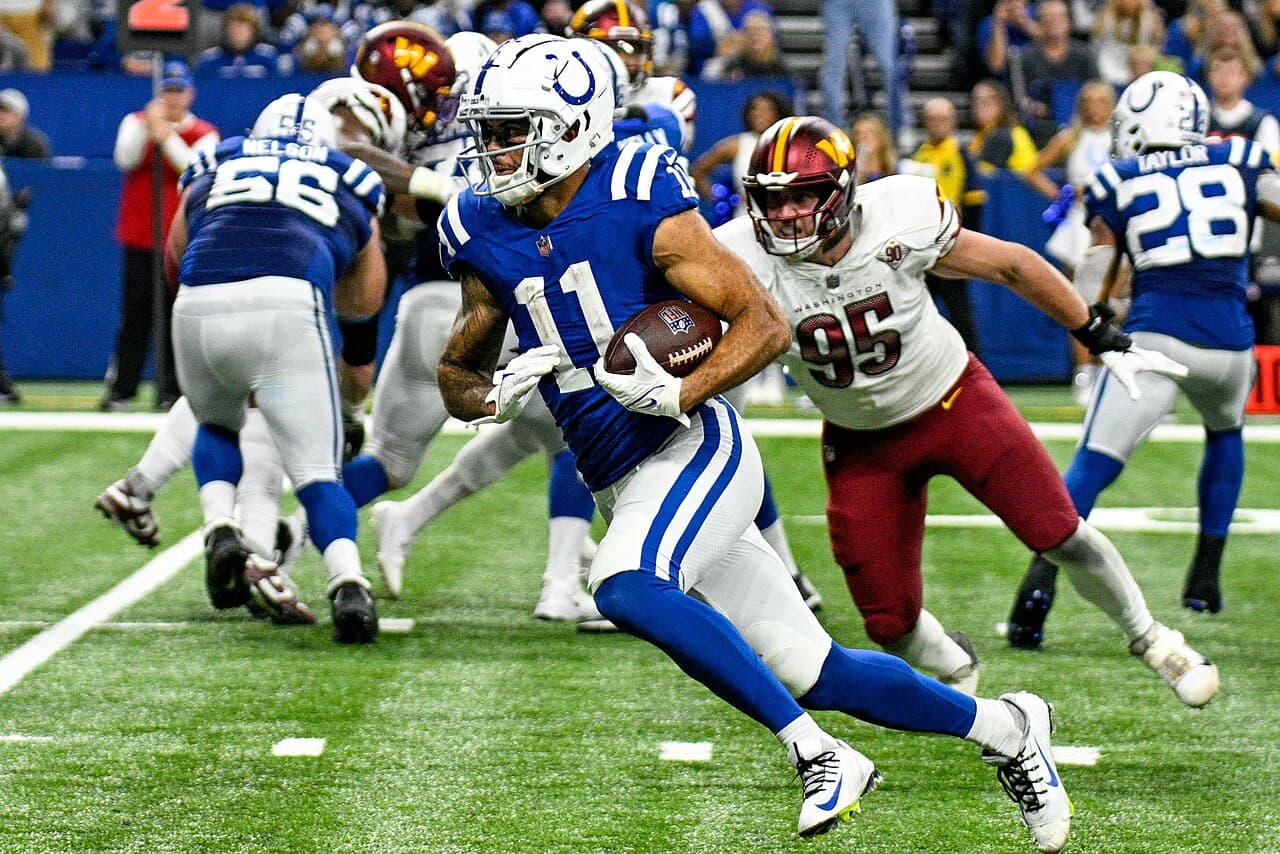
Pittsburgh downgraded wide receiver Michael Pittman Jr. from questionable to out for Sunday's game at New England, the team confirmed, with a foot injury that kept him off the practice field for most of the week. Pittman was limited on Wednesday and then did not practice on Thursday or Friday, a progression that almost always ends this way for a road team.
The mechanics matter here. A road team that does not expect a player to be available typically leaves him home rather than burning a travel spot, and the Saturday downgrade is the formal acknowledgment of a decision that was effectively made on Friday. Pittsburgh also ruled out cornerback Joey Porter Jr. and carried right tackle Troy Fautanu into Sunday as questionable with an ankle injury.
How Pittsburgh got here
The Steelers traded for Pittman in March, sending late-round draft capital to Indianapolis to pair a high-volume possession receiver with DK Metcalf. The logic was straightforward: Metcalf is a field-stretcher who has never been a 100-target-per-season target hog, and Pittman is the opposite profile. Together they were supposed to give Pittsburgh a two-man route tree that did not collapse when a defense bracketed one of them.
That is the plan that goes on hold this week. Behind Metcalf, the Steelers' receiver depth runs through Calvin Austin III and Roman Wilson, with veteran bodies rotating in on the outside. Austin has been the more productive of the two over the last two seasons, though his snap counts and yardage both dipped a year ago. Wilson has spent most of his young career trying to stay on the field.
Fantasy fallout
Metcalf is the start. He was already the start. What changes is the shape of his projection rather than the direction: with Pittman out, Metcalf's target share should climb toward the level that makes him a genuine WR1 rather than a boom-or-bust WR2 dependent on one deep shot connecting. Defenses will roll coverage his way, which caps the ceiling, but a receiver who commands a quarter of his team's targets is a start in every format regardless of the attention he draws.
Calvin Austin III is the speculative play. He is the receiver most likely to absorb Pittman's underneath and intermediate volume, and he is available in most leagues. Treat him as a flex dart in deeper formats rather than a confident starter, because Pittsburgh's offense does not generate the raw pass volume to support three fantasy-relevant receivers even when healthy.
The bigger beneficiary may be the Pittsburgh tight end and running back rooms. Offenses that lose a possession receiver almost always replace those targets closer to the line of scrimmage rather than by promoting a fourth wideout. Checkdown and flat volume tends to spike in exactly this situation.
The matchup on the other side
New England is coming off a Week 1 in which Drake Maye threw three interceptions, and the Patriots' passing game is working without A.J. Brown, who is on injured reserve. That is the context that shapes this game more than the Pittman absence does. Two offenses that are both short a starting receiver, in a stadium where the weather can turn, is the recipe for a low-event football game.
Pittsburgh's defense should be the beneficiary of a quarterback who is still finding his footing. The Porter absence hurts on the perimeter, but the Steelers' pass rush remains the unit that decides their games.
The Verdexed model take
Verdexed's model has this as one of the lowest-projected scoring environments on the Week 2 board, and the Pittman downgrade pushes it lower rather than sideways. When a model removes a possession receiver from an offense that was already projected below the league average in pass attempts, the effect shows up almost entirely in the total rather than in the spread.
The side is closer than the public perception of these two teams suggests. New England's Week 1 turnover problem is the kind of thing that regresses, and home teams with a young quarterback in a divisional-adjacent environment historically outperform their market price in the second week of a season. The model is not far off the number here, which is usually a signal to look at the total instead.
On the total, the case for the under is straightforward: two short-handed passing games, a Pittsburgh defense that suppresses efficiency, and a road offense that just lost its second-most-targeted receiver.
Betting angle
The Metcalf receiving yardage prop is the market's problem this week. Books have to price a receiver who is about to see a larger target share against a defense that will devote extra coverage to him. Those two effects push in opposite directions, and the resulting line is usually a fair one rather than an edge. The more exploitable angle is on the Pittsburgh reception props for the pass catchers closest to the line of scrimmage.
Team total unders on both sides are the cleanest way to express the game environment without taking a position on which short-handed offense sputters worse.
What to do in your league
Start Metcalf. Add Calvin Austin III off waivers in leagues deeper than 12 teams if you need a flex body, but do not start him in a standard league on a projection built from one week of absence. Do not drop Pittman: a foot injury that does not land a player on injured reserve is usually a week-to-week issue, and his role when healthy is a weekly starter's role in PPR formats.
The structural takeaway is that Pittsburgh's offense in 2026 was built to be two-headed at receiver, and it has not gotten to play that way yet. Until it does, Metcalf's usage will look like the usage of a No. 1 receiver on a team with no other options, which is a better fantasy outcome than the balanced version the Steelers actually want.