 NFL2026-07-12
Ladd McConkey's WR1 Leap: Why the Post-Keenan Allen Chargers Make Him a 2026 Fantasy Value
By Verdexed Fantasy Desk
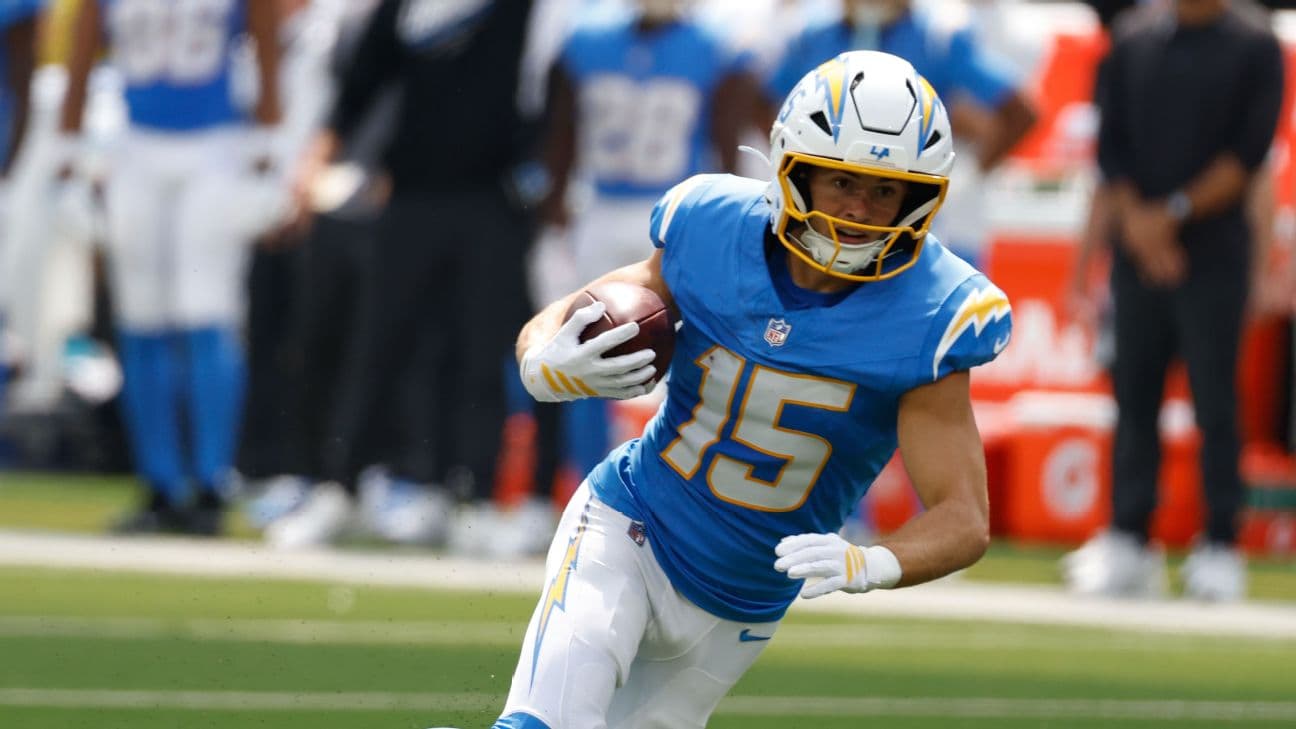
Ladd McConkey is one of the most compelling value bets on the 2026 fantasy wide receiver board, and the reason is a subtraction. With Keenan Allen no longer competing for targets in the Chargers offense, McConkey has the clearest runway of his career to emerge as Justin Herbert's unquestioned top receiver. For managers drafting in the middle of the WR ranks, that combination of vacated volume and quarterback quality is exactly the setup that produces a breakout.
Why last season disappointed
McConkey's sophomore campaign was a step back on paper. His production dipped from roughly 15 fantasy points per game as a rookie to just over 11, a drop that soured some of the industry on his outlook. But the cause was situational, not a decline in ability. Allen's return commanded a heavy target share, and the Chargers passing game had only so many looks to distribute. When a proven veteran absorbs a large chunk of targets, a young complementary receiver's ceiling gets capped no matter how well he plays.
That context is the key to the buy-low case. McConkey did not get worse; the target pie got smaller for him. His route running, separation, and rapport with Herbert remained assets, and his per-target efficiency held up even as the volume fell. When the underlying skills stay intact and the only thing suppressing production is competition for touches, removing that competition is the most bankable path to a leap.
The 2026 opportunity
With Allen out of the mix, the math flips in McConkey's favor. He now projects as the primary read in a Herbert-led passing attack, with Quentin Johnston as the clear WR2 alongside him. That is a target hierarchy that funnels volume toward McConkey, and a quarterback of Herbert's caliber elevates the value of whoever occupies the top of the depth chart. The scheme fit matters too: McConkey's strengths as a separator and underneath-to-intermediate weapon align well with an offense that can feature him on high-percentage, high-volume routes.
The fantasy translation is straightforward. Improved health, reduced target competition, and a role better suited to his game position McConkey for the best season of his career. A receiver who can command an elite target share in a good passing offense is a weekly starter, and the current WR ranking, hovering around the back half of the WR1 tier, likely understates where his production could land if the target share materializes as projected.
The risk to weigh
No breakout is risk-free. The chief concern is whether the Chargers lean run-heavy enough to cap the passing volume, and whether a rising ground game siphons red-zone scoring away from the receivers. Touchdown variance is also real for a receiver whose value is built more on volume and yardage than on end-zone dominance. And while Johnston projects as the clear WR2, any breakout from the second option would trim McConkey's ceiling.
These are manageable risks rather than red flags. The volume case is strong enough that even a modest touchdown total supports WR2 production, with the upside of a WR1 finish if the scoring comes. That is a favorable risk-reward profile at his draft cost.
The Verdexed model take
Our projections key on target share as the single most predictive input for wide receiver fantasy value, and McConkey's post-Allen role is the driver of his climb up the board. The model sees a clear path to a top-15 target share in an efficient offense, which supports a rest-of-season line comfortably inside the WR2 range with a WR1 ceiling if the touchdowns land. The confidence comes from the vacated volume being concrete rather than speculative: Allen's targets have to go somewhere, and McConkey is first in line.
The ADP context
What makes McConkey a value rather than just a good player is the gap between his likely role and his current price. The market has anchored on his down sophomore numbers, which means his ADP reflects the target-suppressed version of him rather than the projected featured version. That is the classic recipe for a profitable pick: a receiver whose situation improved materially while his perception lagged.
Drafters should also weigh the format. In full-PPR leagues, McConkey's projected volume and short-area target profile are especially valuable, since receptions carry independent scoring weight and his role should generate a high catch count. In standard scoring, the case rests more on yardage and touchdowns, which introduces slightly more variance. Either way, the underlying driver is the same: a clear path to a large target share in a quality passing offense. The receivers who deliver WR1 seasons at WR2 prices are almost always the ones who inherit vacated volume, and McConkey fits that mold as cleanly as any player at his cost.
What to do in your draft
Treat McConkey as a target-share breakout and draft him a step ahead of his current ADP. He is the kind of player whose price rises through training camp as the beat reporting confirms his role, so acquiring him now, before the market fully prices in the Allen subtraction, is where the edge lives. Pair him with a more touchdown-dependent receiver to balance your roster, and bank on the volume that a clear WR1 role in a Herbert offense provides. The disappointing sophomore numbers are the discount; the vacated targets are the reason the discount will not last.