 NFL2026-09-02
Kyler Murray Is Minnesota's Week 1 Starter and J.J. McCarthy Is the Backup
By Verdexed NFL Desk
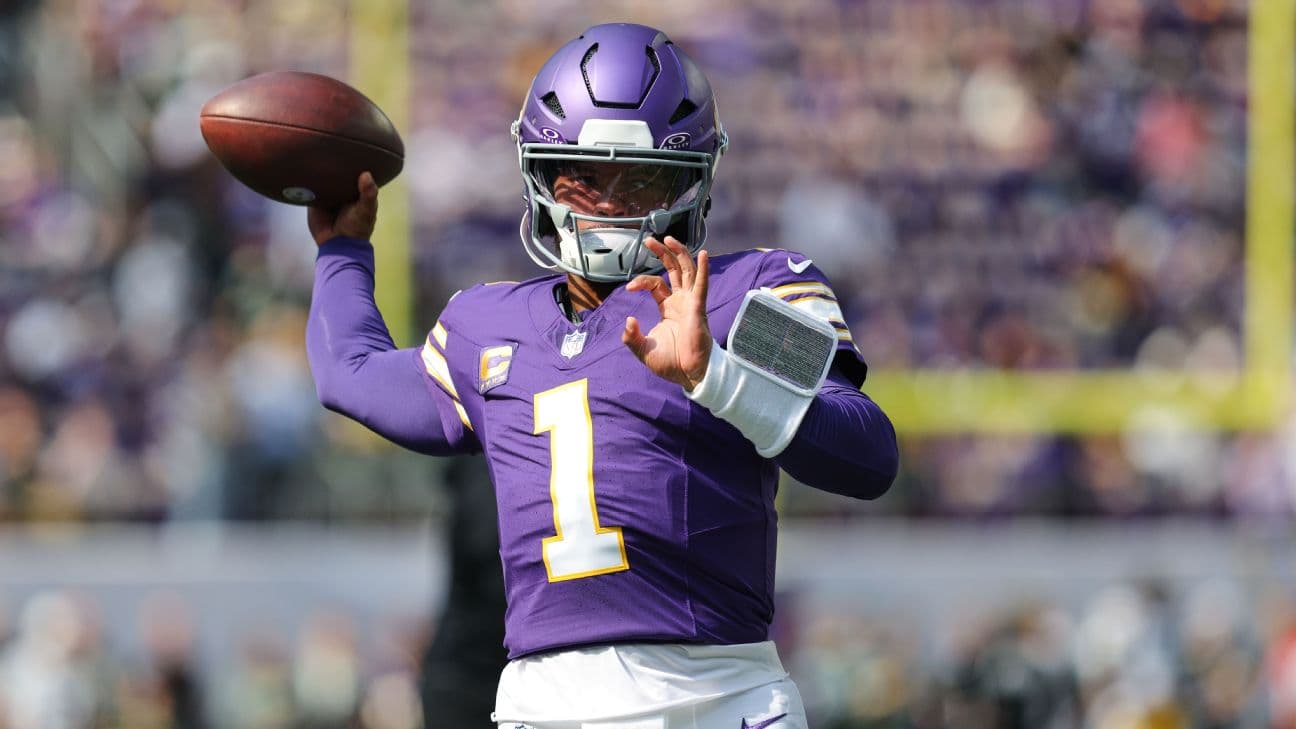
Kevin O'Connell named Kyler Murray the Minnesota Vikings' Week 1 starting quarterback on Tuesday, ending a training camp competition that had been split down the middle since the spring and installing a 29-year-old former No. 1 overall pick as the trigger man for one of the league's most quarterback-friendly play-callers. J.J. McCarthy, the 2024 first-round pick who was supposed to own this job by now, opens the season as the backup.
Murray signed with Minnesota in March on a one-year deal after Arizona released him, a landing spot that looked at the time like a veteran insurance policy rather than a takeover. It is a takeover. The Vikings open the regular season on September 13 against the Green Bay Packers, and the market has that game priced inside two points, which means Minnesota's offense is being treated as a legitimate NFC North threat rather than a team rebuilding around a young passer.
How the competition actually broke
The Vikings split first-team snaps between Murray and McCarthy at the start of camp, which is the classic sign of a coaching staff that genuinely had not decided. That is unusual. Most quarterback competitions are settled before the pads go on and the reps distribution tells you the answer three weeks early. This one did not.
Murray separated in the preseason. He showed command of the operation in his Vikings debut, and McCarthy did not do enough in his extended looks to close the gap. The health question matters here too: McCarthy has dealt with availability problems across his first two professional seasons, and a coaching staff on a competitive roster is not going to hand the keys to a player it cannot trust to take every snap in September.
O'Connell told reporters McCarthy will be the backup. That is a meaningful phrasing. It is not a redshirt, it is not an open-ended reevaluation, and it does not come with a promised checkpoint. Minnesota is playing to win now.
Fantasy fallout for the pass catchers
This is unambiguously good news for Justin Jefferson. Jefferson's fantasy ceiling has always been capped by quarterback volatility rather than by anything in his own game, and Murray's floor as a starter is meaningfully higher than what Minnesota got from the position last year. Jefferson should be drafted and started as a top-tier WR1 without any quarterback discount attached.
Jordan Addison is the more interesting price. Addison operates as the field-stretching complement in three-receiver sets alongside Jefferson and Jauan Jennings, and Murray's willingness to push the ball on scramble drills tends to reward the receiver who works back to the quarterback rather than the one running the designed route. Addison's boom weeks get boomier with a quarterback who extends plays. His floor stays choppy.
Jennings is the roster spot most fantasy managers are undervaluing. He is the third receiver on paper, but Minnesota's three-wide personnel is its base look, and a quarterback who leans on the middle of the field under pressure historically feeds the slot and the tight end. T.J. Hockenson is the direct beneficiary of that same tendency and remains a startable TE1 in a passing game that just got its most stable operator.
The Verdexed model take
Our model treats a named Week 1 starter as a variance reduction event, not a talent upgrade. The projection for Minnesota's passing offense does not move much in expectation. What moves is the width of the distribution: the 10th percentile outcome for Jefferson's target share, for Hockenson's routes run, and for the team's implied total all tighten considerably now that the offense gets an uninterrupted 11 days of first-team reps with one quarterback.
That matters for the opener. Vikings and Packers priced inside two points is a coin flip on the spread, and coin flips are where the market's edge is thinnest and the model's edge is widest. Our read leans toward the total rather than the side: Minnesota's offense with a settled quarterback and Green Bay's own passing game make the over the cleaner expression of what the depth chart just told us.
What McCarthy's status means going forward
Backup quarterbacks on competitive rosters are not fantasy assets, and McCarthy should be dropped in every redraft format. In dynasty he is a hold, not a buy. The value proposition on a former first-round pick who loses a camp battle in year three is entirely about what happens next offseason, and Murray's contract situation is the variable that decides it. Minnesota signed Murray for one year. That is a bridge deal by definition, and the Vikings did not spend a first-round pick on McCarthy to abandon the position after 17 games.
For now, though, the depth chart is the depth chart. If McCarthy is on your roster, the only reason to keep him is if you are in a superflex league deep enough that a mid-season injury changes the calculus.
What to do in your league
Move Jefferson up your board if he had drifted at all on quarterback concerns. Treat Hockenson as a stable TE1 rather than a name-value pick. Take the Addison and Jennings discount in best-ball formats where the spike weeks are worth more than the floor.
And in season-long leagues that draft this week, Murray belongs in the QB2 tier as a streaming option with rushing upside rather than as a set-and-forget starter. The rushing production is what makes him fantasy-relevant at all, and it is also the reason his weekly range of outcomes is wider than his passing profile suggests. The Vikings just told the league what they think of that trade-off. Fantasy managers should price it the same way.